

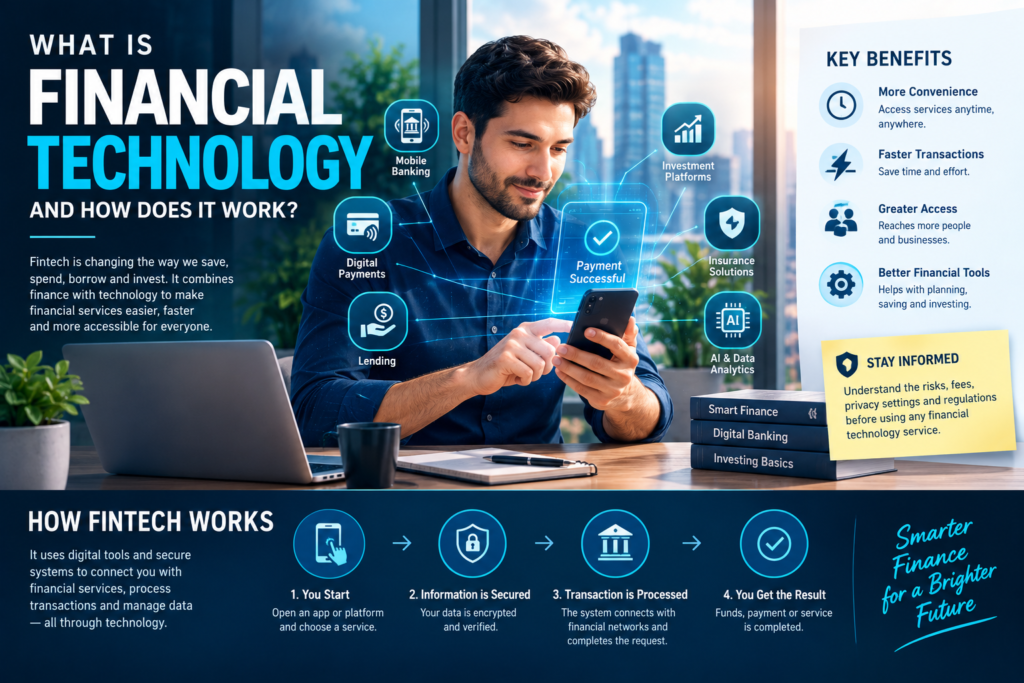
Financial technology, commonly known as fintech, has changed how people and businesses interact with financial services. From digital payments and mobile banking to automated financial tools and online investment platforms, technology is becoming an increasingly important part of the modern financial system.
But what exactly is financial technology, and how does it work?
In simple terms, fintech refers to the use of technology to provide, improve, or transform financial products and services. It can involve software, mobile applications, cloud computing, data analytics, artificial intelligence, digital payment systems, and other technologies that support financial activities.
For consumers, fintech can make certain financial services more convenient and accessible. For businesses, it can improve payment processing, financial management, customer experiences, and access to financial tools.
However, fintech is not automatically safer or better simply because it uses modern technology. Users still need to consider fees, privacy, cybersecurity, reliability, regulations, and the terms of any financial product or service they use.
1. What Is Financial Technology and What Does Fintech Include?
Financial technology is a broad term covering technology-enabled innovation in financial services. The Federal Reserve describes fintech as technology-enabled innovation that can create new business models, applications, processes, products, or services within financial markets and financial services.
Fintech can therefore include many different types of services rather than one specific product.
Digital Payments
Digital payments are one of the most familiar examples of fintech. People can use mobile applications, online banking platforms, digital wallets, cards, and other electronic systems to send or receive money and pay for goods and services.
These systems can make transactions faster and more convenient, although users should still protect their account credentials and review transactions carefully.
Online Banking and Financial Management
Traditional banking services have increasingly moved into digital environments. Customers may be able to check balances, transfer money, pay bills, review transactions, and manage accounts through websites or mobile applications.
Financial management applications can also help users organize spending, monitor budgets, and understand their financial activity.
For people trying to improve their overall finances, understanding Smart Money Management can provide a useful foundation before relying on digital financial tools.
Digital Lending
Some fintech companies use technology to provide or support lending services. Online applications may allow borrowers to submit information digitally and receive decisions through automated systems.
However, digital lending does not remove the financial responsibilities associated with borrowing. Consumers should understand interest rates, fees, repayment requirements, eligibility conditions, and the total cost of borrowing before accepting credit.
Investment Technology
Technology is also used in investment services. Online brokerage platforms, portfolio-management tools, financial research platforms, and automated investment services can give individuals more ways to access financial markets.
That does not mean investing becomes risk-free. Investments can lose value, and users should understand the risks and costs associated with any investment product.
You can also learn more about the basics in How to Start Investing for Beginners before making investment decisions.
Insurance Technology
Technology is also being used in insurance. Digital applications can help customers compare products, submit information, communicate with providers, and manage policies.
The specific services available vary by country and provider, and consumers should always review the terms and coverage of an insurance product rather than relying only on an application’s description.
Artificial Intelligence and Data Analytics
Artificial intelligence and data analytics can help financial companies process information, identify patterns, automate certain tasks, and improve customer experiences.
These technologies can be useful, but they also create important questions about data quality, privacy, transparency, security, and how automated systems are used.
Fintech is therefore much broader than simply mobile banking or payment applications. It represents a wider transformation in how financial services can be designed and delivered.
2. How Does Fintech Work and What Are Its Benefits?
Fintech generally works by combining financial services with digital technologies that allow information and transactions to be processed electronically.
A simple example is a digital payment. A customer initiates a transaction through an application or payment interface. The system securely sends the necessary transaction information through the relevant payment infrastructure, verifies the transaction according to the provider’s procedures, and processes the transfer.
Other fintech services can involve much more complicated systems.
For example, a financial application may combine user information, transaction data, software algorithms, cloud infrastructure, security controls, and connections to financial institutions or payment networks.
The exact process depends on the service and the companies involved.
One important advantage of fintech is convenience. Digital services can allow customers to access certain financial products without visiting a physical location.
Fintech can also improve the speed of some financial transactions. The World Bank notes that digital financial services powered by fintech can potentially improve the speed, security, transparency, and accessibility of financial transactions.
Another potential benefit is improved access.
Digital financial services can reach people and businesses that may have limited access to traditional financial infrastructure. The World Bank identifies digital financial services as an important part of efforts to expand financial inclusion.
For small businesses, fintech can also provide useful tools for receiving payments, managing transactions, monitoring cash flow, and accessing certain financial services.
Businesses should still evaluate these tools carefully. A convenient platform may have transaction fees, subscription costs, limits, or other conditions that affect its overall value.
Fintech can also support automation.
For example, software can automatically categorize transactions, generate financial reports, schedule payments, or provide notifications. Automation can reduce repetitive work, but users should still review important financial information rather than assuming automated systems are always correct.
Data is another major part of modern fintech.
Financial technology companies may use data to personalize services, identify patterns, assess applications, or detect potentially unusual transactions. This can improve efficiency, but it also makes data protection extremely important.
The way personal and financial information is collected, stored, shared, and processed should therefore be considered before using a financial technology service.
Fintech can offer meaningful benefits, but those benefits depend on how the technology is designed, regulated, secured, and used.
3. Fintech Risks, Security, and What Consumers Should Consider
While financial technology can make financial services more convenient, it also introduces risks that consumers and businesses should understand.
One major concern is cybersecurity.
Financial accounts and applications can contain sensitive information. Weak passwords, phishing attempts, malware, account takeovers, or other security problems can potentially expose users to financial loss or privacy problems.
Users should therefore use strong, unique passwords, enable available security features such as multi-factor authentication, keep devices updated, and avoid entering financial credentials into suspicious websites or applications.
Privacy is another important issue.
Before using a fintech application, review its privacy information and understand what data it collects and how that data may be used or shared. The availability of a convenient digital service does not mean users should ignore its data practices.
Consumers should also pay attention to fees and costs.
A financial technology service may advertise convenience or speed while charging transaction fees, subscription fees, withdrawal fees, exchange-rate markups, account fees, or other charges.
Always check the complete pricing information before using a service.
Regulation is another important consideration. Financial technology services can operate under different legal and regulatory frameworks depending on the country, product, and provider.
This means consumers should verify whether a financial service is properly authorized or regulated where required and understand which consumer protections may apply.
The World Bank also highlights risks associated with digital financial services, including data privacy concerns, cybersecurity and operational risks, and consumer-protection challenges.
Another important issue is automated decision-making.
Some fintech services may use algorithms or automated systems to evaluate information or provide recommendations. Users should understand that automated systems can have limitations and that technology does not guarantee that every decision will be accurate or suitable for an individual situation.
For borrowing decisions, it is particularly important to understand the complete repayment obligation. If debt is already affecting your finances, a structured Debt Repayment Strategy can help you evaluate your obligations and prioritize repayment.
Consumers should also be cautious of financial services promoted through social media or unsolicited messages. A professional-looking application or website does not automatically prove that a financial service is legitimate.
Avoid financial offers that rely on guaranteed profits, pressure you to act immediately, or ask you to send money without providing clear and verifiable information.
The best approach to fintech is therefore balanced. Technology can make financial services more accessible and efficient, but users should combine convenience with careful research, security awareness, and responsible financial decision-making.
Final Thoughts
Financial technology is changing how people and businesses access and use financial services. Digital payments, online banking, lending platforms, investment technology, insurance applications, financial management tools, artificial intelligence, and data analytics are all examples of how technology can interact with finance.
The benefits can include greater convenience, faster transactions, broader access, and improved digital financial management. At the same time, fintech users need to understand cybersecurity, privacy, fees, regulations, and the risks associated with financial products.
Fintech should be viewed as a tool rather than a guarantee of better financial outcomes. The technology can make certain processes easier, but responsible financial decisions still require research, planning, and an understanding of the risks involved.
As financial technology continues to develop, consumers and businesses can benefit most by learning how these systems work and using them carefully.