

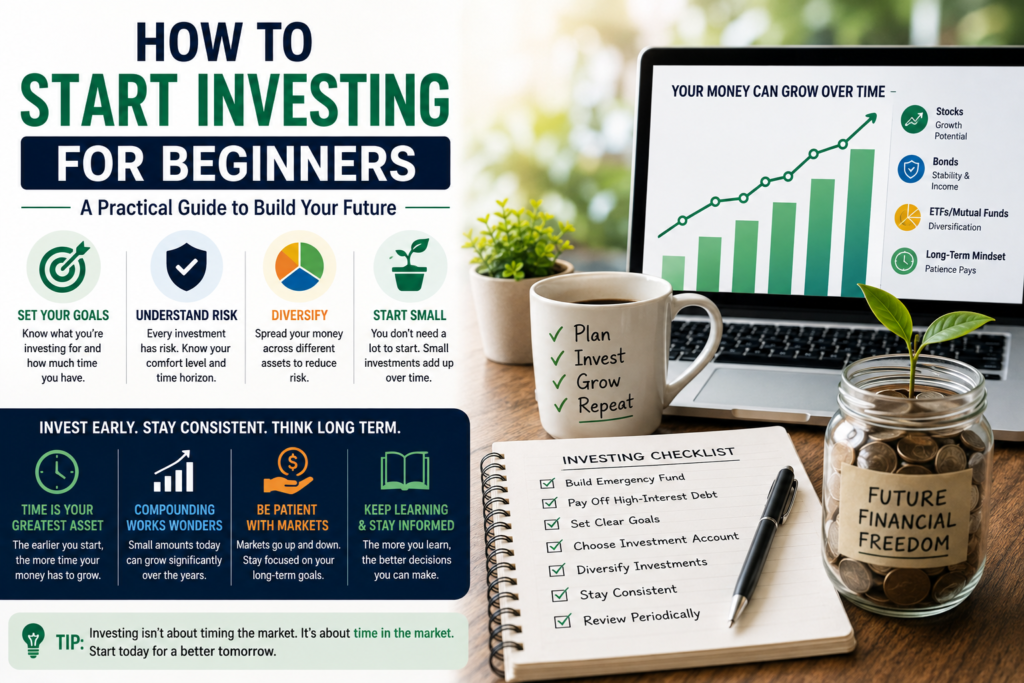
Investing can be an important part of long-term financial planning, but getting started can feel confusing. There are many types of investments, financial accounts, strategies, fees, and risks to understand before putting your money into the market.
For beginners, investing should not start with trying to find the “next big stock” or looking for a guaranteed return. A better starting point is understanding your financial goals, time horizon, risk tolerance, and the basic characteristics of different investment options.
Investing also carries risk. Unlike money held in certain insured deposit accounts, investments such as stocks, bonds, mutual funds, and exchange-traded funds can lose value. The amount and type of risk can vary significantly between investments.
A thoughtful approach can help you make decisions based on your own financial circumstances rather than short-term market excitement or promises of easy profits.
1. Understand Your Financial Situation Before You Start Investing
Before opening an investment account, take a step back and look at your overall finances.
Investing should generally be considered as part of a broader financial plan rather than as a replacement for managing everyday expenses, emergency savings, or expensive debt.
Start by reviewing your monthly income and expenses. Knowing how much money is available after essential costs can help you determine whether you have money that can be set aside for longer-term goals.
Our Smart Money Management guide can help you organize income, expenses, savings, and financial priorities before you begin investing.
Set a Clear Investment Goal
The reason you are investing matters.
Someone investing for a goal several decades away may have a different approach from someone saving for a major expense that is only a few years away.
Common investment goals can include:
- Retirement
- Long-term wealth building
- Education
- Buying a home
- Starting or expanding a business
- Other long-term financial goals
Your time horizon—the amount of time you expect to keep the money invested—is an important consideration when determining how much investment risk may be appropriate.
The U.S. Securities and Exchange Commission’s Investor.gov explains that asset allocation decisions depend partly on an investor’s time horizon and risk tolerance.
Build an Emergency Fund First
Investments are generally not a substitute for emergency savings.
If you need money unexpectedly, having accessible savings can reduce the need to sell investments at an inconvenient time.
An emergency fund is designed for unexpected expenses and financial disruptions, while investing is generally focused on longer-term goals.
If you are still building your emergency savings, see our guide on How to Build an Emergency Fund before deciding how much money you can reasonably commit to long-term investing.
Consider High-Interest Debt
Another important consideration is existing debt.
High-interest debt can make it harder to build financial stability because interest charges can continue increasing the amount you owe.
Before investing significant amounts of money, review your outstanding debts, interest rates, and repayment obligations.
Our guide on How to Create a Debt Repayment Strategy explains how to organize debts and develop a structured repayment approach.
This does not mean every person should completely eliminate every form of debt before investing. Different financial situations require different decisions. The important point is to understand the cost of your debt and how it fits into your overall financial plan.
2. Learn the Basics of Investment Options, Risk, and Diversification
Once your basic financial foundation is in place, the next step is learning what you are actually buying.
An investment is not simply a number that goes up over time. Different investments have different potential returns, risks, costs, liquidity, and characteristics.
Stocks
Stocks represent ownership in a company.
When you buy shares of a company, your investment can increase or decrease in value depending on many factors, including the company’s performance, economic conditions, investor expectations, and market sentiment.
Stocks can provide growth potential, but they can also experience significant price declines.
A single company’s stock can carry company-specific risk, which is one reason diversification is important.
Bonds
Bonds are generally debt securities. When an investor purchases a bond, the investor is effectively lending money to an issuer under specified terms.
Bonds can have different levels of credit risk, interest-rate risk, maturity periods, and other characteristics.
Although bonds are sometimes viewed as less volatile than stocks, they are not risk-free. Bond prices can change, and investors can face risks depending on the issuer and the type of bond.
Mutual Funds and ETFs
Mutual funds and exchange-traded funds, commonly called ETFs, pool money from investors and use it to purchase a collection of investments according to the fund’s strategy.
Some funds invest across many companies and sectors, which can make diversification easier for investors.
However, not every fund is broadly diversified. A narrowly focused fund may concentrate on a particular industry, country, asset class, or theme.
Therefore, investors should understand what a fund actually owns rather than assuming that every fund automatically provides broad diversification.
Diversification Can Reduce Concentration Risk
Diversification means spreading investments across different assets or holdings rather than relying heavily on one investment.
The purpose is to reduce concentration risk.
For example, putting all your investment money into one company means your results depend heavily on that company’s performance. If you hold a wider range of investments, poor performance from one holding may have a smaller effect on the overall portfolio.
However, diversification does not guarantee that you will avoid losses. A broad market decline can still affect many investments at the same time.
Investor.gov explains that diversification can help reduce overall portfolio risk, but it cannot guarantee protection from losses.
Understand Risk and Return
Every investment involves some level of risk.
Generally, investments with greater potential for return can also involve greater risk, although the relationship is not a promise that higher-risk investments will actually produce higher returns.
Before investing, consider:
- How much money you can afford to lose
- How long you plan to invest
- How comfortable you are with market fluctuations
- Whether you may need the money soon
- Whether you understand the investment
- What fees and expenses apply
Your risk tolerance is not simply about whether you like or dislike market volatility. It also relates to your financial ability to withstand losses.
Someone who needs money soon may have less ability to tolerate a significant decline than someone investing for a goal many years away.
Pay Attention to Fees
Investment fees may appear small, but they can affect long-term results.
Depending on the investment or service, costs can include:
- Account fees
- Fund expense ratios
- Trading costs
- Advisory fees
- Sales charges
- Other administrative expenses
Two investments with similar objectives can have different costs.
Before investing, read the available information about fees and expenses so you understand what you are paying.
The SEC warns that investment costs can have a meaningful impact on portfolio value over time.
3. Create a Simple Investing Process and Avoid Common Beginner Mistakes
After understanding your goals and the basics of investing, you can create a process that is easier to follow.
You do not need to understand every financial product before taking the first educational step. But you should understand the investment you are considering before committing money.
Start With a Long-Term Perspective
Markets can move up and down.
Short-term price movements can be influenced by economic news, company announcements, interest rates, geopolitical events, investor expectations, and many other factors.
Trying to predict every short-term movement is difficult.
For long-term goals, investors often focus on creating an appropriate asset allocation, diversifying their holdings, controlling costs, and maintaining a disciplined approach rather than constantly reacting to daily market movements.
This does not eliminate investment risk, but it can provide a more structured framework for decision-making.
Consider Regular Contributions
Some investors choose to contribute a fixed amount regularly rather than investing only when they believe the market is at the “perfect” time.
Regular contributions can make saving and investing a consistent habit.
The amount should be appropriate for your budget and financial goals.
It is important to remember that regular investing does not guarantee a profit or protect against losses. The investments purchased can still decline in value.
Avoid “Get Rich Quick” Promises
One of the most important lessons for beginner investors is to be skeptical of claims that promise unusually high returns with little or no risk.
Investment opportunities that guarantee large profits or claim that an investment “cannot lose” should receive careful scrutiny.
Fraudsters may use urgency, social media, testimonials, celebrity endorsements, or complicated financial language to create the impression that an opportunity is legitimate.
Do your own research and verify information through reliable sources before investing.
Do Not Invest Based Only on Someone’s Tip
Friends, influencers, online communities, and social media accounts can provide opinions, but an investment decision should not be based solely on someone else’s prediction.
Before buying an investment, research:
- What the investment actually owns
- How it generates potential returns
- What risks are involved
- What fees apply
- How liquid it is
- Who manages or issues it
- Whether the investment is appropriate for your goals
Investor.gov recommends researching investments carefully and warns investors not to rely solely on stock tips from others.
Review Your Portfolio Periodically
Your financial situation can change.
Income may increase or decrease. Your goals may change. Your investment timeframe may become shorter. Your risk tolerance may also change.
For these reasons, it can be useful to review your investments periodically and check whether your portfolio still matches your objectives.
That does not necessarily mean constantly buying and selling investments.
Frequent trading can create additional costs and may cause investors to react emotionally to short-term market movements.
Think About Taxes and Local Regulations
Investment taxation can vary significantly depending on where you live, the type of investment, the account used, and how long an investment is held.
For this reason, beginners should not assume that tax rules from another country automatically apply to them.
If your investment situation is complicated or involves significant amounts of money, consider consulting a qualified financial or tax professional familiar with the rules in your jurisdiction.
Final Thoughts
Learning how to start investing for beginners is less about finding a perfect investment and more about developing a sound financial process.
Start by understanding your income, expenses, emergency savings, debt, financial goals, and investment timeframe. Then learn the basics of stocks, bonds, funds, diversification, fees, and investment risk.
Remember that investing involves the possibility of losing money. No legitimate investment can guarantee a particular return simply because it performed well in the past.
A disciplined approach can include setting clear goals, investing according to your financial situation, diversifying appropriately, understanding costs, researching investments carefully, and avoiding unrealistic promises.
The goal should not be to become an expert overnight. The goal is to become a more informed investor who understands both the potential opportunities and the risks involved.