
Healthcare organizations manage much more than patient care. Behind every appointment, registration, claim, referral, and record are administrative processes that help hospitals, clinics, and other healthcare organizations operate smoothly.
When these processes depend heavily on manual work, employees may spend significant time entering information, organizing documents, communicating between systems, and following up on routine tasks.
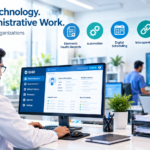
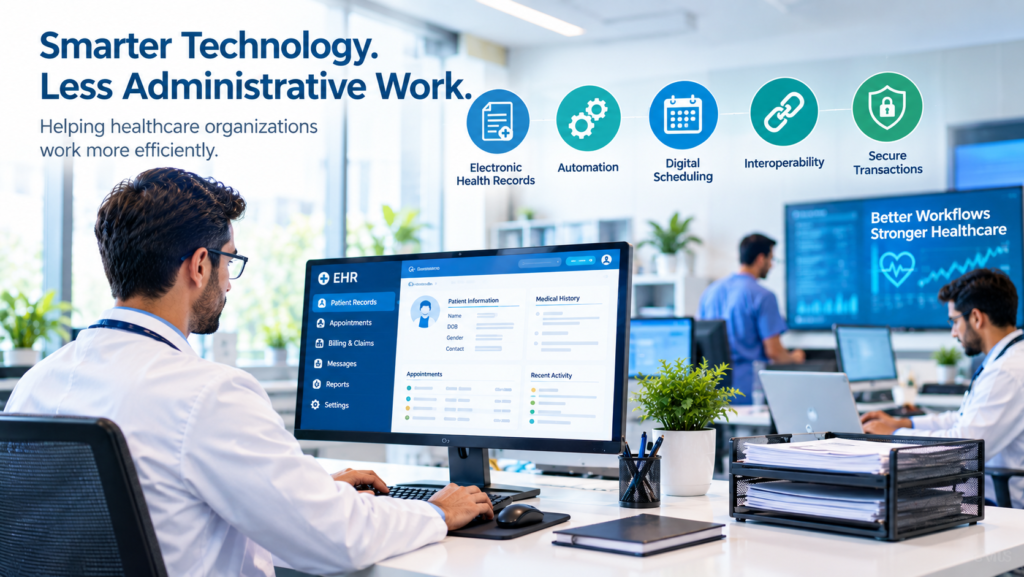
Healthcare technology is increasingly being used to make these processes more organized and efficient. Electronic health records, digital forms, automated workflows, patient portals, and electronic transactions can help reduce repetitive administrative activities while improving how information moves through an organization.
The goal is not to replace healthcare professionals. Instead, digital tools can handle appropriate routine processes while employees focus on responsibilities that require human judgment, communication, and oversight.
The Future of Healthcare: How Technology Is Improving Patient Care
Understanding Administrative Work in Healthcare
Administrative work covers many of the non-clinical activities required to operate a healthcare organization. These activities can include appointment scheduling, patient registration, insurance-related processes, billing, claims management, documentation, referrals, record handling, and communication.
Although these tasks are different from direct clinical care, they are an important part of the healthcare system. Delays or inefficiencies in administrative processes can affect how information is collected, transferred, and managed.
The Centers for Medicare & Medicaid Services (CMS) describes Administrative Simplification as an effort to streamline administrative healthcare transactions and establish standards for transmitting electronic health information.
Many administrative tasks are also repetitive. For example, employees may repeatedly enter similar information into different systems, send routine notifications, check documentation, or move information from one workflow to another.
This is where digital tools can potentially make a difference. Instead of performing every step manually, organizations can use software to organize information and automate selected parts of a process.
The Office of the National Coordinator for Health Information Technology (ONC) notes that electronic health records can help streamline provider workflows and reduce administrative burden.
How Healthcare Technology Can Streamline Work
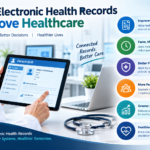
One of the most common examples is electronic health records, often called EHRs. These systems allow authorized healthcare staff to manage information digitally rather than relying primarily on paper records.
Digital records can make information easier to access and organize within connected workflows. EHRs can contain a range of information and can support information sharing between authorized providers and staff across healthcare organizations.
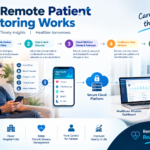
Another important area is automation. Software can be configured to handle certain predictable tasks, such as appointment reminders, routine notifications, document routing, task assignments, and workflow alerts.
For example, a scheduling system can automatically send a reminder instead of requiring a staff member to contact each patient manually. Similarly, digital systems can route documents or administrative requests to the appropriate department.
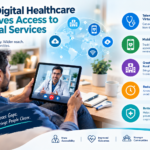
Patient portals can also reduce some routine administrative communication. Depending on the organization, they may allow patients to manage appointments, access selected information, submit forms, or communicate through a digital channel.
Interoperability is another important part of modern healthcare technology. When separate systems can exchange information appropriately, employees may have less need to manually re-enter or transfer the same data.
CMS identifies standardized electronic transactions as an important part of reducing administrative burden, while ONC highlights interoperability and electronic information exchange as important components of health IT.
CMS Administrative Simplification
Digital claims and other electronic transactions can also simplify administrative processes. CMS explains that Administrative Simplification requirements cover standardized electronic healthcare transactions such as claims and payments.
Artificial intelligence is another developing area. AI-based systems may assist with administrative activities such as organizing information, classifying documents, summarizing certain records, or routing requests. These applications are different from clinical AI systems and should be evaluated according to their specific purpose and risks.
For a broader look at AI and its growing role across industries, readers can explore:
Artificial Intelligence: How AI Is Transforming Businesses and Everyday Life
Challenges of Digital Administrative Workflows
Technology does not automatically make every healthcare process better. A poorly designed system can create additional steps instead of removing them.
One common challenge is system integration. A healthcare organization may use multiple software platforms for scheduling, records, billing, communication, and other operations. If these systems do not work together effectively, employees may still have to move information manually.
Training is another consideration. Staff need to understand new systems and workflows before an organization can expect technology to deliver operational benefits.
Data quality also matters. Digital systems can process information quickly, but incorrect or incomplete information can still create problems. Technology improves the speed of a process, but it does not automatically guarantee the quality of the information being processed.
Privacy and security are equally important. Healthcare organizations handle sensitive electronic information, so technology must be used with appropriate safeguards.
The U.S. Department of Health and Human Services explains that the HIPAA Security Rule requires regulated entities to use appropriate administrative, physical, and technical safeguards to protect electronic protected health information.
HHS Summary of the HIPAA Security Rule
Implementation costs can also be significant. Software, infrastructure, integration, maintenance, staff training, and technical support can all require investment.
For this reason, healthcare organizations should evaluate technology based on the complete workflow rather than simply purchasing new software. The most useful solutions are generally those that address a clearly identified administrative problem.
A practical approach is to identify repetitive activities, measure the existing process, find unnecessary manual steps, and then determine whether digital tools can simplify those steps.
Organizations can also monitor the results after implementation. The important question is not whether a new system has been installed, but whether the process has become more organized and manageable for the people using it.
The Future of Healthcare Administrative Technology
Healthcare administration is becoming increasingly digital. EHRs, patient portals, electronic transactions, interoperability tools, and automation are changing the way organizations manage information and routine processes.
CMS continues to work on administrative simplification and standardized electronic transactions, including initiatives focused on reducing manual handling of healthcare information.
ONC also continues to support health information technology and interoperability initiatives designed to improve electronic information exchange and healthcare workflows.
In the coming years, healthcare organizations may increasingly combine automation, data systems, interoperability, and AI-based tools to support administrative operations.
However, technology will remain only one part of the process. Successful digital transformation also depends on appropriate training, reliable information, secure systems, good workflow design, and human oversight.
Healthcare technology should therefore be viewed as a tool for improving administrative processes rather than a solution that automatically fixes every organizational problem.
For additional reading about technology and prevention in healthcare, you can connect this article with:
Preventive Healthcare: Benefits, Importance & Tips for a Healthier Life
Overall, healthcare technology can help organizations reduce repetitive administrative work by making information easier to manage and selected processes easier to coordinate. The most useful approach is to identify genuine workflow problems first and then use technology where it can provide a practical improvement.
Editorial Note: This article is intended for general informational and educational purposes only. It does not provide medical, legal, regulatory, or professional advice. Healthcare organizations should consult appropriate qualified professionals and applicable official requirements for decisions concerning their specific circumstances.