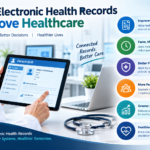

Healthcare increasingly depends on accurate information being available at the right time. As hospitals, clinics, laboratories, pharmacies, and other healthcare organizations become more digitally connected, electronic health records (EHRs) have become an important part of modern health information systems.
An electronic health record is a digital record that can contain information such as a patient’s medical history, medications, allergies, test results, diagnoses, treatment plans, and other clinical information. Unlike paper records that may be stored in different locations, an EHR can help authorized healthcare professionals access relevant information through a connected digital system.
The benefits of EHRs depend on how well systems are designed, implemented, secured, and used. They do not automatically guarantee better healthcare. Accurate documentation, appropriate privacy controls, staff training, interoperability, and reliable workflows are all important.
This article explains how electronic health records improve healthcare, focusing on information availability, coordination, patient safety, efficiency, interoperability, and the patient experience.
1. Better Access to Patient Information and More Coordinated Care
One of the most important advantages of electronic health records is improved access to patient information.
Healthcare professionals often need information from different parts of a patient’s healthcare history. This may include previous diagnoses, medications, allergies, laboratory results, imaging reports, and notes from other healthcare professionals.
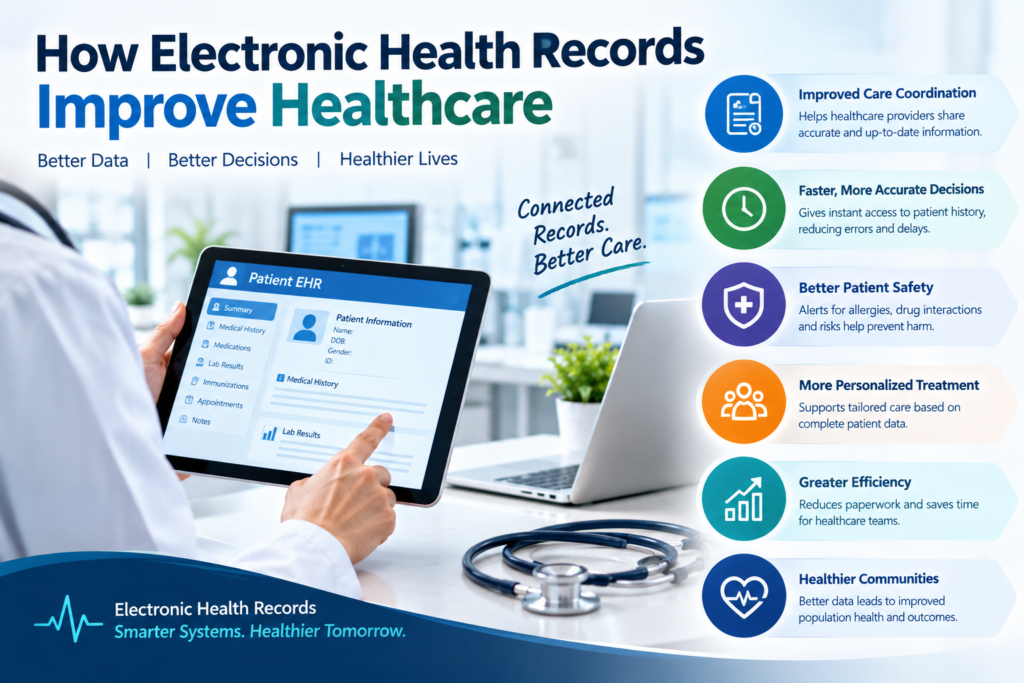
With a properly implemented EHR system, relevant information can be available electronically when an authorized healthcare professional needs it. The Office of the National Coordinator for Health Information Technology (ONC) explains that EHRs can provide better access to information, support more coordinated care, and help healthcare professionals make informed decisions.
This can be particularly useful when patients receive care from multiple healthcare professionals. A primary care provider, specialist, hospital team, laboratory, and pharmacy may each contribute information to a person’s overall care.
Without effective information exchange, healthcare information can become fragmented. A provider may not immediately know about a recent test, medication change, hospital visit, or relevant condition documented elsewhere.
EHRs can help address this problem by supporting care coordination. ONC notes that EHR systems can integrate and organize patient information and make it available to authorized providers involved in a patient’s care.
Better coordination does not mean that every EHR system automatically communicates with every other system. Different organizations may use different technologies and data formats. This is why interoperability remains an important part of digital healthcare.
WHO also emphasizes the importance of interoperability and standards for digital health systems. Interoperable systems can help information move between appropriate healthcare services while supporting consistent data practices.
EHRs can therefore support continuity of care by making relevant information easier to access and organize across different points of the healthcare system.
2. Improving Patient Safety, Documentation, and Healthcare Workflows
Accurate documentation is an important part of safe healthcare. An electronic record can organize clinical information in a structured format and make it easier for authorized professionals to review relevant details.
For example, an EHR may contain medication lists, allergy information, laboratory results, clinical notes, and previous diagnoses. Having these details available together can support safer decision-making.
ONC reports that EHRs can contribute to reduced medical errors, better coordination, improved documentation, and more efficient provider workflows.
However, it is important not to assume that technology itself eliminates medical errors. EHRs can also introduce challenges when information is entered incorrectly, systems are poorly designed, alerts are excessive, or workflows are not properly configured.
AHRQ highlights the importance of accurate and complete documentation. Its research on diagnostic documentation notes that better access to meaningful clinical information can support communication, coordination, and decision support, while documentation integrity remains essential.
Another area where EHRs can help is patient safety. Electronic access to medication histories and allergies can give healthcare professionals information that may be relevant when reviewing a patient’s care. Health information exchange can also help reduce duplicate tests when authorized providers can access information that already exists elsewhere.
EHRs can also support reminders, clinical alerts, electronic referrals, and other workflow functions. These features can help healthcare organizations organize tasks and make information available at different stages of care.
For patients, this may reduce the need to repeatedly provide the same basic information at every healthcare encounter. Patient portals can also allow patients to access certain health information, depending on the system and local rules.
The broader benefit is that healthcare organizations can organize information and routine processes more efficiently. This may help staff spend less time searching for records and more time handling appropriate clinical and administrative responsibilities.
Still, EHR implementation requires careful planning. Healthcare organizations need suitable workflows, staff training, technical support, data-quality processes, and security controls.
3. Supporting Interoperability, Patients, and Future Healthcare
The long-term value of EHRs increasingly depends on their ability to exchange useful information securely between different systems.
This concept is known as healthcare data interoperability. In practical terms, interoperability means that different healthcare systems can exchange and use information in a meaningful way rather than keeping data isolated in separate digital environments.
WHO identifies interoperability and data sharing as important elements of digital health development. Its digital health work also emphasizes standards that support the exchange and use of health information.
Interoperability can become especially important when patients move between healthcare settings. Someone may receive care from a primary care clinic, specialist, hospital, laboratory, pharmacy, or another provider. The ability to share appropriate information can help reduce fragmentation.
EHRs can also support patients by giving them greater access to their own health information through suitable patient portals and digital services. ONC notes that patient portals can provide access to health information and facilitate certain forms of communication between patients and healthcare providers.
Patient access does not mean that every person should interpret complex medical information without professional guidance. Health records can contain technical information that requires appropriate clinical context. Patients should discuss questions about their records with qualified healthcare professionals when clarification is needed.
Another important area is privacy and security. Healthcare information is highly sensitive, so digital systems need appropriate protections for access, storage, transmission, and use. WHO’s guidance on digital health data identifies privacy, security, interoperability, and data access and control as important considerations for digital health systems.
EHRs are also becoming part of a broader digital healthcare environment. They may interact with patient portals, laboratory systems, health information exchanges, remote monitoring technologies, clinical decision-support tools, and other digital services.
This creates opportunities for more connected healthcare, but it also creates responsibilities. Healthcare organizations must consider data quality, cybersecurity, privacy, interoperability, usability, governance, and staff training when adopting or upgrading digital systems.
Conclusion
Electronic health records have become an important foundation of modern healthcare information systems. They can make relevant information easier to access, support coordination between healthcare professionals, improve documentation, strengthen certain patient-safety processes, and make healthcare workflows more organized.
However, EHRs are not a substitute for qualified healthcare professionals. Their effectiveness depends on accurate information, appropriate implementation, secure systems, interoperability, and responsible use.
As healthcare becomes increasingly digital, the future of EHRs will likely focus on making information more connected, secure, accessible, and useful while keeping patient privacy and safety at the center of system design.