
Healthcare is increasingly using digital technology to collect and share health information outside traditional hospitals and clinics. One important example is remote patient monitoring, which allows certain health information to be collected while a patient is at home and transmitted to a healthcare provider for review.
Remote patient monitoring can involve connected devices that collect information such as blood pressure, weight, blood glucose, oxygen saturation, or heart-related measurements. Depending on the system, information may be transmitted automatically or entered and shared by the patient.
The purpose is not to replace healthcare professionals. Instead, remote monitoring can give providers additional information between appointments and help support ongoing care when the technology is appropriate for the patient and condition.
1. What Is Remote Patient Monitoring and How Does It Work?
Remote patient monitoring (RPM) is a form of digital healthcare in which health information is collected outside a traditional clinical setting and made available to healthcare professionals. HHS describes RPM as a type of telehealth that uses devices to track health information at home and share it with a healthcare provider.
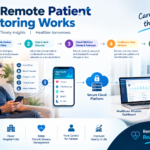
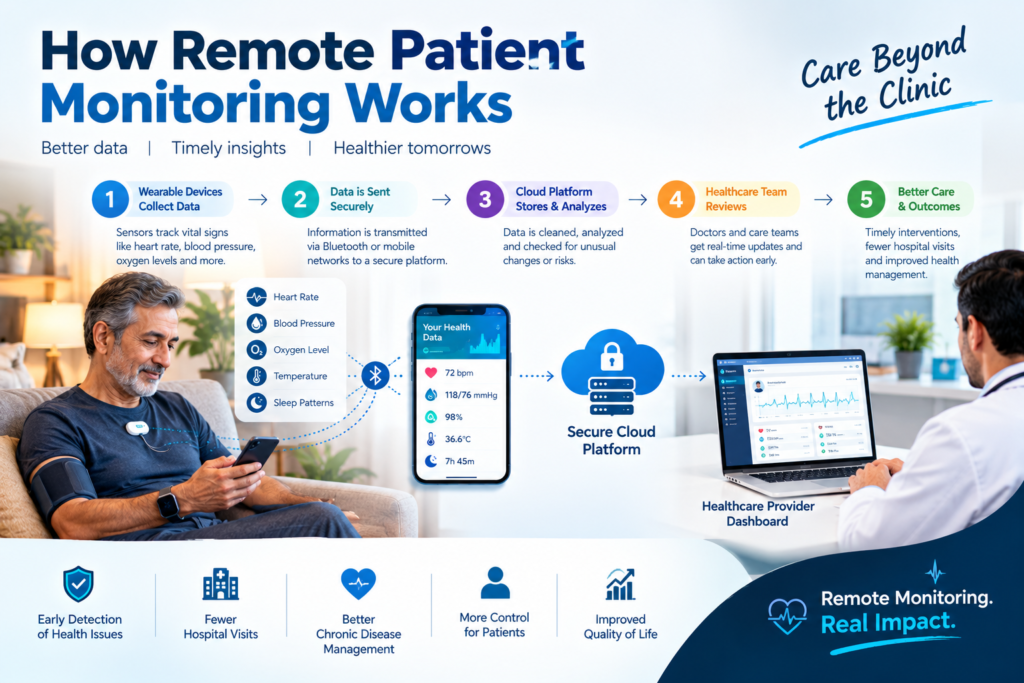
A typical RPM process involves several basic steps.
First, a healthcare professional determines whether remote monitoring is appropriate for a particular patient and situation. The patient may then receive or use a suitable connected device.
The second step involves collecting information. Depending on the monitoring program, this may include measurements such as blood pressure, weight, blood glucose, heart rate, or oxygen saturation. CMS lists connected blood pressure cuffs, scales, pulse oximeters, and glucose-related devices among examples used for remote monitoring.
The third step is data transmission. Many connected medical devices can send information electronically to a healthcare platform. The information can then become available to authorized healthcare professionals for review.
The fourth step is professional review. Remote monitoring is not simply about collecting large amounts of information. The data needs to be reviewed and interpreted within the appropriate clinical context. Providers can use the information as part of ongoing patient management when remote monitoring is medically appropriate.
This makes RPM different from simply checking a health measurement on a personal device. A structured remote monitoring program connects data collection with a healthcare workflow.
For patients, this approach may reduce the need to travel for every monitoring activity. For providers, it can provide additional information between appointments. However, RPM does not mean that every patient needs continuous monitoring or that a connected device can replace an in-person medical assessment.
2. Devices, Data and the Role of Healthcare Professionals
The technology behind RPM can range from relatively simple connected devices to more advanced monitoring systems.
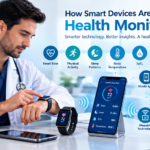
Common examples include connected blood pressure monitors, digital weight scales, pulse oximeters, glucose-monitoring technologies, and other devices capable of collecting relevant health information. HHS identifies several of these device categories as common examples of RPM technology.
connected medical devices are important because they can make the transfer of information more efficient. FDA explains that wireless medical devices can use technologies such as Wi-Fi, Bluetooth, and cellular communication to support functions including remote patient monitoring and the transfer of medical data.
However, technology alone does not create a complete monitoring service. CMS identifies three important components of RPM: education and setup, device supply, and treatment or management based on the collected information.
Education is particularly important. Patients need to understand how to use the equipment correctly and how information is transmitted. Incorrect use of a device can affect the quality of the information being collected.
The quality of health data is another important consideration. Healthcare professionals need information that is relevant, sufficiently reliable, and collected in a way that supports the purpose of the monitoring program. More data is not automatically better data.
Healthcare professionals also remain central to the process. RPM systems may organize readings, display trends, or generate notifications, but clinical interpretation requires appropriate professional judgment.
This is why remote monitoring should be viewed as a healthcare service supported by technology rather than simply a collection of consumer gadgets.
Patient participation also matters. A monitoring program can depend on patients using devices correctly and consistently. Clear instructions, accessible technology, technical support, and communication can therefore influence how useful a monitoring system becomes.
patient engagement is especially relevant because RPM moves part of the monitoring process into the patient’s everyday environment. Patients may become more involved in recording and sharing information, while healthcare professionals can use that information as part of ongoing care.
Remote monitoring can also be combined with other digital healthcare services. For example, information collected through a monitoring device may be reviewed alongside a telehealth appointment or other health records when the healthcare system supports those connections.
3. Benefits, Limitations and Privacy Considerations
Remote patient monitoring can offer several potential advantages when implemented appropriately.
One potential benefit is greater visibility between routine appointments. Instead of relying only on information collected during occasional visits, healthcare professionals may have access to additional measurements collected at home.
RPM can also support care for people who face geographic or transportation barriers. WHO describes remote monitoring as one component of digital health and notes that digital solutions can help address barriers related to distance and access to healthcare.
Another potential advantage is continuity. Regularly collected information can help healthcare teams observe changes over time rather than relying only on a single measurement.
At the same time, RPM has limitations. Technology may not be suitable for every patient, every condition, or every healthcare situation. Internet connectivity, device availability, technical skills, cost, accessibility, and patient willingness can all affect implementation.
There is also a risk of misunderstanding personal health information. A reading from a device should not automatically be interpreted as a diagnosis. Patients should follow the instructions provided by their healthcare professionals and use appropriate medical services when they have health concerns.
Privacy and security are equally important. Remote monitoring involves the collection, transmission, storage, and potentially sharing of sensitive health information. Healthcare organizations therefore need appropriate safeguards and privacy practices.
data privacy becomes particularly important when connected devices communicate with healthcare platforms or other digital systems. HHS explains that the HIPAA Privacy Rule establishes national standards for protecting certain individually identifiable health information handled by covered entities and gives individuals rights regarding their protected health information.
Healthcare organizations also need to consider cybersecurity, authentication, access controls, secure data transmission, device management, and appropriate handling of information throughout its lifecycle.
The future development of RPM will likely depend not only on better devices but also on better integration, usability, privacy protection, interoperability, and evidence about how different technologies perform in real healthcare settings.
Conclusion
Remote patient monitoring is an important part of the growing digital healthcare ecosystem. It connects patients, healthcare professionals, medical devices, and health information through technology.
The basic process involves collecting relevant information, securely transmitting it, making it available to authorized healthcare professionals, and using appropriate clinical judgment to support patient management.
The technology can improve access to information and support care outside traditional clinical settings, but it is not a replacement for professional medical care. Successful RPM depends on appropriate device selection, patient education, reliable data, healthcare workflows, privacy protections, and responsible implementation.
As digital healthcare continues to develop, remote monitoring is likely to remain an important area of innovation. Its long-term value will depend on how effectively technology is combined with patient needs, professional oversight, security, accessibility, and evidence-based healthcare practices.