

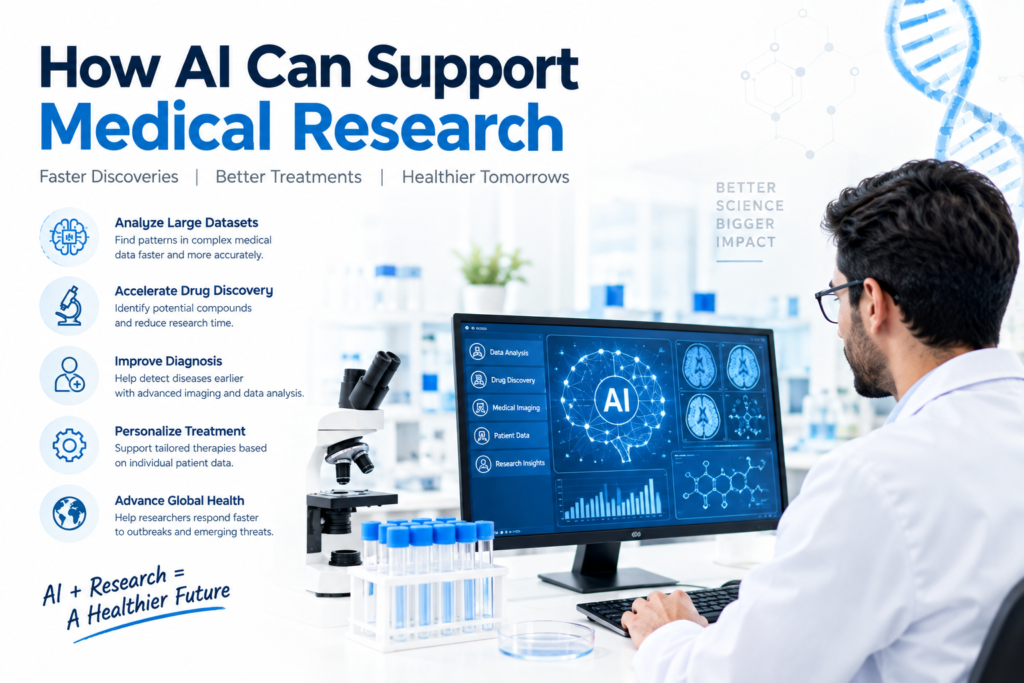
Artificial intelligence (AI) is becoming an increasingly important tool in medical and biomedical research. Researchers can use AI to analyze large datasets, identify patterns, process medical images, support scientific literature review, and assist with the development and evaluation of new research methods.
AI does not replace researchers, clinicians, ethics committees, or established scientific processes. Instead, it can support researchers by helping them work with complex information more efficiently. The National Institutes of Health (NIH) describes AI as an area with applications across medical research, including analysis of test results, medical images, wearable-sensor data, and other research problems.
Because medical research involves sensitive health information and, in many cases, human participants, responsible use is especially important. The World Health Organization’s July 2026 guidance highlights the need for appropriate ethical review and oversight when AI is used in health-related research.
1. How AI Can Help Researchers Work With Complex Medical Data
Medical research can involve large and complicated datasets. Depending on the research area, these may include medical images, laboratory information, electronic records, genomic information, survey responses, or data collected through research devices.
AI can help researchers organize and analyze this information. Machine-learning systems can identify patterns across large datasets that may be difficult to examine manually. This can support researchers when they are exploring relationships between different variables or looking for areas that require further investigation.
One important area is medical data analysis. AI-based methods can process large quantities of structured and unstructured information and help researchers identify patterns for further scientific investigation. However, an AI-generated pattern is not automatically a scientific discovery. Researchers still need to evaluate the quality of the data, methodology, statistical evidence, and reproducibility of the findings.
AI can also support medical imaging research. Researchers may use computational methods to analyze images such as scans or other forms of medical imaging. These systems can assist with tasks such as identifying image features or organizing large collections of images for research purposes.
The NIH has highlighted research using AI to work with test results and image data, demonstrating how these technologies can contribute to research workflows.
Another potential application is research data processing. Instead of manually handling every stage of a large dataset, researchers can use software tools to help clean, categorize, summarize, or prepare information for further analysis.
The quality of the output, however, depends heavily on the quality and suitability of the underlying data. Poorly collected, incomplete, or biased datasets can produce misleading results even when sophisticated AI systems are used.
2. AI Can Support Drug Discovery, Literature Review and Research Workflows
Medical research often requires researchers to examine large amounts of scientific information before developing or testing a research hypothesis. AI can assist with parts of this process by helping researchers organize information, identify relevant patterns, and explore relationships within large bodies of scientific data.
One area receiving attention is AI-assisted drug discovery. AI methods can be used to support parts of the drug-development research process, such as analyzing biological information, examining potential molecular relationships, or helping researchers prioritize areas for further investigation.
This does not mean that AI independently creates safe or effective medicines. Drug development remains a complex scientific process involving laboratory research, preclinical studies, clinical research, regulatory review, and other forms of evaluation.
AI can also support scientific literature workflows. Researchers may use AI-based tools to help organize large collections of publications, identify relevant documents, summarize information for preliminary review, or find connections between research topics.
However, researchers need to verify AI-generated summaries against original scientific publications. AI systems can make errors, omit important context, or produce incorrect information. For this reason, human review remains essential when AI is used in scientific research.
Large language models and other generative AI systems may also assist researchers with certain administrative and analytical tasks. The WHO’s guidance on large multimodal models notes that these systems may have applications in scientific research and drug development, while also emphasizing the need to address ethical and governance concerns.
Another useful area is scientific research automation. AI can help researchers automate repetitive information-handling tasks, allowing more time for study design, interpretation, collaboration, and critical evaluation.
Automation should not remove important review stages. In medical research, researchers must understand how an AI system produced an output and determine whether that output is appropriate for the specific research question.
3. Why Human Oversight, Privacy and Research Ethics Still Matter
The growing use of AI in medical research creates opportunities, but it also introduces important responsibilities.
Medical research may involve highly sensitive personal information. Researchers therefore need appropriate safeguards for patient data privacy, including suitable data governance, access controls, security measures, and compliance with applicable research and privacy requirements.
Bias is another important issue. If an AI system is trained or evaluated using data that does not adequately represent the population being studied, its results may not work equally well across different groups.
Researchers should therefore examine the origin, quality, completeness, and representativeness of datasets before relying on AI-generated findings.
Reproducibility is also important. Scientific conclusions should not depend solely on an AI system producing an apparently convincing result. Researchers need appropriate documentation of methods, datasets, model characteristics, validation procedures, and analytical decisions so that findings can be properly evaluated.
The WHO’s 2026 guidance specifically addresses ethical review and oversight for AI-related health research and identifies concerns including fairness, privacy, inequity, benefit sharing, and responsible research conduct.
human oversight is therefore a central part of responsible AI use in medical research. Researchers should remain responsible for research decisions, interpretation, validation, and communication of findings.
AI should be treated as a research-support technology rather than an independent scientific authority. Its outputs need to be checked against appropriate evidence and reviewed by qualified professionals.
Conclusion
AI can support medical research by helping researchers analyze complex datasets, process medical images, organize scientific information, explore drug-development research, and automate selected repetitive tasks.
Its value depends on responsible implementation. High-quality data, transparent methods, appropriate validation, privacy protection, ethical review, and human oversight remain essential.
As AI becomes more integrated into biomedical research, the goal should not simply be to use more AI. The more important objective is to use AI in ways that strengthen scientific research while protecting research participants, maintaining scientific standards, and supporting trustworthy evidence.