

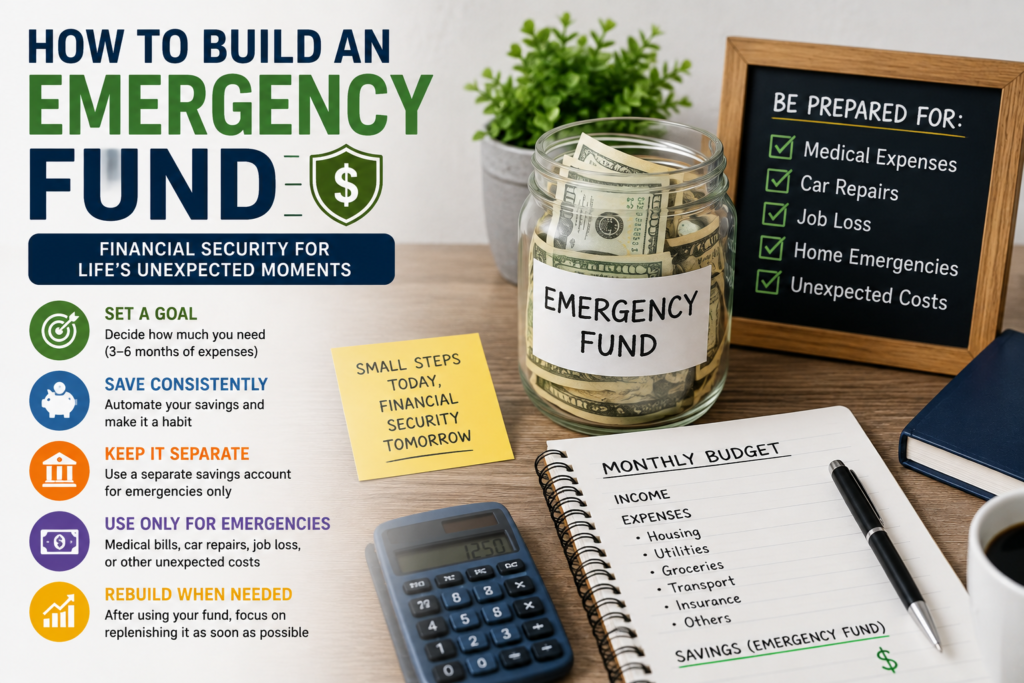
An emergency fund is money set aside specifically for unexpected expenses such as medical bills, urgent home or car repairs, sudden travel, or a temporary loss of income. Having a dedicated emergency fund can make financial problems easier to manage because you do not have to immediately rely on credit cards, loans, or money meant for other financial goals.
Building an emergency fund does not require a large income or a huge starting balance. The most important step is to begin with an amount you can realistically save and then build it consistently over time.
Why an Emergency Fund Matters and How Much You Need
Unexpected expenses are a normal part of life. A vehicle may need an urgent repair, a household appliance may stop working, or an unexpected medical expense may appear. Without savings, even a relatively small financial shock can disrupt your monthly budget.
An emergency fund provides a financial buffer between an unexpected expense and your regular income. Instead of changing your entire budget or borrowing money, you can use money that was already reserved for emergencies.
The right emergency fund size depends on your personal circumstances. There is no single amount that works for everyone. Someone with stable employment and low fixed expenses may need a different reserve from someone with variable income, dependents, high monthly expenses, or a less predictable job.
A practical approach is to start with a small initial target. For example, you might first aim to save $500 or $1,000, depending on your income and expenses. Once you reach that amount, you can gradually increase your target.
You can also calculate your emergency fund based on essential monthly expenses. Add costs such as:
- Housing
- Utilities
- Groceries
- Transportation
- Insurance
- Minimum debt payments
- Essential healthcare
- Other necessary household expenses
Once you know your essential monthly costs, decide how many months of those expenses you would like your emergency savings to cover. A commonly used guideline is several months of essential expenses, but your personal target should reflect your income stability, responsibilities, debt, and access to other resources.
The important thing is not to delay saving simply because your final target seems large. The Consumer Financial Protection Bureau notes that even small amounts can provide some financial security, particularly when savings are built consistently.
Your emergency fund should also be separate from money intended for holidays, entertainment, investments, or everyday spending. Keeping the money separate makes it easier to understand what is actually available for emergencies.
For a broader approach to managing your finances, see our guide to Smart Money Management and our practical guide to Smart Financial Planning.
How to Build an Emergency Fund Step by Step
The easiest way to build an emergency fund is to turn saving into a regular financial habit.
Start by reviewing your current monthly budget. Look at your income and essential expenses and determine how much you can realistically save without creating another financial problem.
Even a small contribution can be useful. If you can save $25 each week, that would give you about $100 per month. If you can save $50 per week, you could put aside roughly $200 per month. The exact amount is less important than choosing an amount you can maintain.
One useful strategy is to treat emergency savings as a regular expense in your monthly budget. Instead of waiting to see whether money is left over at the end of the month, include savings in your plan from the beginning.
Automatic transfers can make this easier. You can arrange for a specific amount to move from your everyday account into your emergency savings account after receiving income. Automation reduces the need to make the decision manually every time you get paid.
You can also increase your savings when you receive extra income. Bonuses, freelance payments, tax refunds, gifts, or other unexpected income can provide opportunities to increase your emergency fund without changing your normal monthly spending.
Another strategy is to look for temporary ways to reduce expenses. Review subscriptions, unnecessary fees, frequent takeout, impulse purchases, and other discretionary spending. You do not necessarily need to eliminate everything. Redirecting a portion of these expenses toward savings can gradually strengthen your financial cushion.
If your income changes from month to month, consider using a percentage-based approach instead of a fixed amount. For example, you might decide to save a certain percentage whenever you receive income.
Your savings plan should also be flexible. If you have an unusually expensive month, reducing your contribution temporarily does not mean your plan has failed. Resume your normal contribution when your cash flow improves.
Keep track of your progress. A simple spreadsheet, banking app, or savings tracker can show how much you have saved and how far you are from your target.
Most importantly, avoid comparing your emergency fund with someone else’s. Your financial situation is different, so your savings target and monthly contribution should be based on your own needs.
Where to Keep Your Emergency Fund and When to Use It
An emergency fund should be accessible enough to handle genuine unexpected expenses while being separate from your everyday spending money.
For many people, a dedicated savings account at a bank or credit union can be a practical option. The goal is to keep the money in a place where it is reasonably accessible when needed but not so convenient that you regularly spend it on non-essential purchases.
Before choosing an account, check the account’s fees, withdrawal rules, accessibility, and other terms. Your emergency fund is primarily designed for financial stability, so the ability to access the money when necessary is important.
You should also establish clear rules for what qualifies as an emergency.
Examples may include:
- Unexpected medical expenses
- Urgent vehicle repairs
- Necessary home repairs
- Emergency travel
- Temporary loss or reduction of income
- Essential replacement of a broken appliance
On the other hand, planned expenses such as vacations, new electronics, entertainment, or routine shopping generally belong in separate savings categories.
Having clear rules can reduce the temptation to spend emergency savings on ordinary purchases.
At the same time, do not be afraid to use the fund when a genuine emergency occurs. The purpose of an emergency fund is to provide financial protection when unexpected costs arise.
After using your emergency savings, make rebuilding the fund part of your next financial priorities. For example, if you saved $2,000 and used $700 for an unexpected repair, your new target would be to restore that $700 over time.
It is also useful to review your emergency fund periodically. Your income, housing costs, family responsibilities, debt, and other expenses can change. If your essential monthly expenses increase, your emergency savings target may need to increase as well.
Building an emergency fund is not about becoming financially perfect overnight. It is about creating a financial safety net step by step. Start with an achievable amount, automate your contributions where possible, keep the money separate, and increase your target as your financial situation improves.
A strong emergency fund can become an important part of a broader personal finance strategy because it helps protect your monthly budget while allowing you to continue working toward longer-term financial goals.