

A business can generate sales and still struggle to grow efficiently. As customer demand increases, costs can rise, employees can become overloaded, and manual processes can create bottlenecks. This is why building a scalable business model is important for entrepreneurs who want sustainable long-term growth.
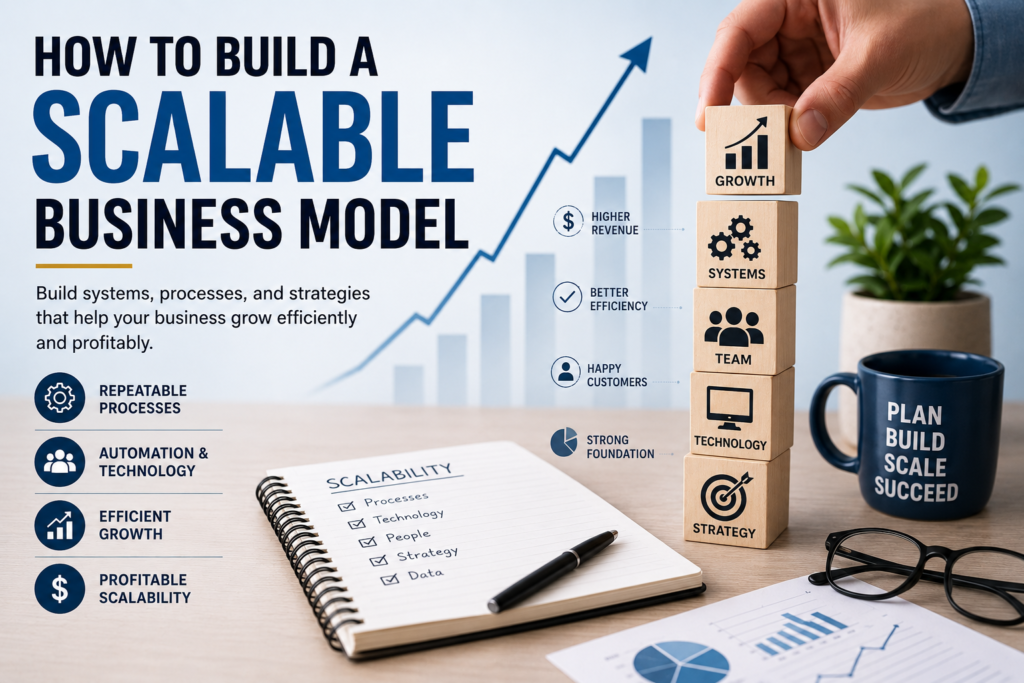
A scalable business model allows a company to serve more customers, generate more revenue, and expand its operations without increasing costs and complexity at the same rate. Scalability does not mean growing as quickly as possible. Instead, it means creating systems, processes, technology, and financial structures that allow growth to happen efficiently.
For small businesses, scalability should be considered from the beginning. A company does not need to be large before it starts building scalable systems. By understanding customer demand, standardizing operations, using technology, managing finances carefully, and creating repeatable processes, a small business can create a stronger foundation for future expansion.
1. Build a Business Model That Can Grow Efficiently
The first step toward scalability is understanding how the business creates value and generates revenue. A business model should clearly explain what the company sells, who its customers are, how it reaches them, and how it makes money.
Before investing heavily in growth, entrepreneurs should understand their target customers and the problem their business is solving. A clear customer profile can make it easier to create products, pricing, marketing campaigns, and services that meet genuine demand. Businesses can also review How to Identify Your Target Market to better understand how customer research can support business decisions.
A scalable business model should ideally have a repeatable way of acquiring and serving customers. If every new customer requires completely different processes, extensive manual work, or significant additional resources, scaling can become difficult.
For example, a consulting company that requires a senior consultant to personally handle every customer may face limitations as demand grows. The company could improve scalability by developing standardized service packages, documented processes, templates, training materials, and technology that allow more customers to be served without relying entirely on one person.
Technology can also play an important role. Cloud-based software, customer relationship management systems, accounting platforms, communication tools, analytics, and automation can reduce repetitive work and improve efficiency.
According to Shopify, scalable businesses are designed to handle increased demand without sacrificing performance or efficiency. Technology, standardized processes, strategic hiring, and effective use of external resources can all contribute to scalability. Scalable Business Model guidance can provide additional context on these principles.
Another important consideration is pricing. A business should understand how much it costs to deliver a product or service and how much profit remains after those costs. If revenue increases while the cost of serving every additional customer increases at nearly the same rate, rapid growth may not produce meaningful improvements in profitability.
Entrepreneurs should therefore monitor unit economics, customer acquisition costs, margins, customer lifetime value, and other financial indicators. The U.S. Small Business Administration also highlights the importance of analyzing unit economics and scalability when evaluating a business model.
A company should also avoid building a business that depends entirely on one customer, one supplier, one employee, or one marketing channel. Diversifying important parts of the operation can make the business more resilient as it grows.
Starting with limited resources can actually encourage better decisions. Entrepreneurs can review How to Start a Small Business With Limited Money to understand how controlling expenses and testing demand can help create a stronger foundation before expanding.
2. Create Repeatable Systems, Processes, and Technology
Once the business model is clear, the next step is creating systems that can support higher demand. A business that depends on informal processes and individual employees remembering how everything works can become difficult to manage as it grows.
Documenting important processes is one of the simplest ways to improve scalability. Businesses should identify repetitive activities and create clear procedures for completing them.
These may include:
- Customer onboarding
- Sales follow-ups
- Order processing
- Invoicing
- Customer support
- Marketing campaigns
- Content publishing
- Inventory management
- Employee training
- Reporting
A documented process makes it easier to train new employees and maintain consistency. It also reduces the risk of the business becoming dependent on one person who knows how everything works.
Automation can make these systems even more efficient. Businesses can automate repetitive tasks such as appointment reminders, email follow-ups, invoice notifications, customer communications, data entry, and reporting.
However, automation should solve genuine problems rather than being introduced simply because a technology is available. Businesses should first identify bottlenecks and determine which tasks consume significant amounts of time.
Stripe’s scalability guidance recommends mapping business processes, identifying bottlenecks, automating repetitive work where appropriate, and standardizing core processes so that companies can handle increased demand more effectively. Scalability Solutions for Businesses provides additional guidance on developing scalable processes.
Hiring is another important consideration. A business should avoid adding employees simply because sales are increasing if technology, outsourcing, or process improvements could handle some of the additional workload.
At the same time, trying to operate without enough employees can create poor customer service and quality problems. The objective is to build a flexible team structure that can expand when demand increases.
Businesses can also use external resources when appropriate. Freelancers, specialized agencies, logistics providers, software platforms, and other partners can provide expertise without requiring every capability to be built internally.
Scalability also depends on customer experience. A business should be able to increase its customer base without allowing service quality to decline. Clear onboarding, support procedures, service standards, and communication systems can help maintain consistency.
Small businesses can also strengthen their competitive position by focusing on areas where they can deliver better value. How Small Businesses Can Compete With Larger Companies explains how specialization, customer experience, technology, and focused marketing can help smaller companies compete more effectively.
The goal is to create a business where growth does not automatically create chaos. When systems are documented and processes are repeatable, adding customers becomes more manageable.
3. Manage Growth, Cash Flow, and Performance Carefully
A scalable business model requires more than efficient operations. Financial planning is equally important because rapid growth can sometimes create cash flow problems.
For example, a company may receive a large number of orders but need to purchase inventory, hire employees, increase advertising, or pay suppliers before receiving payment from customers. Revenue may be increasing while available cash remains limited.
Businesses should therefore monitor cash flow carefully and understand how much working capital is required to support expansion.
Growth should also be based on evidence. Before investing heavily in a new product, market, employee, or marketing channel, businesses should evaluate whether the opportunity has demonstrated customer demand.
Testing on a smaller scale can reduce unnecessary risk. A company could launch a new service to a limited group of customers, test a marketing campaign with a controlled budget, or introduce a product in one market before expanding more broadly.
Performance measurement is another key part of scalability. Businesses should track metrics that show whether growth is actually improving the company.
Useful metrics may include:
- Revenue growth
- Gross margin
- Customer acquisition cost
- Customer lifetime value
- Conversion rate
- Customer retention
- Repeat purchase rate
- Operating costs
- Cash flow
- Revenue per employee
These numbers can reveal whether the business is becoming more efficient or simply becoming larger.
A scalable business should also have a clear growth strategy. Digital transformation, customer relationships, content marketing, SEO, technology, and innovation can all support expansion when they are connected to measurable business objectives. For broader planning, businesses can review Business Growth Strategies in 2026 for additional ideas.
Another important factor is adaptability. Markets change, customer preferences evolve, and new competitors enter industries. A business model that works today may need adjustments in the future.
Companies should regularly review their products, pricing, customer segments, marketing channels, technology, and operating costs. If a process becomes inefficient as the business grows, it should be redesigned rather than simply adding more people to solve the problem.
Scalability does not mean removing humans from the business. Instead, it means using people where they create the most value and using systems and technology for repetitive work.
Businesses should also protect quality during expansion. Growing quickly while delivering poor products or unreliable service can damage customer trust and create expensive problems later.
The best approach is controlled growth. Expand when demand is proven, processes are ready, finances can support the investment, and the customer experience can be maintained.
A scalable business model is ultimately about creating a company that can grow without constantly rebuilding itself. When customer acquisition, operations, technology, staffing, finances, and customer service are designed with future growth in mind, expansion becomes more predictable.
Entrepreneurs should not focus only on how to generate more sales. They should also ask whether the business can handle those sales efficiently and profitably.
A company that can serve 100 customers successfully should begin thinking about what would need to change to serve 1,000 customers. This could involve better software, standardized processes, automated tasks, additional staff, improved supplier relationships, or a different pricing structure.
By planning for these requirements before they become urgent, businesses can reduce operational pressure and create a stronger path toward sustainable growth.
A scalable business model is not created overnight. It develops through continuous testing, measurement, process improvement, customer feedback, and financial discipline. Entrepreneurs who build these habits early can create businesses that are better prepared to grow while maintaining efficiency, quality, and profitability.