

Starting a business does not always require a large investment. Many successful small businesses begin with a simple idea, a specific customer problem, and a carefully controlled budget. The key is not to spend as much money as possible at the beginning, but to invest in the areas that can help the business generate customers and revenue.
For aspiring entrepreneurs, starting with limited money can actually encourage better decision-making. Instead of renting an expensive office, purchasing unnecessary equipment, or building a large team immediately, a new business owner can focus on validating the idea, understanding the target market, and generating the first customers.
If your goal is to build a sustainable company, learning how to start a small business with limited money can help you reduce unnecessary risks and create a stronger foundation for future growth.
1. Start With a Business Idea That Solves a Real Problem
The first step is not spending money. It is identifying a problem that people are willing to pay to solve.
A good business idea should answer three basic questions:
- What problem does the customer have?
- Who experiences this problem?
- Why would customers choose your solution?
For example, instead of simply deciding to start an online store, you could identify a specific group of customers and a product category that addresses a particular need.
Market research can help you understand customer demand, market size, pricing and competitors. The U.S. Small Business Administration recommends using market research and competitive analysis to understand customers and identify opportunities. Learn more about market research and competitive analysis.
The goal is to avoid spending money on a product or service before you know whether people actually want it.
2. Create a Simple Business Plan Before Spending Money
You do not necessarily need a complicated 50-page document to begin. A simple business plan can help you understand what you are building, who you are serving and how the business will make money.
Your initial plan should cover:
- Business idea
- Target customers
- Products or services
- Pricing
- Competitors
- Marketing strategy
- Startup costs
- Expected revenue
- Short-term goals
A business plan can also help you identify expenses that are unnecessary at the beginning.
The SBA describes a business plan as a roadmap for structuring, managing and growing a business, and provides business-plan resources and templates for entrepreneurs. See the SBA guide to writing a business plan.
A simple plan is better than starting without understanding your numbers.
3. Keep Your Initial Startup Costs Under Control
One of the biggest mistakes new entrepreneurs make is spending too much before the business has customers.
When starting with limited money, separate expenses into three groups:
Essential expenses:
Things you genuinely need to operate, such as basic software, inventory, licenses or essential equipment.
Growth expenses:
Investments that can help you acquire customers, improve operations or increase revenue.
Optional expenses:
Things that may look professional but are not necessary at the beginning.
For example, a new service business may not need an expensive office, premium furniture or a large team. It may be able to start from home with a laptop, internet connection, basic software and a professional website.
The objective is to preserve cash until the business demonstrates demand.
4. Start Small and Test Your Business Model
You do not always need to launch the final version of your business immediately.
Instead, consider starting with a smaller version of your product or service. This allows you to collect customer feedback before making a larger investment.
For example, an entrepreneur planning an online education business could start with one course instead of creating twenty courses.
A freelancer could begin with one specialized service instead of offering everything.
An online store could test a small selection of products instead of purchasing a large inventory.
This approach allows entrepreneurs to learn what works before committing significant capital.
Your first objective should be proof of demand, not perfection.
5. Choose a Specific Target Market
Trying to sell to everyone can make marketing much more expensive.
Instead, identify a specific audience that has a clear need for your product or service.
Your target market could be defined by:
- Age
- Location
- Profession
- Income
- Business size
- Industry
- Interests
- Problems or needs
For example, instead of marketing a general accounting service to everyone, a company could specialize in accounting services for small e-commerce businesses.
A narrower audience can make your message clearer and help you compete more effectively.
Once you understand your audience, you can create a more focused marketing strategy and avoid wasting money reaching people who are unlikely to become customers.
6. Use Low-Cost Marketing Channels
Marketing does not always require a large advertising budget.
Small businesses can use several relatively affordable channels to build visibility, including:
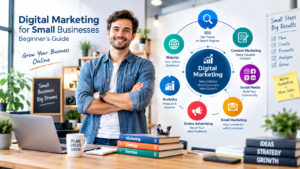
- Search engine optimization
- Content marketing
- Social media
- Email marketing
- Local SEO
- Business networking
- Referral marketing
- Online communities
A website can become a long-term marketing asset when it publishes useful content that answers questions customers are searching for.
For local businesses, optimizing a Google Business Profile, collecting legitimate customer reviews and creating location-relevant content can also support visibility.
Social media can be useful for demonstrating expertise, sharing customer success stories and communicating directly with potential customers.
The best marketing channel depends on where your target customers actually spend their time.
7. Build a Professional Online Presence Without Overspending
A professional online presence is important, but that does not mean you need an expensive website.
A small business can start with:
- A simple professional website
- Clear service or product pages
- Contact information
- About page
- Customer reviews where appropriate
- Useful educational content
- Social media profiles relevant to the audience
Your website should make it immediately clear what you offer, who you help and how customers can contact you.
Over time, you can improve the website as revenue grows.
This approach is especially useful for service businesses because the website can function as a digital sales and credibility tool without requiring a large initial investment.
8. Focus on Getting Your First Customers
The first customers are more important than having a large audience that never buys.
Start by identifying people who have a genuine need for your product or service.
You can reach potential customers through:
- Personal and professional networks
- Referrals
- Local communities
- Industry groups
- Email outreach
- Partnerships
- Search engines
- Social media
Do not focus only on selling. Ask potential customers about their problems and listen to their feedback.
Your first customers can provide valuable information about pricing, service quality, objections and product improvements.
That information can help you refine your offer before attempting to scale.
9. Track Every Important Business Expense
When money is limited, financial discipline becomes extremely important.
Track expenses such as:
- Software subscriptions
- Inventory
- Advertising
- Website costs
- Professional services
- Equipment
- Transportation
- Packaging
- Payment processing
- Business registration costs
Separate personal and business expenses where appropriate and maintain accurate records.
Business structure, tax responsibilities and recordkeeping requirements vary by country and jurisdiction. Entrepreneurs should check the requirements that apply to their specific location.
For example, the U.S. Internal Revenue Service provides guidance covering business structures, employer identification numbers, taxes and recordkeeping for people starting businesses. Read the IRS guide to starting a business.
For U.S.-based businesses, the IRS also provides a business startup checklist covering several basic startup considerations.
Entrepreneurs outside the United States should consult the appropriate government authorities in their own country.
10. Reinvest Revenue Carefully
Once the business begins generating revenue, avoid immediately increasing every expense.
Instead, consider reinvesting part of the revenue into activities that can produce measurable improvements.
For example:
Revenue → essential costs → customer acquisition → business improvement → growth
Possible reinvestments include:
- Better website functionality
- More effective marketing
- Additional inventory
- Improved customer support
- Business software
- Employee or contractor support
- New products
- Search engine optimization
The right reinvestment depends on the business model.
A company with strong demand but limited capacity may need to invest in operations, while a business with excellent capacity but too few customers may need to invest more heavily in marketing.
11. Avoid Common Small Business Startup Mistakes
Limited funds make mistakes more expensive.
Some common mistakes include:
- Spending too much before validating demand
- Trying to serve everyone
- Ignoring competitors
- Underpricing products or services
- Failing to track expenses
- Hiring too early
- Buying unnecessary technology
- Depending on one customer
- Ignoring customer feedback
- Expecting immediate profits
A business does not have to be perfect when it launches. It needs a clear value proposition and a willingness to learn.
The strongest entrepreneurs continuously test, measure and improve their businesses.
12. Build Toward Long-Term Growth
Starting with limited money does not mean you should think small forever.
Once the business has consistent customers and revenue, the next step is to develop a sustainable growth strategy.
That may include improving your business growth https://globalbusinesstimes.com/how-to-grow-a-small-business/strategy, expanding your customer base, introducing new products, entering new markets or using technology to improve efficiency.
For more ideas on building and scaling a company, read How to Grow a Small Business in 2026: The Ultimate Guide to Long-Term Success on Global Business Times.
The important thing is to scale according to evidence. If a particular product, service or marketing channel is working, invest more in it. If something consistently produces poor results, reconsider it.
Conclusion
Starting a small business with limited money is challenging, but it is entirely possible when spending is controlled and decisions are based on customer demand.
The most important steps are simple: identify a real problem, research the market, create a practical business plan, control startup costs, find a specific target audience, use affordable marketing channels and focus on acquiring your first customers.
You do not need to build a large company on day one. You need to build something customers value and then improve it over time.
The goal should not be to spend more money than your competitors. It should be to use limited resources more intelligently.
With disciplined financial management, focused marketing and continuous improvement, a small business can gradually move from a simple idea to a sustainable and scalable company.