
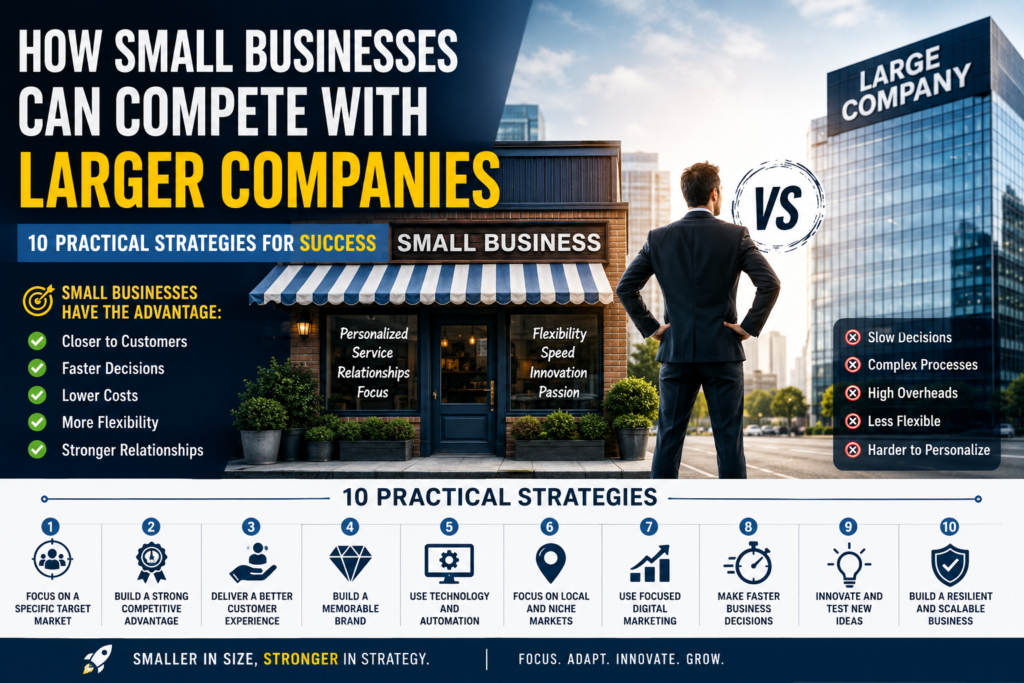
Large companies often have bigger budgets, larger teams, stronger brand recognition and greater access to resources. For a small business, competing with those companies may seem difficult, but size is not the only factor that determines success.
Small businesses can compete by focusing on specific customers, providing better service, making faster decisions and using technology efficiently. Instead of trying to copy large corporations, smaller companies can build advantages around flexibility, specialization and customer relationships.
Here are 10 practical strategies that can help small businesses compete with larger companies and build sustainable growth.
1. Focus on a Specific Target Market
Trying to sell to everyone can make a small business difficult to understand and expensive to market.
A better approach is to define a clear target market and focus resources on the customers most likely to need and buy your products or services.
For example, instead of targeting all businesses, a company could specialize in marketing for local restaurants, accounting firms, healthcare practices or small online retailers.
A focused market makes it easier to understand customer needs, create relevant products and develop targeted marketing campaigns.
Your target market should be based on factors such as:
- Customer needs
- Location
- Industry
- Purchasing behavior
- Budget
- Business size
- Common problems
A smaller, well-defined market can sometimes be more attractive than a huge market dominated by established competitors.
Your existing How to Identify Your Target Market article provides a useful foundation for this part of the strategy.
2. Build a Strong Competitive Advantage
A small business does not need to beat a large company at everything. It needs to be better at something that customers value.
That could be:
- Specialist expertise
- Faster delivery
- Better support
- Personalized service
- Local knowledge
- Flexible pricing
- Higher quality
- Easier purchasing
This is your competitive advantage.
For example, a large software company may offer a product to thousands of businesses, while a smaller company can specialize in one specific industry and provide more customized support.
The important question is:
Why should a customer choose your business instead of a larger competitor?
The answer should be specific and easy to communicate.
Generic claims such as “best service” or “high quality” are difficult to prove. A stronger position might be “same-day support for independent retailers” or “specialized accounting for small technology companies.”
The OECD highlights the importance of specialization, innovation and digitalization in helping SMEs remain competitive. OECD SME indicators and competitiveness resources.
3. Deliver a Better Customer Experience
Customer experience can become a major advantage for small businesses.
Large companies may have more resources, but their processes can sometimes be more complex. A small business can often communicate directly with customers, respond quickly and solve problems without multiple levels of approval.
Focus on:
- Fast responses
- Clear communication
- Reliable delivery
- Easy purchasing
- Helpful support
- Personalized service
- Quick problem resolution
Customer experience does not end after a purchase. It includes every interaction a customer has with your business.
A strong experience can increase repeat purchases, referrals and customer loyalty.
Your existing customer experience article can support this section and give readers more detailed information.
4. Build a Memorable Business Brand
Brand recognition is one area where large companies often have an advantage. However, small businesses can build strong brands by being consistent and highly relevant to a specific audience.
A business brand includes much more than a logo.
It includes:
- Brand positioning
- Visual identity
- Tone of voice
- Website design
- Marketing messages
- Customer experience
- Reputation
Your website, social media profiles, email communication and advertising should communicate the same core message.
A focused brand can help customers quickly understand what the company offers and why it is different.
Instead of trying to appeal to everyone, create a clear identity that reflects the needs and expectations of your chosen market.
5. Use Technology and Automation
Technology can help small businesses perform tasks that would otherwise require larger teams.
Cloud software, automation, artificial intelligence, customer relationship management tools and analytics can improve productivity while reducing repetitive work.
Businesses can automate:
- Email follow-ups
- Appointment scheduling
- Invoicing
- Customer support
- Reporting
- Marketing workflows
- Inventory notifications
The goal is not to automate everything. It is to identify repetitive tasks where technology can save time and reduce errors.
Digital tools can also help small businesses understand customer behavior and measure marketing performance.
The OECD notes that digitalization can help SMEs improve productivity, innovation and competitiveness. OECD digitalisation of SMEs.
6. Focus on Local and Niche Markets
Large companies usually target broad markets. Small businesses can often gain an advantage by becoming highly relevant in a local or specialized market.
A local business could focus on a particular city or region. A B2B company might focus on one industry. A service provider could specialize in a particular type of client.
This type of positioning can make marketing more efficient because the business knows exactly who it is trying to reach.
Local businesses can strengthen their presence through local search optimization, customer reviews, partnerships and community involvement.
Niche businesses can compete by developing expertise that larger general-purpose competitors may not provide.
7. Use Focused Digital Marketing
A small business does not need the same advertising budget as a large corporation if it can reach the right audience more efficiently.
Instead of trying every marketing channel, identify where your target customers spend time and focus on the channels most likely to produce results.
Useful options can include:
- SEO
- Content marketing
- Email marketing
- Social media
- Local SEO
- Referral marketing
- Digital PR
A strong digital marketing strategy should connect marketing activity with measurable business goals.
Track website traffic, leads, conversion rates, customer acquisition costs and sales.
Your existing 10 Effective Digital Marketing Strategies to Grow Your Business in 2026 article can provide additional information about broader digital marketing tactics.
8. Make Faster Business Decisions
Speed can be one of the biggest advantages of a small company.
Large organizations may require several approvals before changing a product, pricing structure, campaign or customer policy.
Small businesses can often test ideas much faster.
Use this flexibility to:
- Test new services
- Try different pricing
- Improve website pages
- Launch small campaigns
- Experiment with new content
- Respond to customer feedback
- Enter new niches
Faster decision-making does not mean acting without research. It means reducing unnecessary delays between identifying a problem and testing a solution.
Small businesses should create a culture where reasonable experiments are encouraged and results are measured.
9. Innovate and Test New Ideas
Innovation is not limited to inventing new technology.
A small business can innovate by:
- Improving an existing service
- Simplifying a complicated process
- Creating a better customer experience
- Introducing a new pricing model
- Using technology in a new way
- Serving an overlooked customer segment
Test ideas on a small scale before making a large investment.
For example, instead of launching a completely new service nationwide, test it with a small group of existing customers.
This approach provides real feedback and reduces financial risk.
Businesses that consistently test and improve their offers can adapt more quickly when customer needs change.
10. Build a Resilient and Scalable Business
Competing successfully requires more than attracting customers. A business also needs the ability to survive challenges and grow without losing control of costs and quality.
Avoid becoming dependent on:
- One customer
- One supplier
- One marketing channel
- One product
- One employee
- One source of revenue
A resilient business can continue operating when market conditions change.
At the same time, think about scalability.
Ask:
- Can we serve more customers without costs increasing at the same rate?
- Can technology reduce repetitive work?
- Can our processes be documented?
- Can we expand into related products or services?
- Can we enter new markets?
A strong business growth strategy should connect customer acquisition with profitability, operations and long-term expansion.
Your existing Business Growth Strategies in 2026 article can provide additional guidance on scaling and managing growth.
Conclusion
Small businesses do not need to become bigger versions of large corporations to compete successfully.
They can win by being more focused, more responsive and more relevant to specific customers.
The most effective strategies include choosing a clear target market, building a strong competitive advantage, improving customer experience, developing a memorable brand, using technology efficiently, focusing on niche markets, applying targeted digital marketing, making faster decisions, testing new ideas and building a resilient business model.
Large companies may have more resources, but small businesses can use specialization, flexibility and customer relationships to create meaningful advantages.
The objective is not simply to compete with larger companies. It is to build a business that customers understand, trust and prefer.