

Debt is a common part of modern financial life. People may borrow money to buy a home, finance education, purchase a vehicle, start a business, or handle an unexpected expense. But not all debt has the same financial impact.
This is why the terms good debt and bad debt are often used when discussing personal finance. The basic idea is that some borrowing may support a useful financial goal or create long-term value, while other debt can become expensive without providing lasting financial benefits.
However, the difference is not always as simple as labeling one type of loan “good” and another “bad.” The amount borrowed, interest rate, repayment period, fees, affordability, and purpose of the borrowing all matter.
Understanding these factors can help you make more informed borrowing decisions and avoid taking on debt that puts unnecessary pressure on your finances.
1. What Is Good Debt and What Is Bad Debt?
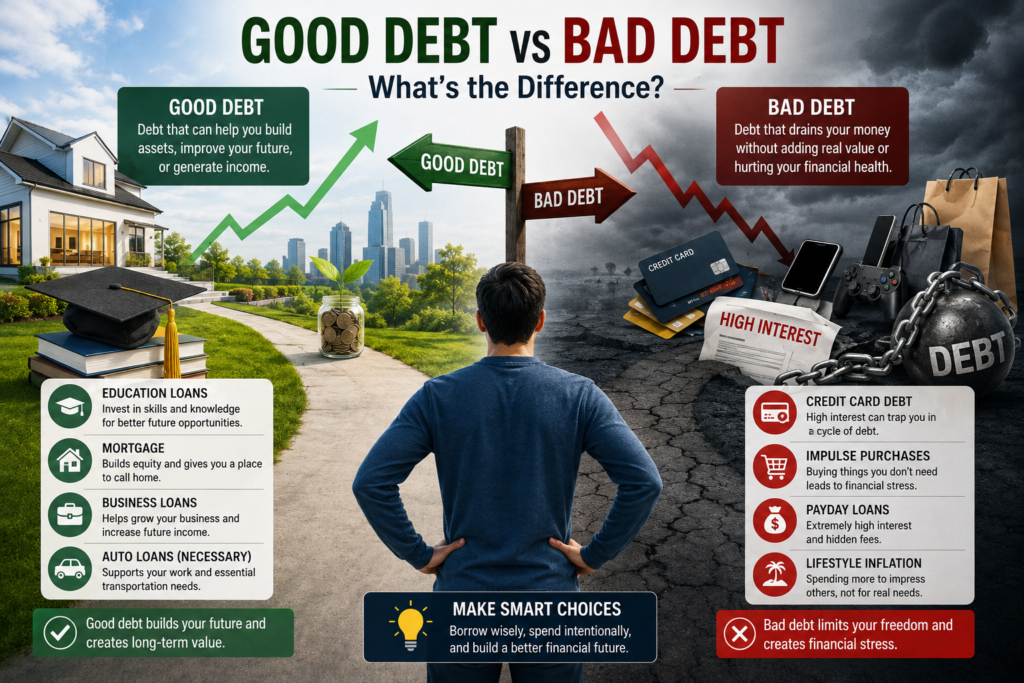
Good debt is generally used to describe borrowing that may help you achieve an important financial objective or acquire something that can provide value over time.
For example, borrowing for education may potentially help someone develop skills that improve future employment opportunities. A mortgage may allow someone to purchase a home rather than paying the entire cost upfront. A business loan may help an established business purchase equipment or expand operations.
But calling these debts “good” does not mean they are automatically beneficial.
A loan can become difficult to manage if the amount borrowed is too large, the interest rate is high, or the borrower cannot comfortably afford the payments.
The Consumer Financial Protection Bureau explains that debt can sometimes help people reach goals or build assets, but the outcome depends on the circumstances surrounding the borrowing.
Before taking on debt, it is therefore important to consider both the potential benefit and the financial cost.
Examples of Potentially Productive Debt
Some forms of borrowing may support long-term financial goals.
Education loans: Borrowing for education or professional training may make sense when the cost is reasonable and the education is likely to support the borrower’s goals.
Mortgage debt: A home loan can finance a major purchase over many years. However, buyers need to consider the mortgage payment, interest, taxes, insurance, maintenance, and other ownership costs.
Business debt: Financing can sometimes help a business purchase equipment, improve operations, or expand. Business owners should carefully compare the expected benefit with the cost of borrowing.
Necessary vehicle financing: A reliable vehicle may be important for employment or other essential activities. However, choosing an affordable vehicle and understanding the complete financing cost are important.
MyMoney.gov recommends that borrowers understand loan terms, compare borrowing options, pay attention to APR, and consider the total cost of borrowing.
You can also improve your overall financial foundation by following the principles in our guide to Smart Money Management.
What Is Bad Debt?
Bad debt generally refers to borrowing that creates a financial burden without providing enough lasting value to justify its cost.
Examples can include high-interest credit card balances used for unnecessary purchases, expensive short-term borrowing for routine expenses, or financing purchases that are quickly consumed while the debt remains for months or years.
Again, the label depends on the circumstances.
A credit card itself is not necessarily “bad debt.” The problem can arise when balances are carried at high interest and payments become difficult to manage.
Likewise, borrowing for a car is not automatically bad. The financial impact depends on the vehicle’s price, financing terms, interest rate, down payment, and affordability.
The key question is not simply:
“What type of debt is this?”
A better question is:
“Does the financial benefit of this borrowing justify its total cost and risk?”
2. How to Evaluate Debt Before Borrowing
Before accepting a loan or using credit, look beyond the monthly payment.
A payment may appear affordable while the overall cost of borrowing is much higher than expected.
Start by reviewing the APR, interest rate, fees, repayment period, and total amount you will repay.
APR is particularly useful because it can incorporate interest and certain fees into an annualized borrowing cost. Comparing APR and other loan terms can help you evaluate different offers more effectively.
Ask These Five Questions Before Taking on Debt
1. Why am I borrowing?
Identify the exact purpose.
Is the money being used for an essential expense, an investment in education or business, a major purchase, or something that could simply be postponed?
Understanding the purpose can help you distinguish between necessary borrowing and impulse spending.
2. Can I comfortably afford the payment?
Do not calculate affordability based only on today’s income.
Consider rent or mortgage costs, food, utilities, transportation, insurance, savings, existing debt payments, and unexpected expenses.
A payment that looks manageable on paper may become difficult if your income decreases or your expenses increase.
3. What is the total cost?
A loan is more than its monthly payment.
For example, a loan with a low monthly payment but a very long repayment period could result in substantially more interest being paid over time.
MyMoney.gov notes that the longer you take to repay borrowed money, the more interest you may pay.
4. What happens if my circumstances change?
Think about possible changes in employment, income, family expenses, or other financial obligations.
A responsible borrowing decision should account for uncertainty rather than assuming everything will remain exactly the same.
5. Are there better alternatives?
Sometimes waiting, saving, buying a less expensive item, negotiating a price, or choosing a different financing option may reduce the amount you need to borrow.
You can also review your overall financial goals using our Smart Financial Planning Guide before making a major financial commitment.
Watch Out for High-Cost Borrowing
Some forms of borrowing can become particularly expensive.
Payday loans, certain title loans, high-interest credit products, and other expensive forms of short-term borrowing can create significant repayment pressure.
If you are considering any loan, carefully review the complete terms rather than focusing only on how quickly you can receive the money.
The Federal Trade Commission warns consumers about loan and debt-relief scams, including offers that demand upfront payments in exchange for promised loans or guaranteed debt solutions.
Never assume that a loan is affordable simply because the lender approves you for it.
Your ability to borrow is not the same thing as your ability to comfortably repay.
Credit Cards: Useful Tool or Expensive Debt?
Credit cards can provide convenience and may offer useful consumer protections, but carrying balances can become expensive when interest accumulates.
Using a credit card for purchases that you cannot realistically afford can gradually increase financial pressure.
If you already carry credit card debt, consider creating a structured repayment plan rather than continuing to add new balances.
Our guide on How to Create a Debt Repayment Strategy explains methods such as prioritizing high-interest debt and creating a realistic monthly repayment plan.
3. How to Manage Debt Responsibly and Build Financial Stability
Understanding good debt and bad debt is useful, but responsible financial management goes beyond classification.
The objective should be to keep borrowing within a level that your finances can reasonably support.
Start by tracking your existing debts.
Create a simple list containing:
- Creditor or lender
- Outstanding balance
- Interest rate
- Minimum payment
- Due date
- Remaining repayment period
- Any relevant fees
This gives you a clear picture of your current financial obligations.
Prioritize Expensive Debt
If you have several debts, high-interest balances can deserve particular attention because interest can significantly increase the cost of carrying the balance.
You can use a debt repayment strategy that prioritizes higher-interest debt while maintaining required payments on other accounts.
Another approach is the debt snowball method, which focuses on paying smaller balances first.
Neither method is universally perfect. The best approach depends on your financial situation, behavior, debt terms, and ability to stay consistent.
Maintain an Emergency Fund
Unexpected expenses are one reason people may rely on credit.
Building an emergency fund can provide a financial buffer for situations such as unexpected repairs, temporary income disruption, or other necessary expenses.
Even if you cannot save a large amount immediately, developing the habit of setting money aside can strengthen your financial resilience.
Our guide on How to Build an Emergency Fund explains practical ways to start building emergency savings.
Avoid Borrowing for Lifestyle Inflation
As income increases, it can be tempting to increase spending at the same time.
A larger car, more expensive electronics, frequent dining out, and other lifestyle upgrades can become expensive when financed through credit.
Instead of automatically increasing debt as your income rises, consider directing some additional income toward savings, existing debt, and long-term financial goals.
This can help improve your financial position without requiring every increase in income to be matched by higher spending.
Know When to Ask for Professional Help
If debt payments have become difficult to manage, do not ignore the problem.
Depending on your situation, you may be able to contact creditors and ask about available payment options. A reputable credit counselor may also help you review your budget and debt situation.
Be cautious of companies that promise to eliminate all your debt quickly or demand large upfront fees.
The FTC recommends researching debt-relief providers carefully and avoiding companies that make unrealistic guarantees.
Final Thoughts
The difference between good debt and bad debt is not simply the type of loan you have.
The purpose of borrowing, interest rate, fees, repayment period, total cost, affordability, and potential financial benefit all matter.
Debt used for education, housing, business, or essential transportation may sometimes support important financial goals, but even these forms of borrowing can become problematic when the cost is too high or payments are unaffordable.
On the other hand, borrowing for unnecessary purchases can create long-term financial pressure, particularly when high interest is involved.
Before taking on debt, ask why you need the money, whether you can comfortably repay it, how much it will cost in total, and whether there are less expensive alternatives.
Responsible borrowing is ultimately about making decisions that support your broader financial goals rather than creating unnecessary financial stress.