
Running a small business involves making decisions every day, but good decisions require more than instinct. Business owners need to know whether the company is actually improving, where money is being made, which activities are producing results, and where problems are developing.
Measuring small business performance provides this information. Instead of relying on assumptions, owners can use financial data, customer information, sales results, operational metrics, and employee productivity to understand the health of the business.
Performance measurement does not have to be complicated. A small business does not need hundreds of metrics or an expensive analytics department. The key is choosing a small number of meaningful indicators and reviewing them consistently.
1. Track Financial Performance and Revenue
Financial performance is one of the clearest ways to understand whether a small business is moving in the right direction.
The first metric to monitor is revenue. Revenue shows how much money the business generates from selling its products or services during a specific period.
However, increasing revenue does not automatically mean the business is becoming more profitable. A company could generate more sales while also experiencing significantly higher expenses.
For this reason, business owners should also monitor profit.
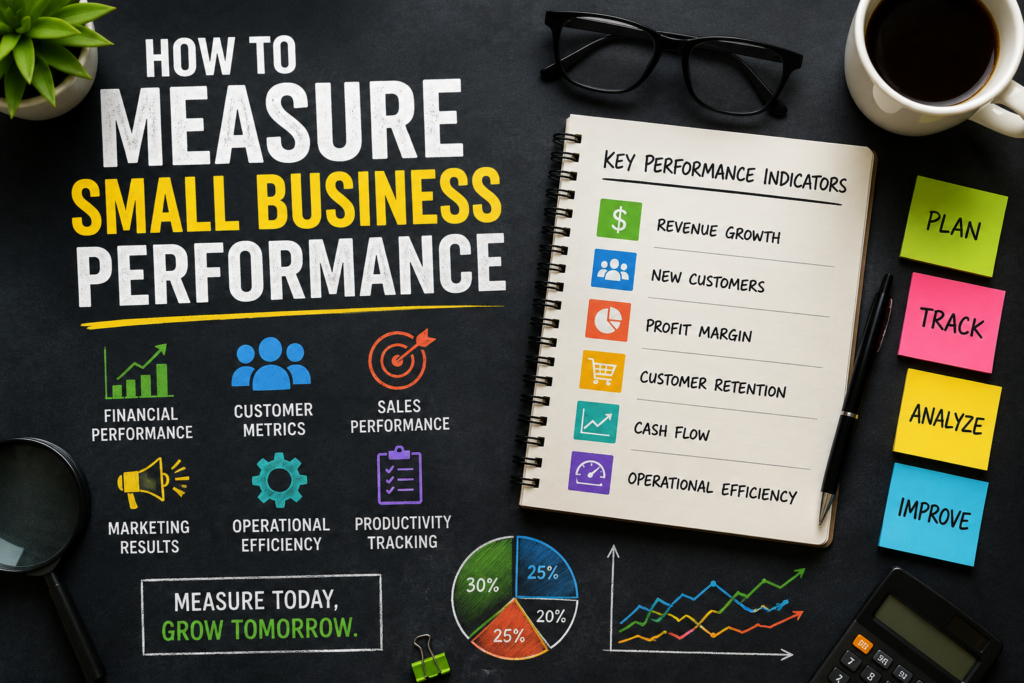
Important financial metrics include:
- Total revenue
- Gross profit
- Net profit
- Operating expenses
- Profit margin
- Cash flow
- Accounts receivable
- Accounts payable
- Customer acquisition cost
Gross profit shows how much remains after the direct costs associated with producing products or delivering services are deducted.
Net profit goes further by considering operating expenses and other costs. Monitoring both figures helps business owners understand whether sales are translating into sustainable profitability.
Cash flow deserves particular attention. A profitable business can still experience financial problems if money is not available when bills, salaries, suppliers, taxes, or other obligations become due.
Business owners should regularly compare money coming into the business with money going out.
Creating a simple monthly financial report can make this process easier. Compare the current month with the previous month and the same period from the previous year when historical data is available.
For example, if revenue increased by 15% but operating expenses increased by 30%, the business needs to investigate why costs are growing faster than sales.
Profit margin can provide another useful perspective.
A business generating $100,000 in sales with a 20% profit margin is in a different position from a business generating the same revenue with a 5% margin.
Business owners should therefore avoid focusing only on sales numbers. Revenue, costs, margins, and cash flow should be reviewed together.
The Business Growth Strategies in 2026 article provides additional guidance on growth, efficiency, customer relationships, and data-driven decision-making.
Another useful practice is creating a realistic financial budget. Set expected revenue and expenses at the beginning of a period and compare actual results against those expectations.
If expenses are consistently higher than planned, investigate the reason instead of simply accepting the difference.
Similarly, if revenue is below expectations, determine whether the problem comes from pricing, demand, marketing, sales performance, customer retention, or another factor.
Small businesses should also monitor their largest expenses. Rent, payroll, software subscriptions, advertising, inventory, suppliers, and other recurring costs can gradually increase.
Reviewing expenses regularly can identify unnecessary subscriptions, inefficient processes, or opportunities to negotiate better terms.
The goal of financial measurement is not simply to produce reports. It is to understand what is happening inside the business and use that information to make better decisions.
2. Measure Customers, Sales, Marketing, and Operational Performance
Financial results show the outcome, but business owners also need to understand what is driving those results.
Customer and sales metrics can provide this information.
One important metric is the number of new customers acquired during a specific period. Track this number monthly or quarterly and compare it with previous periods.
Customer acquisition cost is also valuable. It estimates how much the business spends to acquire a new customer.
For example, if a company spends $2,000 on marketing and sales activities and acquires 40 new customers, the approximate acquisition cost is $50 per customer.
This number becomes more meaningful when compared with the customer’s average value.
A business should also monitor customer retention. If customers make one purchase and never return, the company may need to improve product quality, customer service, pricing, communication, or the overall customer experience.
Useful customer metrics include:
- New customers
- Returning customers
- Customer retention rate
- Customer acquisition cost
- Average order value
- Customer lifetime value
- Customer satisfaction
- Number of complaints
- Referral customers
Customer feedback can provide information that financial reports cannot.
Ask customers why they chose the business, what they liked, what could be improved, and whether they would recommend the company to others.
Reviews, surveys, support conversations, and direct feedback can reveal recurring problems.
Sales performance should also be measured throughout the sales process.
Track the number of leads generated, qualified leads, proposals or quotes submitted, deals won, and deals lost.
This helps identify where potential customers are dropping out.
For example, if a business receives many inquiries but very few customers purchase, the problem may be pricing, sales communication, product positioning, or the sales process.
Marketing performance should be measured in the same way.
Website traffic can be useful, but traffic alone does not tell you whether marketing is producing business results.
Track metrics such as:
- Organic traffic
- Leads generated
- Conversion rate
- Cost per lead
- Email sign-ups
- Social media referrals
- Advertising results
- Sales generated from marketing channels
A marketing channel that produces fewer visitors but more qualified customers may be more valuable than a channel producing large amounts of low-quality traffic.
Technology can make this process easier. Analytics platforms, CRM systems, accounting software, and reporting dashboards can bring information together and reduce manual reporting.
Businesses adopting digital tools can also improve the speed at which they understand their performance. The Why Small Businesses That Embrace Digital Transformation Are Winning in 2026 article explains how automation, cloud technology, artificial intelligence, and analytics can support better business decisions.
Operational performance is another area that should not be ignored.
A business can generate strong sales while losing money through inefficient operations.
Measure factors such as:
- Order processing time
- Delivery time
- Production output
- Inventory turnover
- Customer response time
- Error rates
- Product returns
- Employee productivity
For a service business, response time may be especially important. If customers wait several days for an answer, they may choose a competitor.
For an e-commerce business, delivery delays and inventory problems can damage customer satisfaction.
For a professional service company, measuring billable hours, project completion times, and client retention may be more useful.
The right metrics depend on the business model.
There is no universal list of performance indicators that every small business should follow. Choose metrics that directly connect to the company’s goals.
3. Create a Simple Performance Dashboard and Improve Continuously
Once a business has identified its most important metrics, the next step is creating a simple system for reviewing them.
A performance dashboard does not have to be complicated. A spreadsheet can be enough for many small businesses.
Create categories such as financial performance, customers, sales, marketing, and operations.
For each metric, record the current result, previous result, target, and percentage change where appropriate.
For example:
| Metric | Current | Previous | Target |
|---|---|---|---|
| Monthly Revenue | $45,000 | $41,000 | $50,000 |
| Net Profit Margin | 14% | 12% | 15% |
| New Customers | 85 | 72 | 100 |
| Customer Retention | 78% | 75% | 80% |
| Qualified Leads | 120 | 105 | 130 |
This type of dashboard makes trends easier to see.
A business owner can quickly identify which areas are improving and which require attention.
Set realistic targets rather than choosing arbitrary numbers.
A target should be connected to the company’s financial position, capacity, market opportunity, and broader business strategy.
For example, increasing revenue by 50% may sound attractive, but if the business does not have enough employees, inventory, equipment, or customer support capacity, such growth could create operational problems.
This is why performance measurement should be connected to the wider business plan.
Review important metrics on a regular schedule.
Some metrics may need weekly monitoring, such as sales leads, cash flow, or customer inquiries. Others may be more useful monthly or quarterly.
Do not wait until the end of the year to discover that performance has been declining.
Look for trends instead of reacting to one unusual result.
A single weak sales week does not necessarily mean the business has a serious problem. However, declining sales over several months may require action.
The same principle applies to expenses, customer retention, conversion rates, and other indicators.
Business owners should also compare performance against previous periods and, when reliable information is available, industry benchmarks.
The purpose of benchmarking is not to copy competitors. It is to understand whether your business is operating efficiently and where improvement may be possible.
When a metric changes significantly, ask why.
If sales increase, determine what caused the improvement.
If customer retention falls, investigate customer feedback.
If marketing costs increase, identify which campaigns are responsible.
If productivity decreases, examine workloads, processes, technology, and employee capacity.
This turns performance measurement into a continuous improvement process.
Small businesses should also avoid measuring too many things. Tracking dozens of metrics can create unnecessary complexity and make it harder to identify what actually matters.
Choose perhaps five to ten core indicators that provide a clear picture of business health.
Your How Small Businesses Can Compete With Larger Companies article also highlights the importance of technology, customer experience, focused marketing, and measurable business strategies when building sustainable competitive advantages.
The final step is taking action based on the data.
A dashboard has little value if the business owner looks at it but does nothing.
If customer acquisition costs are rising, test new marketing channels. If profit margins are falling, review pricing and expenses. If customer retention is declining, improve the customer experience. If productivity is weak, simplify processes or introduce appropriate technology.
Performance measurement should lead to decisions.
Small businesses that consistently measure, analyze, and improve their performance are better positioned to identify problems early, use resources efficiently, and build sustainable growth.
Conclusion
Measuring small business performance does not require complicated systems or a large analytics team.
Start with the numbers that matter most: revenue, profit, cash flow, customers, sales, marketing results, and operational efficiency.
Create a simple dashboard, establish realistic targets, review results regularly, and investigate significant changes.
The most important part is turning information into action. Performance metrics should help business owners understand what is working, what is not working, and what needs to change.
As the business grows, its performance measurement system can become more sophisticated. However, the basic principle remains the same: measure the right things, understand the results, and use the information to make better business decisions.