

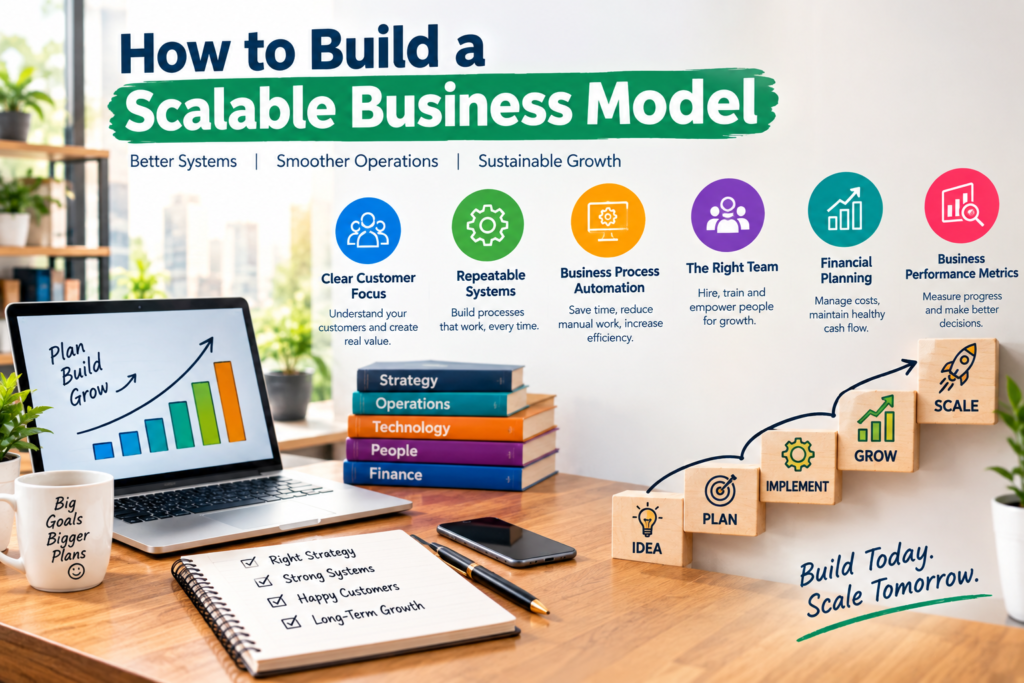
A business can grow in sales and still struggle to handle that growth efficiently. As customer demand increases, owners may face more operational work, higher complexity, communication problems, staffing pressure, and inconsistent customer experiences. A scalable business model is designed to reduce these problems by creating systems that can support growth without requiring the business to rebuild its entire operation every time demand increases.
Scalability does not simply mean getting more customers. It means creating a business structure that can serve additional customers, enter new markets, expand its team, or increase its operations while keeping processes organized and sustainable.
For small businesses, thinking about scalability early can make future growth easier. The U.S. Small Business Administration recommends understanding the target market, competitive environment, costs, customer needs, and business structure as part of effective business planning.
1. Build a Business Model Around a Clear Customer and Repeatable Value
The foundation of a scalable business model is a clear understanding of what the business provides, who it serves, and how it creates value.
Before trying to expand, a business should clearly identify its target customers. A company that tries to serve everyone may find it difficult to create consistent products, services, marketing messages, and customer experiences.
Market research can help businesses understand customer demand, market size, competition, customer characteristics, and other factors that influence business opportunities.
A scalable business should therefore begin with a clearly defined customer problem.
For example, instead of simply saying that a company provides marketing services, the business could define its target audience and the specific problem it solves. This makes it easier to develop repeatable services, pricing structures, marketing strategies, and customer processes.
The next step is developing a clear value proposition. This explains why customers should choose the business and what useful outcome they receive from its products or services.
A strong value proposition does not need to be complicated. It should communicate:
- Who the business serves
- What problem it solves
- What it provides
- Why the solution is useful
- What makes the business different
Once the value proposition is clear, businesses should examine whether the product or service can be delivered repeatedly without requiring completely different processes for every customer.
This is particularly important for service businesses. If every customer requires a completely customized process, growth can quickly create additional workload. Standardized packages, documented workflows, templates, onboarding procedures, and clear service boundaries can make delivery more consistent.
A business can still provide personalized customer service while using standardized internal processes.
Revenue structure is another important part of scalability. A business should understand how it generates revenue and whether its revenue model can support future expansion.
For example, a company may use direct sales, subscriptions, memberships, recurring services, product sales, licensing, or a combination of different revenue streams. The appropriate structure depends on the business and its customers.
The SBA recommends that business plans clearly explain revenue streams, customer segments, channels, cost structure, customer relationships, and key resources.
A scalable model should also be tested before major expansion. Businesses can start with a manageable customer base, monitor the delivery process, collect feedback, and improve the model before increasing its scale.
This approach helps identify weaknesses early.
For related guidance, see How to Build an Online Presence for a Small Business.
2. Create Repeatable Systems, Technology, and Processes
Once the business model is clear, the next step is building systems that allow the business to handle additional work without creating unnecessary complexity.
This is where business systems become important.
A business system is a repeatable method for completing an activity. It can cover areas such as sales, customer onboarding, order processing, inventory management, customer support, marketing, accounting, hiring, and reporting.
Instead of relying on individual employees to remember how every task should be completed, businesses can document important processes.
For example, a customer onboarding process could include:
- Receiving the customer inquiry
- Collecting required information
- Confirming the service
- Creating the customer record
- Assigning responsibilities
- Delivering the first step
- Following up with the customer
Documenting this process makes it easier to train new employees and maintain consistency.
The SBA has also highlighted the importance of operating systems that support smooth operations, customer experience, employee onboarding, and future growth.
Technology can strengthen these systems. Businesses can use project management software, customer relationship management systems, accounting platforms, scheduling tools, inventory systems, communication platforms, and analytics tools depending on their needs.
However, adding more software does not automatically make a business more scalable.
The goal should be business process automation where automation genuinely reduces repetitive work and improves consistency.
For example, a business may automate appointment reminders, routine emails, invoice notifications, reporting, data entry, or task assignments.
Automation should be introduced after understanding the process. Automating a poorly designed process can simply make an inefficient process happen faster.
Technology integration also matters. If a business uses several systems that do not communicate with one another, employees may spend unnecessary time moving information between platforms.
SCORE recommends creating a technology integration strategy so businesses choose tools based on actual workflow needs rather than simply adding software reactively.
A scalable operation should also reduce dependence on one individual wherever practical.
If only the owner knows how to perform important tasks, the business may struggle when the owner becomes unavailable or when the company grows.
Businesses can reduce this dependency through:
- Documented procedures
- Employee training
- Clear responsibilities
- Shared knowledge
- Standard operating procedures
- Appropriate software access
- Regular process reviews
Another important factor is team structure. As the business grows, employees should understand who is responsible for different activities and how their work connects with other departments or functions.
Clear roles can reduce duplicated work and communication problems.
Businesses should also review their processes regularly. A system that works with a small team may need to change when the company adds employees, products, customers, or locations.
Scalability therefore requires continuous improvement rather than a one-time setup.
For another technology-focused business guide, see How Technology Can Help Small Businesses Grow.
3. Manage Growth Through Financial Discipline, People, and Performance Measurement
A business cannot scale effectively without understanding whether growth is financially and operationally sustainable.
Financial planning should be part of the scalability process from the beginning. Businesses need to understand their recurring costs, variable costs, staffing requirements, technology expenses, marketing costs, supplier requirements, and other operational commitments.
Growth can increase revenue while also increasing expenses. Therefore, businesses should evaluate whether additional sales are creating sustainable improvements rather than simply increasing workload.
This is where financial planning becomes important.
Businesses should regularly review revenue, expenses, cash flow, margins, customer acquisition costs where applicable, and other relevant performance indicators.
They should also consider capacity.
For example, a company that receives more orders than its current team can process may experience delays, customer complaints, quality problems, and employee pressure.
Before increasing demand, the business should consider whether it has enough:
- Staff
- Equipment
- Inventory
- Supplier capacity
- Customer support
- Technology
- Operational space
- Management capacity
People are another major part of scalability.
Hiring too early can create unnecessary costs, while hiring too late can create operational bottlenecks. Businesses should therefore identify which responsibilities genuinely require additional employees and which activities can be improved through better processes or technology.
Clear job responsibilities can also make recruitment easier because the business knows what it actually needs.
Employee training is equally important. A scalable business should make it possible for new team members to understand their responsibilities without depending entirely on informal explanations from the owner.
Customer experience should also remain consistent during growth.
A company that provides excellent service to a small number of customers but struggles after expansion has a scalability problem.
Businesses can monitor customer feedback, response times, delivery quality, repeat purchases, complaints, support requests, and other indicators that are relevant to their industry.
Performance measurement helps identify where growth is creating pressure.
Useful business performance metrics may include:
- Revenue growth
- Operating costs
- Customer retention
- Lead conversion
- Customer satisfaction
- Productivity
- Order completion time
- Employee capacity
- Website or marketing performance
- Cash flow indicators
The exact metrics should depend on the business model. A retailer, software company, restaurant, consultancy, and manufacturing business will not necessarily use the same measurements.
Businesses should also set realistic growth stages instead of trying to expand everything at once.
A practical approach can be:
- Stabilize the current business model.
- Document important processes.
- Identify operational bottlenecks.
- Improve technology and workflows.
- Train the team.
- Monitor financial and operational performance.
- Expand when the business has enough capacity.
- Review the model and improve it continuously.
This creates a more controlled path toward expansion.
A scalable business model is ultimately about building an organization that can operate effectively beyond the owner’s direct involvement in every task. Strong systems, clear responsibilities, reliable technology, financial discipline, and consistent measurement can help create that foundation.
For more guidance on measuring results, see How to Measure Small Business Performance.
Conclusion: Building a scalable business model requires more than increasing sales. Businesses need a clear customer focus, repeatable value, documented processes, appropriate technology, capable teams, financial discipline, and reliable performance measurement. When these elements are developed together, a business can become better prepared to handle additional customers and operational complexity while maintaining consistency and efficiency.