
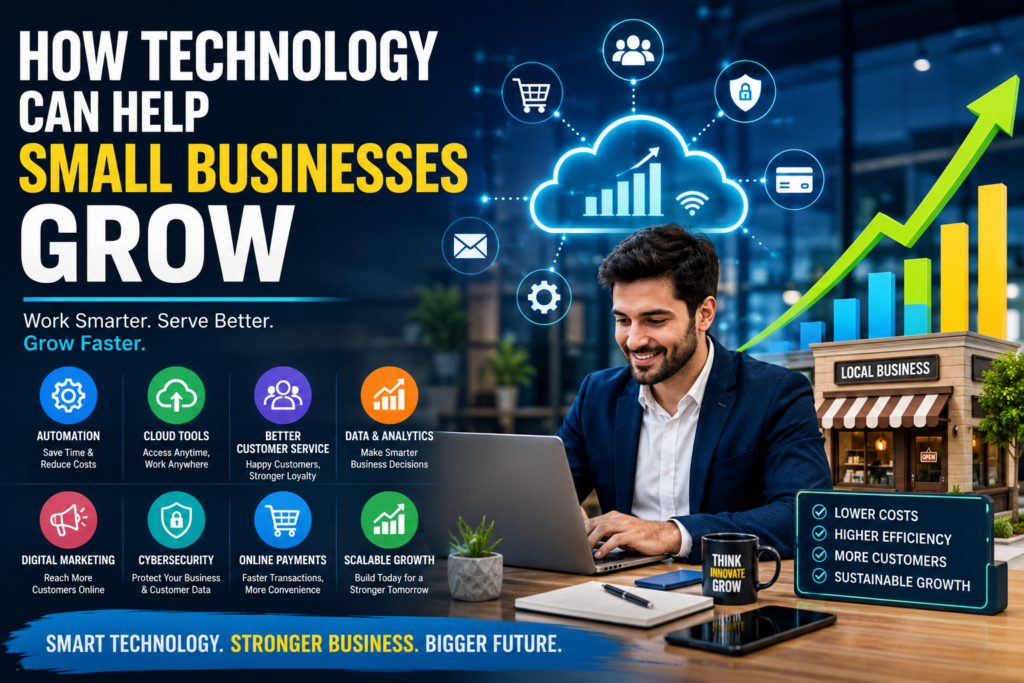
Technology has become one of the most practical tools available to small businesses. A company does not need a large IT department or a huge technology budget to benefit from digital tools. Cloud software, automation, artificial intelligence, online payments, customer relationship management systems, analytics, and digital marketing platforms can help small businesses save time, reduce costs, improve customer service, and create new opportunities for growth.
For many small businesses, the biggest advantage of technology is efficiency. When repetitive tasks are handled by software, business owners and employees can spend more time on customers, sales, strategy, and other activities that directly contribute to growth.
Technology can also help small companies compete with larger businesses. Instead of trying to match a large competitor’s workforce or budget, a small business can use technology to automate processes, reach specific audiences, analyze data, and provide a more personalized customer experience.
1. Use Technology to Improve Efficiency, Productivity, and Customer Service
One of the simplest ways technology can help a small business grow is by reducing unnecessary manual work.
Many businesses still spend significant amounts of time managing invoices, appointments, emails, customer information, reports, inventory, and routine communications manually. Digital tools can automate many of these activities.
For example, an online scheduling system can allow customers to book appointments without calling the business. Accounting software can organize invoices and financial records. Email automation can send confirmations, reminders, and follow-up messages automatically.
Customer relationship management (CRM) software can also help businesses organize customer information in one place. Instead of keeping customer details across spreadsheets, emails, and different applications, a CRM can provide a centralized record of interactions, leads, sales opportunities, and follow-ups.
This can become particularly useful as a business grows. A system that works for ten customers may become difficult to manage when the company has hundreds or thousands of customers.
Cloud technology provides another important advantage. Cloud-based applications allow authorized users to access information and work from different locations. This can support remote work, collaboration, file sharing, and business continuity.
Small businesses can also use collaboration tools to improve communication between employees, freelancers, contractors, and clients. Shared documents, project management platforms, video meetings, and communication applications can reduce delays and make responsibilities easier to track.
Artificial intelligence is another area that is becoming increasingly accessible to small businesses. AI tools can assist with tasks such as customer support, research, data analysis, scheduling, content development, and routine communication.
However, AI should be used as a business tool rather than a complete replacement for human judgment. Important decisions, customer relationships, financial matters, and sensitive information still require appropriate human oversight.
Technology can also improve customer service. Businesses can use chat systems, automated notifications, online booking, customer portals, and self-service resources to make interactions more convenient.
The U.S. Small Business Administration provides resources that can help small business owners understand different aspects of managing and growing a business.
The goal should not be to adopt every new technology. Instead, identify the tasks that consume the most time or create the most errors and look for technology that solves those specific problems.
A small business can start with one process, measure the improvement, and then introduce additional tools when there is a clear business benefit.
2. Use Digital Technology to Reach Customers and Make Better Decisions
Technology can help small businesses not only operate more efficiently but also find and understand potential customers.
Digital marketing platforms allow businesses to reach specific audiences based on factors such as location, interests, industry, demographics, and online behavior. This can make marketing more targeted than many traditional advertising methods.
Search engine optimization is another important technology-supported growth strategy. Businesses can use SEO tools to research keywords, monitor rankings, identify technical issues, analyze competitors, and improve website performance.
A strong digital presence can help a small business attract customers who are already searching for its products or services.
Your How Small Businesses Can Compete With Larger Companies article explains how smaller companies can use technology, focused marketing, specialization, and customer relationships to compete with larger competitors.
Content marketing can also benefit from technology. Businesses can use analytics and SEO tools to identify questions customers are searching for and then create useful articles, guides, videos, and other resources.
Social media platforms provide another way to communicate directly with customers. Small businesses can publish updates, answer questions, demonstrate products, share customer experiences, and build relationships without needing a large advertising budget.
Email marketing can be automated based on customer actions. For example, a business can send a welcome email after someone subscribes, a reminder before an appointment, or a follow-up message after a purchase.
Technology also makes it easier to measure marketing performance.
Instead of simply asking whether an advertisement “worked,” businesses can track website visits, leads, sales, conversion rates, customer acquisition costs, and other metrics.
Data analytics can help business owners identify which products are performing well, which marketing channels generate customers, and where customers leave the purchasing process.
For example, a company may discover that its social media accounts generate a large amount of engagement but very few sales. At the same time, organic search may produce fewer visitors but significantly more customers.
This information allows the business to allocate resources more intelligently.
Data can also help identify customer trends. Businesses can analyze purchasing history, repeat purchases, popular products, customer locations, and seasonal demand to make better decisions.
The NIST Cybersecurity Framework provides a useful framework for small and medium-sized businesses that want to improve how they manage cybersecurity risks.
Cybersecurity becomes particularly important as more business processes move online. Customer information, payment details, employee records, business documents, and other sensitive information may be stored digitally.
Businesses should use strong passwords, multi-factor authentication, software updates, regular backups, and appropriate access controls.
The Federal Trade Commission also recommends practical cybersecurity measures for small businesses, including software updates, backups, encryption, and multi-factor authentication through its Cybersecurity for Small Business guidance.
Technology should therefore be viewed as both a growth tool and a responsibility. The more important business operations become dependent on digital systems, the more important it becomes to protect those systems.
3. Choose Technology Strategically and Build for Long-Term Growth
Technology can provide significant benefits, but buying too many tools can create unnecessary costs and complexity.
Small businesses should begin with their business goals rather than starting with technology.
Ask what the business is trying to improve.
Is the goal to generate more leads? Reduce administrative work? Improve customer service? Manage employees? Increase sales? Reduce operating costs? Understand customers better?
Once the goal is clear, identify technology that directly supports it.
For example, a service business that loses customers because it responds slowly to inquiries may benefit from CRM software and automated follow-ups. A company spending hours preparing reports may benefit from analytics and reporting automation.
A growing online business may need better inventory management, payment processing, customer support, and order management systems.
Businesses should also consider whether a technology investment can scale.
A system that works well for a small number of customers may become expensive or difficult to manage as the company expands. Before choosing a major platform, consider pricing, integrations, security, support, data ownership, and the ability to add users or customers.
Technology should also work together where possible. When different systems can share information, employees spend less time entering the same data repeatedly.
For example, a website lead could automatically enter a CRM, trigger a notification, and create a follow-up task for a sales representative.
This type of integration can create a more efficient business process.
Employee training is another important factor. Even the best software will not provide much value if employees do not understand how to use it.
Provide clear instructions, practical training, and time for employees to become comfortable with new systems. Explain why the technology is being introduced and how it will make their work easier or more effective.
Businesses should also regularly review their technology stack.
Remove tools that are no longer being used. Check whether subscriptions are still necessary. Review security settings and user permissions. Update software and replace outdated systems when there is a clear reason to do so.
Technology should support the overall business strategy rather than becoming the strategy itself.
Your Business Growth Strategies in 2026 article highlights the importance of digital transformation, automation, data-driven decisions, and customer-focused growth. Technology becomes most valuable when these tools are connected to measurable business objectives.
Small businesses can also use technology to create new revenue opportunities.
An offline service business might introduce online booking. A consultant could offer virtual consultations. A retailer could launch e-commerce. An education business could create online courses. A professional service provider could develop digital products or subscription services.
These opportunities can allow a business to reach customers outside its immediate geographic market.
Technology can also help businesses become more resilient. Cloud backups, digital communication systems, online payment options, remote collaboration, and automated processes can make it easier to continue operating during unexpected disruptions.
However, businesses should always maintain appropriate backups and contingency plans.
The Why Small Businesses That Embrace Digital Transformation Are Winning in 2026 article provides additional context on how cloud technology, automation, artificial intelligence, and data analytics are changing the way smaller companies operate.
Ultimately, successful technology adoption comes down to solving real business problems. A small business does not need the newest software or the largest technology stack. It needs reliable tools that save time, improve decisions, support customers, and contribute to profitable growth.
Conclusion
Technology can help small businesses grow by improving efficiency, reaching customers, analyzing data, strengthening customer service, and creating new revenue opportunities.
The most effective approach is to start with business needs and then choose technology that solves specific problems. Automation can reduce repetitive work, CRM systems can improve customer management, analytics can support better decisions, and digital marketing tools can help businesses reach more qualified prospects.
Cybersecurity should remain part of every technology strategy. Strong passwords, multi-factor authentication, software updates, backups, and appropriate access controls can help protect business and customer information.
As a business grows, its technology needs will also change. Regularly reviewing tools, training employees, integrating systems, and measuring results can help ensure that technology continues to provide value.
For small businesses, technology is not simply an expense. When selected and implemented strategically, it can become an important competitive advantage and a practical foundation for sustainable growth.