
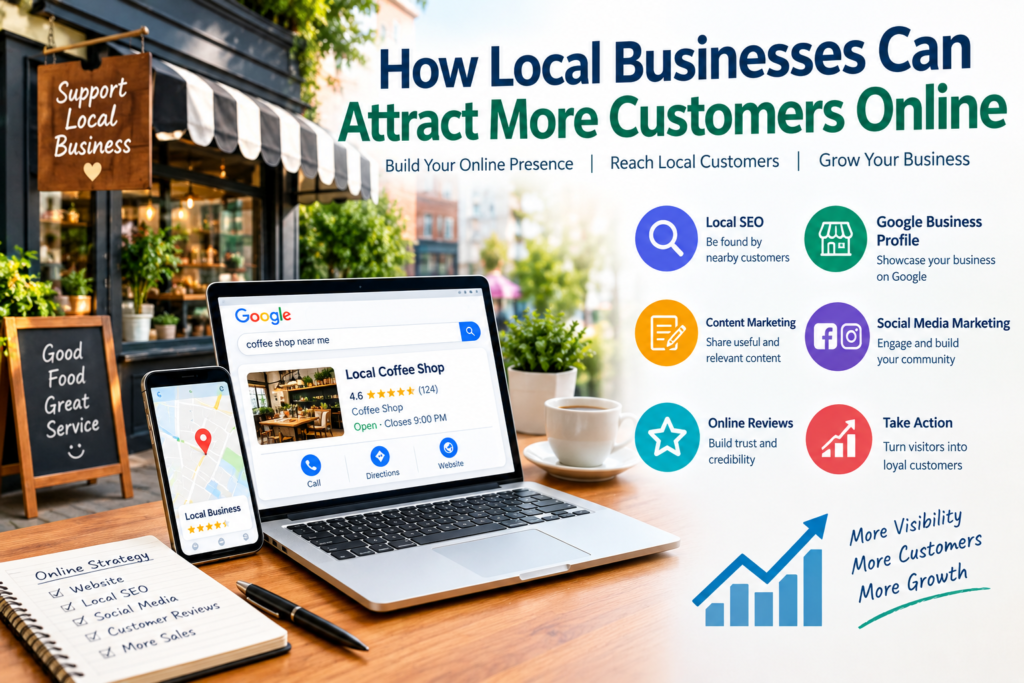
Local businesses have more opportunities than ever to reach nearby customers through search engines, websites, social media, business listings, reviews, and useful online content. Customers often research a business online before deciding whether to visit, call, book a service, or make a purchase.
For this reason, having an online presence is no longer limited to large companies. A local restaurant, salon, clinic, repair service, retailer, consultant, or professional service provider can use digital channels to become more visible to people in its target area.
The key is not to be active everywhere. A local business should focus on the platforms and strategies that help its target customers discover useful information and take the next step.
1. Build a Strong Local Online Presence
The first step in how local businesses can attract more customers online is creating a reliable digital foundation. This usually starts with a professional website and an accurate business profile.
A business website should clearly explain what the company offers, where it operates, who it serves, and how customers can contact it. Important pages may include the homepage, services or products, About page, Contact page, location information, and useful educational content.
The website should also work well on mobile devices. Many local searches happen on smartphones, so customers should be able to quickly find the phone number, address, opening hours, services, and other important information.
Businesses can also improve their visibility through local SEO. This means optimizing online information so search engines can better understand the business, its services, and the areas it genuinely serves.
For example, a plumbing company may create useful pages about plumbing services in its service area. A dental clinic can provide information about its treatments and location. A local restaurant can publish its menu, opening hours, location, and reservation information.
Google recommends keeping business information complete and accurate because local search results are influenced by factors such as relevance, distance, and prominence.
A useful starting point is a verified Google Business Profile. Businesses can use it to provide information such as their location, phone number, website, opening hours, photos, services, and customer reviews. Google also allows eligible businesses to add links that help customers take actions such as booking appointments or placing orders.
Businesses should also keep their name, contact information, website, address, and service details consistent across important online platforms. Inaccurate information can create confusion and make it harder for customers to contact the business.
For additional guidance, see How to Build an Online Presence for a Small Business.
2. Use Search, Content, Reviews, and Social Media to Reach Customers
Once the basic online presence is established, the next step is attracting people who are actively looking for the products or services the business provides.
Search engines can be particularly useful because customers often use specific phrases when looking for local businesses. Instead of targeting only broad keywords, businesses can create useful pages around specific services, customer questions, and locations they genuinely serve.
For example, a local fitness business could publish educational content about workout planning, classes, or fitness services. A home repair company could answer common maintenance questions. A restaurant could publish information about its menu, services, location, and special events.
This is where content marketing can support both visibility and customer education. Useful content can answer questions, explain services, demonstrate expertise, and give potential customers more information before they contact the business.
Businesses should avoid publishing large amounts of low-quality content simply to target keywords. The objective should be to create information that is genuinely useful to the intended audience.
Online reviews are another important part of the customer journey. Customers often look at reviews before choosing a local company, especially when comparing several businesses.
A business can encourage genuine customers to share honest feedback after using its products or services. It should never create fake reviews, purchase misleading reviews, or ask only selected customers for positive reviews. The Federal Trade Commission has specifically warned businesses about deceptive practices involving fake or manipulated reviews.
Businesses should also respond professionally to reviews. Positive feedback can be acknowledged, while legitimate complaints can be addressed respectfully and constructively.
Social media marketing can provide another way to stay visible to local audiences. A business does not need to use every social platform. It is usually more practical to focus on the platforms where its target customers are active.
Useful social content can include:
- New products or services
- Educational tips
- Frequently asked questions
- Behind-the-scenes content
- Business updates
- Customer experiences
- Local community activities
- Helpful short videos
- Links to useful website content
The goal should be to provide useful information rather than publishing constant promotional messages.
Businesses can also connect social media activity with their website. For example, a social post can introduce a useful article and direct interested customers to the website for more detailed information.
For another useful business strategy, read How Small Businesses Can Compete With Larger Companies.
3. Turn Online Visibility Into Customer Relationships and Measure Results
Getting visitors to a website or business profile is only one part of online marketing. A local business also needs to make it easy for potential customers to take action.
Every important page should have a clear next step. Depending on the business, this could be calling the company, requesting information, booking an appointment, visiting the store, making a reservation, or sending an inquiry.
Contact information should be easy to find. Businesses should avoid making customers search through several pages just to discover how to get in touch.
The website should also provide accurate information about services, prices where appropriate, operating hours, locations, and other details customers need before making a decision.
Email can also help businesses maintain relationships with existing customers and prospects. A local company could send useful updates, educational information, new service announcements, or relevant offers to people who have voluntarily subscribed.
Another important step is measuring results. Businesses should not assume that every online activity produces the same outcome.
Useful measurements may include:
- Website visitors
- Local search visibility
- Phone calls
- Contact form submissions
- Appointment requests
- Online bookings
- Direction requests
- New customers
- Returning customers
- Review activity
- Leads generated from different channels
The most useful metrics depend on the type of business. A restaurant may focus on calls, reservations, directions, and orders, while a professional service company may focus more on inquiries, leads, appointments, and qualified customers.
Businesses can also compare results over time instead of judging a strategy after only a few days. This makes it easier to identify which channels are attracting relevant customers and which activities need improvement.
A local business can also use customer feedback to improve its website, services, communication, and online information. This creates a continuous process rather than a one-time marketing campaign.
For more information about measurement, see How to Measure Small Business Performance.
Conclusion
Local businesses can attract more customers online by building an accurate digital presence, improving local search visibility, publishing useful information, collecting genuine customer feedback, using relevant social platforms, and making it easy for customers to take action.
The most effective approach is usually consistent rather than complicated. Businesses should focus on the channels their customers actually use, provide accurate information, create useful content, and measure results regularly. Over time, these activities can make a local business easier to discover and easier for potential customers to trust.