
Measuring small business performance is one of the most important parts of running a sustainable company. Business owners may look at revenue and sales to determine whether things are going well, but these numbers alone do not provide a complete picture. A business can generate more sales while facing rising costs, weak cash flow, declining customer retention, or shrinking profit margins.
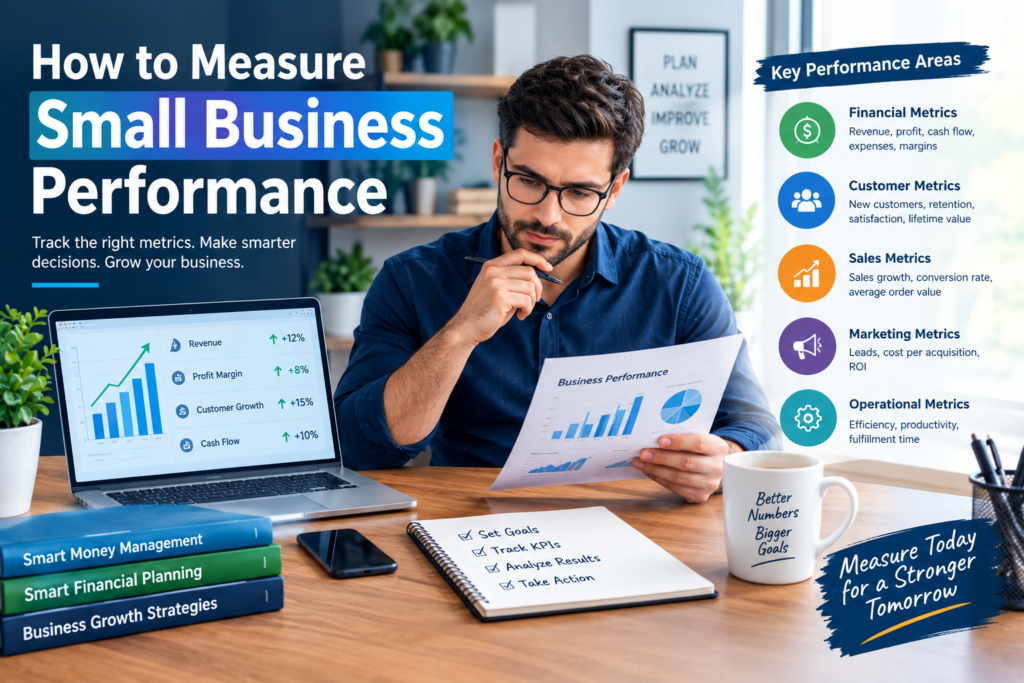
The best approach is to monitor a balanced set of financial, customer, sales, marketing, and operational metrics. These measurements help business owners understand what is working, identify problems early, and make decisions based on evidence rather than assumptions.
Small business performance measurement does not have to involve complicated systems. Even a simple monthly dashboard can provide valuable information when the right numbers are tracked consistently. The key is to connect each metric to a specific business goal and compare results over time.
1. Track the Financial Metrics That Show Business Health
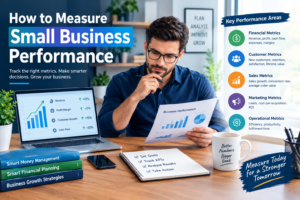
Financial performance should be the starting point when measuring a small business because it shows whether the company is generating enough revenue to cover its costs and maintain sustainable operations. Important financial metrics include revenue, expenses, profit, profit margin, cash flow, accounts receivable, and debt.
Revenue measures the money generated from selling products or services during a specific period. Tracking monthly or quarterly revenue can help you identify growth patterns and seasonal changes. However, increasing revenue does not automatically mean the business is becoming more profitable.
For example, a company might increase sales by 20% while its operating expenses increase by 30%. In that situation, revenue has grown, but overall financial performance may have weakened.
Profit provides another important perspective. Gross profit generally considers revenue after the direct costs associated with producing or delivering goods or services. Net profit goes further by accounting for additional business expenses.
Profit margin helps put profit into context by showing how much of the revenue remains after relevant costs. Tracking the trend over several months can help identify whether the business is becoming more or less efficient.
Cash flow is another critical measure. A profitable business can still experience financial pressure if cash does not arrive when bills and other obligations are due. The U.S. Small Business Administration recommends maintaining financial records and monitoring cash flow as part of managing business finances.
Business owners should also monitor accounts receivable, especially when customers purchase on credit or invoices are paid later. Slow collections can create cash-flow pressure even when sales appear strong.
Another useful measure is the business’s debt level relative to its assets and financial capacity. A balance sheet provides information about assets, liabilities, and owner equity and can help owners understand the company’s overall financial position.
These numbers should not be viewed individually. Looking at revenue, expenses, profit, cash flow, and liabilities together provides a much clearer picture of financial health.
For businesses that are still improving their financial foundation, resources such as Smart Money Management and Smart Financial Planning can provide useful background on budgeting, financial organization, and planning.
2. Measure Sales, Customers, Marketing, and Operational Performance
Financial results tell you what happened, but other KPIs can help explain why it happened. Small businesses should therefore track performance across sales, customers, marketing, and daily operations.
One important sales metric is sales growth. Compare sales across consistent periods, such as month over month or year over year, instead of looking at a single month in isolation. This makes it easier to identify genuine trends.
Another useful metric is average transaction value, which measures how much customers spend per purchase on average. If the average transaction value increases while customer numbers remain stable, the business may be generating more revenue from its existing customer base.
Businesses can also track conversion rate, which shows how many prospects or leads become customers. A low conversion rate may indicate problems with pricing, product positioning, sales processes, customer experience, or lead quality.
Customer acquisition cost (CAC) is another valuable measurement. It estimates how much a business spends to acquire a new customer. The SBA has highlighted customer acquisition cost, cash-flow forecasts, inventory turnover, and profit margin among useful small-business KPIs.
Customer-related metrics are equally important. Depending on the business model, owners may monitor:
- Customer retention rate
- Repeat purchase rate
- Customer complaints
- Refund or return rate
- Customer satisfaction
- Average customer value
- Number of new customers
- Number of lost customers
A business that continuously acquires customers but loses many existing customers may have a retention problem. On the other hand, strong repeat purchases can indicate that customers are finding ongoing value in the company’s products or services.
Marketing performance should also be measured rather than judged only by impressions or social media engagement. Businesses can compare marketing spending with leads, conversions, sales, and revenue generated from specific campaigns.
For example, if one marketing channel produces many leads but very few paying customers, while another generates fewer leads but more sales, the second channel may deserve greater attention.
Operational metrics can reveal another side of business performance. Depending on the company, these might include:
- Order fulfillment time
- Delivery time
- Inventory turnover
- Product defects
- Customer response time
- Employee productivity
- Project completion rate
- Operating cost per order
Not every business needs to track every metric. SCORE notes that businesses can use metrics and KPIs across areas such as customers, employees, products, processes, cash flow, and profitability.
The goal is to select a manageable group of KPIs that directly relate to the company’s objectives.
For example, an online store may prioritize conversion rate, average order value, customer acquisition cost, repeat purchases, inventory turnover, and profit margin. A consulting business may focus more on billable hours, project profitability, client retention, revenue per client, and accounts receivable.
This makes performance measurement more relevant to the actual business instead of creating a dashboard filled with numbers that do not support decision-making.
3. Create a Simple Performance Dashboard and Review It Consistently
Knowing which metrics to track is only the first step. Small business owners also need a consistent process for reviewing the information and turning it into decisions.
A simple performance dashboard can include around five to ten core KPIs. The exact number depends on the size and type of business, but tracking too many metrics can make it difficult to identify what actually matters.
Start by defining the company’s major goals. These might include increasing profitability, improving cash flow, acquiring more customers, reducing operating costs, increasing repeat purchases, or improving productivity.
Next, connect each goal to one or more measurable KPIs.
For example:
Goal: Increase profitability
Track revenue, operating expenses, gross profit margin, and net profit margin.
Goal: Improve customer growth
Track new customers, conversion rate, customer acquisition cost, and retention.
Goal: Improve cash position
Track cash inflows, cash outflows, accounts receivable, and short-term cash requirements.
Goal: Improve operations
Track fulfillment time, productivity, error rates, inventory turnover, or project completion.
Once the metrics are selected, establish a regular review schedule. Monthly reviews can work well for many small businesses, while some operational metrics may need to be reviewed weekly.
Comparing results against previous periods is particularly useful. Instead of asking, “Is this number good?” ask questions such as:
- Is the metric improving or declining?
- What changed compared with last month?
- Did a specific decision affect the result?
- Are costs growing faster than revenue?
- Are customers returning?
- Is marketing generating profitable business?
- Are operational problems affecting customer satisfaction?
- What action should be taken next?
It is also useful to compare actual performance with the business’s budget or targets. A business plan and financial projections can provide a framework for comparing expected results with actual results. The SBA recommends using financial projections and financial statements to understand the financial outlook of a business.
However, targets should be realistic and reviewed when circumstances change. A target created six months ago may no longer make sense if pricing, demand, costs, or the company’s strategy has changed.
Business owners should also avoid focusing on one metric in isolation. For example, rapidly increasing sales may look positive, but if those sales come with substantially higher acquisition costs or lower margins, the overall result may not be as strong as it appears.
The same principle applies to cost reduction. Lower expenses can improve short-term profitability, but cutting essential staff, technology, marketing, or customer support could negatively affect future growth.
The most effective performance measurement system therefore combines financial and non-financial indicators. Financial metrics show the economic results, while customer, sales, marketing, and operational metrics help explain the factors behind those results.
Ultimately, measuring small business performance is not about collecting the largest possible amount of data. It is about identifying the numbers that matter, reviewing them consistently, understanding the reasons behind changes, and using that information to make better business decisions.
Final Thoughts
Small business performance should be measured from multiple perspectives. Revenue and profit are important, but they should be evaluated alongside cash flow, expenses, customer acquisition, retention, marketing effectiveness, and operational efficiency.
A simple KPI dashboard can make this process easier. By setting clear goals, choosing relevant metrics, comparing results over time, and taking action when performance changes, business owners can develop a clearer understanding of their company’s financial and operational position.
The most useful performance measurement system is one that supports better decisions rather than simply producing more numbers. Start with a small group of meaningful KPIs, review them consistently, and expand the system as the business grows.