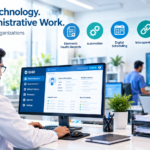

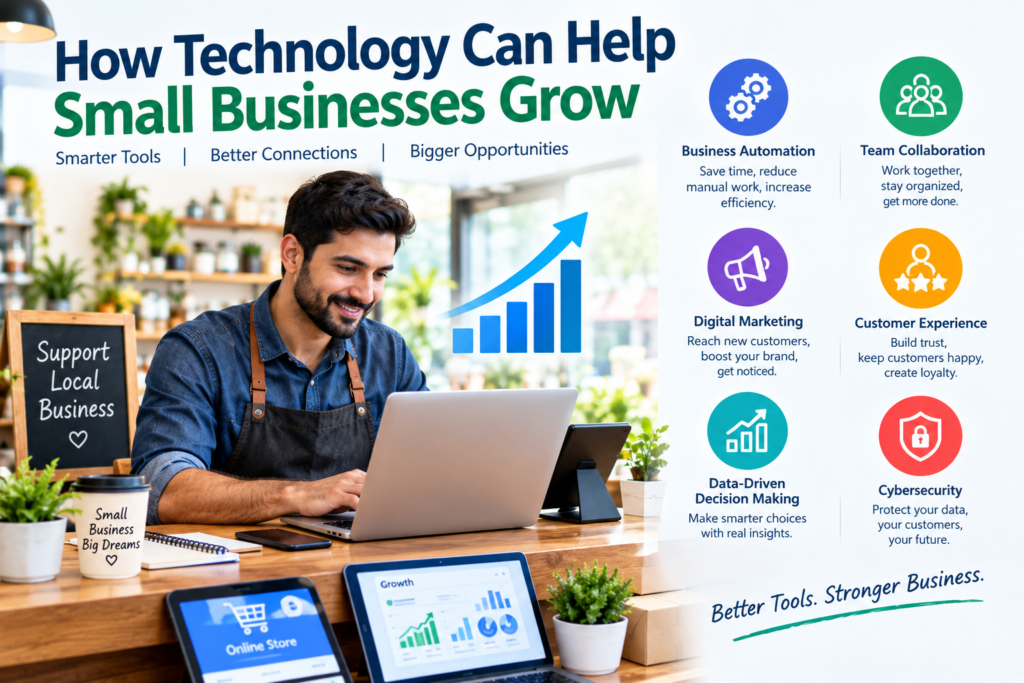
Technology has become an important part of modern business operations. Small businesses can use digital tools to communicate with customers, manage daily tasks, organize information, improve productivity, promote their products and services, and understand business performance.
Technology does not automatically make a business successful. Its value depends on how well a business chooses, implements, and uses the right tools. A small company does not necessarily need a large collection of software. In many cases, a few well-selected tools can solve important operational problems and make everyday work more organized.
The U.S. Small Business Administration has highlighted how digital tools can help small businesses reach customers, improve operations, enter new markets, and build resilience.
1. Use Technology to Improve Business Operations and Productivity
One of the most practical ways technology can support growth is by making everyday business operations more efficient. Small businesses often have limited employees, which means owners and staff may need to handle multiple responsibilities. Digital tools can help organize these responsibilities and reduce unnecessary manual work.
For example, businesses can use accounting software to organize financial records, monitor transactions, prepare reports, and keep important information in one place. Similarly, inventory management systems can help retailers monitor stock levels and identify products that need to be reordered.
Another useful area is business automation. Automation means using software to perform repetitive tasks according to predefined instructions. Examples include sending appointment reminders, generating recurring reports, organizing customer inquiries, updating inventory records, or sending confirmation emails.
The purpose of automation should not be to remove every human interaction. Instead, it can give employees more time to focus on activities that require judgment, communication, creativity, and customer service.
Cloud-based software can also make information easier to access. Instead of keeping important business files on only one computer, businesses can use appropriate cloud services to collaborate and access documents from different locations.
However, businesses should consider security, access permissions, backup procedures, and the sensitivity of information before moving important data to any digital platform.
Technology can also improve team collaboration. Shared calendars, project management platforms, communication tools, and document systems can help employees understand responsibilities and deadlines.
For example, a small marketing team can use a project management system to assign tasks, monitor progress, and organize campaign materials. A service business can use scheduling software to coordinate appointments and staff availability.
The best approach is to identify a business problem first and then select technology that addresses that specific problem. Buying software simply because it is popular can create unnecessary complexity.
Businesses should ask questions such as:
- What task currently takes too much time?
- Which processes are repetitive?
- Where do mistakes frequently occur?
- Which information is difficult to organize?
- Where do employees need better collaboration?
- Can a digital tool simplify the process?
This problem-first approach helps small businesses adopt technology more strategically.
For related guidance, read How to Build an Online Presence for a Small Business.
2. Use Digital Technology to Reach Customers and Make Better Decisions
Technology can also help small businesses improve the way they communicate with customers and reach new audiences.
A professional website can provide customers with information about products, services, locations, opening hours, contact details, and frequently asked questions. A website can also become a central place for publishing educational content and answering common customer questions.
For local businesses, technology can support digital marketing through search engines, business profiles, social media, email, and other online channels. Businesses can use these platforms to share useful information and make it easier for potential customers to discover them.
This is particularly relevant for businesses that depend on local customers. A restaurant, salon, repair company, clinic, retailer, or professional service provider can use online tools to improve visibility among people searching for relevant products or services.
Businesses should avoid treating technology as a replacement for customer understanding. Digital tools work best when the business already understands its audience and uses technology to communicate more effectively.
Customer relationship management systems can help businesses organize customer information and interactions. Depending on the system, businesses may be able to track inquiries, sales opportunities, communications, appointments, and customer service activities.
A CRM system can become particularly useful as the number of customers increases because information is less likely to remain scattered across emails, spreadsheets, notebooks, and individual devices.
Technology can also improve customer experience. Online appointment systems, automated confirmations, digital payment options, self-service information, order tracking, and responsive communication can make interactions easier.
The right technology depends on the business model. A consulting company may benefit from scheduling and CRM tools, while an online retailer may need inventory, order management, analytics, and customer support systems.
Another major advantage is access to business information.
Analytics tools can help owners understand website traffic, customer behavior, sales activity, marketing performance, and other measurable indicators. This information can support better decisions because business owners can compare actual results rather than relying entirely on assumptions.
For example, a business can examine which website pages receive attention, which marketing channels generate inquiries, which products receive more interest, and which customer activities are changing over time.
Technology can therefore support data-driven decision making. This does not mean that every business decision should be based only on numbers. Experience, customer feedback, market conditions, and professional judgment remain important.
Instead, data can provide another layer of information that helps owners identify patterns and evaluate whether their strategies are producing the intended results.
Small businesses should also remember that technology adoption can involve learning and adjustment. The SBA has noted that small businesses can face barriers when adopting digital technologies, including challenges related to understanding and implementing new tools.
For another practical business resource, see How Local Businesses Can Attract More Customers Online.
3. Choose Technology Carefully, Protect Business Information, and Measure Results
Technology can support business growth, but it also introduces responsibilities. Small businesses need to consider security, privacy, costs, employee training, vendor reliability, and the long-term usefulness of the tools they adopt.
One of the most important areas is cybersecurity. Small businesses can be affected by phishing, compromised accounts, ransomware, data loss, insecure devices, and other technology-related risks. The Federal Trade Commission recommends practical measures such as keeping software updated, backing up files, using strong passwords, enabling multi-factor authentication, securing networks, and training employees.
NIST also recommends basic cybersecurity practices for small businesses, including multi-factor authentication, strong passwords, regular backups, software updates, employee training, and protection against phishing and ransomware.
Businesses should therefore treat security as part of technology adoption rather than something to consider later.
Important practices include:
- Use strong and unique passwords.
- Enable multi-factor authentication where available.
- Keep software and operating systems updated.
- Back up important business information.
- Limit access to sensitive information.
- Train employees to recognize suspicious messages.
- Review third-party technology providers carefully.
- Have a plan for responding to technology or security incidents.
Businesses should also consider the privacy of customer and employee information. Not every employee needs access to every piece of company data. Access should be managed according to job responsibilities and business requirements.
Another consideration is choosing technology that can grow with the business. A tool that works for a very small operation may become difficult to manage as customers, employees, transactions, or locations increase.
Before adopting a new platform, a business can evaluate:
- Its main purpose
- Required features
- Ease of use
- Integration with existing systems
- Data protection
- User access controls
- Training requirements
- Customer support
- Scalability
- Long-term suitability
Cost should also be evaluated carefully. A business should consider the total cost of using a tool, including subscriptions, setup, training, maintenance, integration, and potential migration costs.
Technology should ultimately be connected to measurable business objectives. Owners can monitor whether a new system is reducing administrative work, improving response times, increasing customer inquiries, reducing errors, improving productivity, or making reporting easier.
This is where small business performance metrics become useful. Technology can collect and organize information, but business owners still need to decide which measurements matter.
For example, a company could compare productivity before and after introducing an automation tool. A retailer could monitor inventory accuracy after implementing inventory software. A service provider could measure appointment scheduling and customer response times after adopting an online booking system.
The objective is not to use the maximum amount of technology. The objective is to use technology where it provides practical value.
Businesses should periodically review their technology stack and remove tools that are no longer useful. This can reduce complexity and help employees focus on systems that genuinely support their work.
For more guidance on measuring business results, read How to Measure Small Business Performance.
Conclusion: Technology can help small businesses improve operations, reach customers, organize information, automate repetitive tasks, and make more informed decisions. The most effective approach is to start with genuine business needs, select appropriate tools, train users, protect information, and measure results over time.
Technology should be viewed as a business resource rather than an objective by itself. When digital tools are connected to clear business goals and used responsibly, they can help small businesses become more organized, responsive, efficient, and prepared for future growth.