

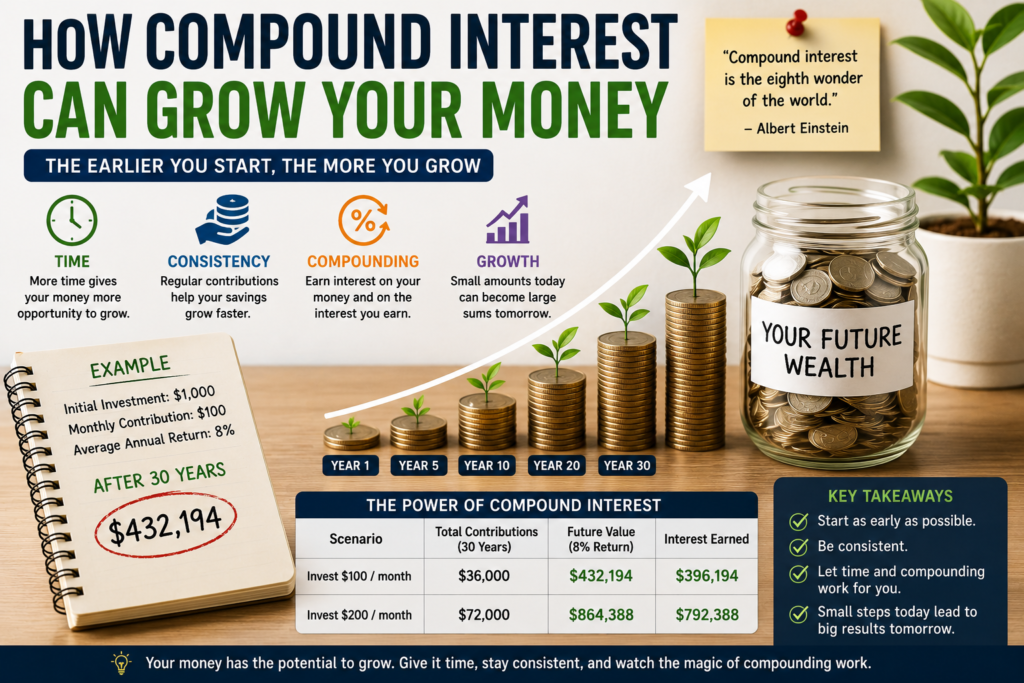
Compound interest is one of the most important concepts in personal finance because it allows money to potentially grow not only from the original amount saved or invested, but also from the interest or returns accumulated over time. Understanding how compound interest works can help you make better decisions about saving, investing, and long-term financial planning.
Unlike simple interest, where interest is calculated only on the original principal, compound interest allows previously earned interest to become part of the amount on which future interest is calculated. Over many years, this can create a significant difference in the value of your money.
Whether you are building an emergency fund, saving for a major financial goal, or investing for the long term, understanding compound growth can help you appreciate why starting early and contributing consistently can matter.
1. What Is Compound Interest and How Does It Work?
Compound interest means earning interest on your original principal as well as on accumulated interest.
For example, suppose you place $1,000 into an account that earns 5% annually and the interest compounds once per year.
After the first year:
$1,000 + $50 = $1,050
During the second year, the 5% interest is calculated on $1,050 rather than the original $1,000.
That produces:
$1,050 + $52.50 = $1,102.50
The additional $2.50 is interest earned on the interest from the first year.
This process continues as long as the money remains in the account and earns interest.
The Consumer Financial Protection Bureau explains that compound interest allows people to earn interest on money they have saved as well as on the interest earned along the way. CFPB: How does compound interest work?
A basic compound interest formula is:
A = P(1 + r/n)^(nt)
Where:
- A = final amount
- P = initial principal
- r = annual interest rate expressed as a decimal
- n = number of compounding periods per year
- t = number of years
For example, if you start with $1,000, earn 5% annually, and compound once per year for 10 years, the balance would grow to approximately $1,628.89 if the rate remained constant and no additional money was added.
The important point is that time allows the compounding process to repeat again and again.
Compound Interest vs. Simple Interest
Simple interest and compound interest work differently.
With simple interest, the interest calculation generally remains based on the original principal. With compound interest, accumulated interest can become part of the amount generating future interest.
This creates a compounding effect.
For personal finance, understanding this difference is especially useful when comparing savings products, loans, credit cards, and long-term investments. Compounding can work in your favor when you are earning returns, but it can also increase the cost of debt when interest compounds against you.
This is one reason why responsible money management is important. Before focusing heavily on growing your money, make sure you understand your existing expenses, debts, and financial obligations.
A good starting point is creating a realistic monthly budget so you know how much money is actually available for saving or investing.
2. Why Time, Regular Contributions, and Compounding Frequency Matter
One of the biggest advantages of compound growth is the effect of time.
If two people save the same amount of money but one starts significantly earlier, the earlier saver may have more time for interest and returns to compound.
This does not mean that investment returns are guaranteed. Actual investment performance varies, and investments can lose value. However, the mathematical principle of compounding remains important when understanding long-term growth.
Investor.gov explains that compound growth occurs when you earn a return on money you invest and also on the returns that money earns. Its educational material emphasizes the relationship between regular contributions, time, and long-term growth. Investor.gov: Introduction to Investing
The Impact of Starting Early
Consider two hypothetical savers.
Saver A starts putting money aside at age 25.
Saver B starts at age 35.
Even if both eventually contribute similar amounts, Saver A has an additional decade for potential growth to compound.
This is why starting with a small amount can sometimes be more practical than waiting until you have a large amount available.
For people with limited income, the first priority should be covering essential expenses and building financial stability. Once your basic financial needs are under control, even small and consistent contributions can become part of a long-term savings strategy.
Your emergency fund should generally be considered separately from money intended for long-term investments because unexpected expenses can require quick access to cash.
Why Regular Contributions Matter
Compound growth can become more powerful when you continue adding money to the principal.
For example, instead of depositing $1,000 once and never adding anything else, you could make regular monthly contributions. Each new contribution can potentially participate in future growth.
The combination of:
- Initial savings
- Regular contributions
- Time
- Compounding
- A consistent financial plan
can create a stronger long-term growth strategy.
Investor.gov also provides a compound interest calculator that allows users to experiment with an initial investment, monthly contributions, estimated interest rate, time period, and compounding frequency. Investor.gov Compound Interest Calculator
Compounding Frequency
Interest may compound at different frequencies depending on the financial product.
Common examples include:
- Annually
- Semi-annually
- Quarterly
- Monthly
- Daily
More frequent compounding can increase the effective growth compared with less frequent compounding when other assumptions remain the same. However, the actual terms, fees, rates, and conditions of a financial product should always be reviewed before making a decision.
Do not focus only on the advertised interest rate. Look at the complete product terms and understand whether the rate is fixed, variable, promotional, or subject to other conditions.
3. How to Use Compound Interest in a Long-Term Financial Plan
Compound interest becomes most useful when it is connected to a broader financial plan rather than treated as a shortcut to getting rich.
Start by identifying your financial goals.
Your goals might include:
- Building emergency savings
- Buying a home
- Funding education
- Preparing for retirement
- Building long-term savings
- Creating financial independence
- Growing business capital
Once you have established your goals, determine how much you can realistically save or invest on a regular basis.
If your income is limited, do not assume you need to make large contributions immediately. A sustainable contribution that fits your budget may be more practical than an unrealistic target that causes you to fall behind on essential expenses.
Your overall approach should fit into your smart financial planning strategy and should be reviewed regularly as your income, expenses, and goals change.
Reduce Expenses and Increase Your Available Savings
One way to increase the amount available for long-term growth is to reduce unnecessary spending.
Review your recurring expenses and identify services, purchases, or subscriptions that provide little value. Even modest monthly savings can become useful when redirected toward financial goals.
For example, reducing expenses by $50 per month creates $600 of additional annual cash flow. If that money is consistently saved or invested, it can potentially participate in compound growth over many years.
This does not mean eliminating every enjoyable expense. The goal is to spend intentionally and direct more of your money toward priorities that matter to you.
Understand the Difference Between Saving and Investing
Saving and investing are not exactly the same.
Savings accounts and similar products can be useful for short-term goals and emergency reserves. Investments such as stocks, bonds, and funds can offer potential long-term growth but also involve risk.
Investor.gov notes that investments involve market fluctuations and that there is no guaranteed rate of return for investing. Therefore, compound growth examples should be treated as illustrations rather than promises of future results.
Before investing, consider factors such as:
- Your financial goals
- Time horizon
- Risk tolerance
- Liquidity needs
- Fees
- Diversification
- Tax considerations
You should also avoid financial opportunities that promise unusually high returns with little or no risk.
Compound Interest Can Work Against You
Compound interest is not always beneficial.
It can also increase the cost of debt.
Credit card balances and certain loans can become more expensive when interest accumulates over time. If you continuously carry high-interest debt, the interest charges may work against your financial goals.
For this reason, improving your financial position may involve both growing savings and reducing expensive debt.
A balanced strategy could include:
- Creating a realistic budget.
- Covering essential expenses.
- Building emergency savings.
- Paying required debt obligations.
- Addressing expensive debt strategically.
- Saving consistently.
- Investing according to your goals and risk tolerance.
The FDIC’s financial education resources also explain how compound interest works and how money deposited in interest-bearing accounts can grow over time. FDIC: Compound Interest Guide
Conclusion
Compound interest can be a powerful part of long-term financial planning because it allows previously earned interest or investment returns to participate in future growth. The biggest factors are generally time, consistency, contribution size, interest or return rate, and compounding frequency.
However, compound interest is not a guarantee of wealth. Real financial products have different rates, fees, risks, taxes, and conditions, while investments can lose value.
The most practical approach is to start with your actual financial situation. Build a manageable budget, establish financial stability, save consistently, and understand the difference between short-term savings and long-term investing.
Even small contributions can become more meaningful when they are given enough time to potentially compound. The earlier you understand the process and build good financial habits, the better prepared you can be to make informed long-term money decisions.