
Small businesses are entering a period where technology, customer expectations, digital competition, and changing business models are creating new opportunities as well as new challenges. Entrepreneurs who understand emerging trends early can make better decisions about marketing, technology, operations, customer service, and growth.
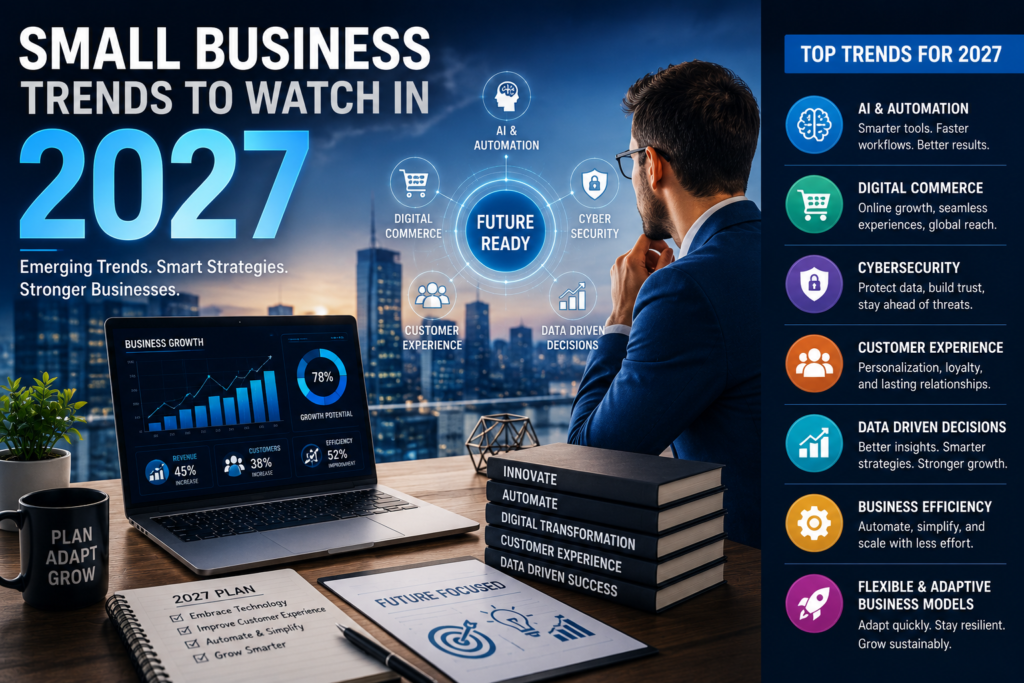
The small business landscape in 2027 is likely to be shaped by artificial intelligence, automation, digital commerce, stronger cybersecurity requirements, personalized customer experiences, and more efficient business operations. These trends do not mean every small business needs to adopt every new technology. Instead, business owners should identify the changes most relevant to their customers and industry and gradually adapt their strategies.
Understanding future trends can also help entrepreneurs avoid falling behind competitors. A business that continuously improves its digital presence, customer experience, and internal processes can be better prepared for changing market conditions.
1. AI and Automation Will Become More Accessible to Small Businesses
Artificial intelligence is likely to remain one of the most important small business trends in 2027. AI tools are becoming easier to use and increasingly available through everyday business software. Small companies can use AI for content creation, customer communication, scheduling, marketing, data analysis, productivity, and other repetitive activities.
Microsoft’s current guidance on the future of AI for small businesses highlights applications such as scheduling, marketing, inventory management, customer communication, generative AI, conversational tools, and low-code automation.
For a small business, the most practical approach may be to start with one specific problem instead of trying to introduce AI across the entire organization.
For example, a company could use AI to draft routine emails, summarize customer feedback, create initial marketing ideas, analyze sales information, or answer common customer questions. Employees can then review the output and handle tasks that require human judgment.
AI can also help businesses improve productivity. When repetitive administrative work is reduced, employees may have more time for customer relationships, sales, product development, and strategic planning.
However, businesses should not assume that every AI tool will automatically improve performance. Owners should consider accuracy, privacy, security, cost, integration, and the amount of human oversight required before adopting a new system.
Businesses should also create clear internal rules for AI use. Employees need to understand what information can be entered into AI systems and what information should remain confidential.
Another important trend will be AI-powered personalization. Businesses can increasingly use customer information and behavior data to create more relevant recommendations, communications, and offers. Personalization can help small companies compete by creating experiences that feel more relevant to individual customers.
Digital transformation will also continue to influence small businesses. Cloud-based tools can help companies collaborate, manage documents, communicate with customers, and operate more efficiently without building large internal technology teams. Microsoft’s guidance on digital transformation highlights cloud platforms, AI-powered automation, collaboration, security, and streamlined workflows as important capabilities for small and medium-sized businesses.
Businesses should therefore evaluate technology based on practical outcomes. The objective is not to become a technology company. The objective is to use technology to save time, improve customer service, reduce errors, and make better decisions.
Small businesses should also continue strengthening their digital presence. A professional website, useful content, search visibility, and accurate business information can help customers discover a company online. Businesses can review How to Build an Online Presence for a Small Business for additional guidance on creating a stronger digital presence.
2. Digital Commerce, Customer Experience, and Flexible Business Models Will Grow
Another important trend for 2027 is the continued growth of digital commerce and online customer journeys. Customers increasingly expect businesses to provide convenient ways to discover products, compare options, communicate with companies, and make purchases.
The U.S. Small Business Administration has previously highlighted e-commerce, online marketing, AI, cybersecurity, and customer experience among important trends for small businesses. Its 2025 trends guidance also noted that e-commerce was expected to continue growing toward 2027.
Small businesses do not necessarily need to become large online retailers to benefit from digital commerce. Service businesses can use online booking, digital consultations, online payments, customer portals, and downloadable resources. Product businesses can use e-commerce websites, marketplaces, social commerce, and digital advertising to reach customers beyond their immediate geographic area.
Businesses should focus on making the customer journey simple.
A potential customer may discover a company through Google, visit its website, read reviews, check social media, compare competitors, and then contact the business. Every stage of this journey can influence whether the customer eventually makes a purchase.
A slow website, unclear pricing information, outdated business details, poor reviews, or difficult communication can cause customers to choose another company.
This makes customer experience an important competitive advantage for small businesses.
Small companies can often compete with larger organizations by offering more personal service, faster communication, specialized expertise, or a stronger understanding of a particular customer group. Businesses can explore How Small Businesses Can Compete With Larger Companies for strategies related to specialization, technology, customer relationships, and competitive positioning.
Another trend to watch is the growth of flexible and scalable business models. Businesses can increasingly combine employees, freelancers, software, automation, agencies, contractors, and digital platforms to build flexible operations.
This can allow a small business to increase capacity without immediately creating a large fixed-cost structure.
For example, a company might use full-time employees for core responsibilities while outsourcing specialized accounting, design, development, legal, or marketing tasks when necessary.
Subscription models and recurring revenue may also continue to attract businesses because they can provide more predictable income. However, these models only work when customers receive continuing value and the company can maintain service quality.
Businesses should also focus on retention. Acquiring a new customer can require significant time and marketing investment, so maintaining strong relationships with existing customers can become increasingly important.
Customer loyalty programs, personalized communication, useful content, excellent service, and reliable products can encourage repeat business.
Another major trend will be the integration of different digital channels. Businesses may connect their websites, customer relationship systems, email marketing, social media, payment platforms, analytics, and customer support tools so that information can move more efficiently between systems.
This can reduce manual work and provide businesses with a clearer view of customer behavior.
Entrepreneurs should avoid adopting technology simply because competitors are using it. Every investment should have a clear business purpose.
The question should be:
“Will this technology help us serve customers better, operate more efficiently, reduce costs, or create new revenue?”
If the answer is unclear, the business may need to investigate the opportunity further before investing.
3. Cybersecurity, Efficiency, and Data-Driven Decisions Will Become More Important
As small businesses become more dependent on digital systems, cybersecurity will become increasingly important in 2027.
A company may rely on websites, cloud storage, payment systems, customer databases, email accounts, social media accounts, and online software. If these systems are poorly protected, a security incident can interrupt operations and damage customer trust.
Microsoft’s 2026 security guidance notes that AI is changing both business operations and the threat landscape, while growing businesses face increasing risks from targeted attacks and AI-assisted threats.
Small businesses should therefore treat cybersecurity as a business responsibility rather than only an IT issue.
Basic measures can include strong passwords, multi-factor authentication, software updates, secure backups, employee training, access controls, and careful handling of customer information.
Businesses should also understand which employees and systems have access to sensitive information. Access should be limited to what people actually need for their roles.
The rise of AI also creates new security considerations. AI systems may process business information, customer communications, or internal documents, so companies should establish appropriate policies before employees begin using AI tools extensively.
Efficiency will be another major focus in 2027. Small businesses will continue looking for ways to do more with limited resources.
Automation, process documentation, cloud software, analytics, and improved employee training can all help reduce wasted time.
Entrepreneurs should regularly review business processes and ask whether a task can be simplified, automated, delegated, or removed entirely.
This is particularly important as a company grows. A process that works for ten customers may become inefficient when the company has hundreds or thousands of customers.
Businesses can review How to Build a Scalable Business Model for strategies involving repeatable processes, automation, technology, financial planning, and controlled growth.
Data-driven decision-making will also become increasingly important. Businesses have access to more information than ever before, including website analytics, customer behavior, sales data, advertising performance, customer reviews, and search performance.
Instead of relying entirely on assumptions, entrepreneurs can use this information to identify which products, services, marketing channels, and customer segments are producing the strongest results.
For example, if a business discovers that one type of content consistently generates qualified leads, it can create more content around related topics. If a marketing channel produces traffic but very few customers, the business may need to change its strategy or allocate resources elsewhere.
Businesses can also use data to monitor costs, customer retention, conversion rates, revenue, and productivity.
This approach supports more disciplined growth.
Entrepreneurs should also continue improving their overall business strategy. Business Growth Strategies in 2026 provides broader ideas around technology, customer-focused growth, innovation, and business expansion.
The key lesson for 2027 is that small businesses do not need to adopt every emerging trend. They need to understand which trends are relevant to their customers and business model.
AI may be valuable for one company but less important for another. E-commerce may be essential for a retail business while online booking may be more important for a service company. Cybersecurity is relevant to virtually every digitally connected business, but the specific security requirements will vary.
The most successful small businesses are likely to be those that remain adaptable. They will test new tools, measure results, listen to customers, improve their processes, and invest in technologies that create measurable value.
Conclusion
Small business trends in 2027 will likely be shaped by AI, automation, digital commerce, customer experience, cybersecurity, flexible business models, and data-driven decision-making.
Entrepreneurs should not treat these trends as reasons to change everything at once. Instead, they should identify the opportunities and risks that are most relevant to their business and develop a practical plan for adapting.
Start with the fundamentals: understand your customers, maintain a strong digital presence, protect business data, improve operational efficiency, and measure performance.
Then experiment with emerging technologies where they can provide a clear benefit.
The future of small business will not simply belong to companies that use the newest technology. It will belong to businesses that use technology intelligently while maintaining strong customer relationships, efficient operations, and a clear understanding of the market.
By preparing early and adapting gradually, small businesses can enter 2027 with stronger systems, better customer experiences, and a more resilient foundation for long-term growth.