

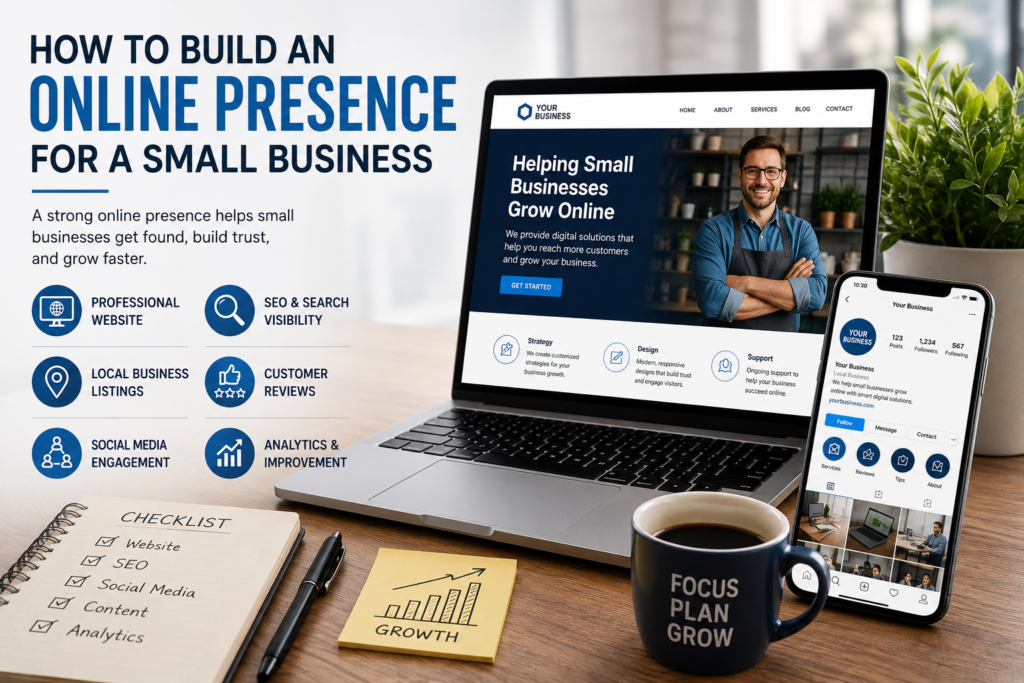
In today’s digital environment, customers often search online before deciding which business to contact, visit, or purchase from. For a small business, having a strong online presence can make it easier for potential customers to discover the company, understand its products or services, and build confidence in the brand. A business that is difficult to find online may lose customers to competitors that provide clearer information and a better digital experience.
Building an online presence for a small business does not necessarily require a large marketing budget. A professional website, accurate business listings, useful content, search engine optimization, social media, customer reviews, and regular performance tracking can create a strong foundation. The important thing is to focus on the channels that are most useful for the target audience and maintain them consistently.
1. Build a Strong Website and Digital Foundation
A professional website should be the central part of a small business’s digital presence. While social media profiles and business directories can help customers discover a company, the website provides a place where the business controls its information, branding, services, content, and customer experience.
A small business website does not have to contain dozens of pages. It should clearly explain what the business offers, who it serves, why customers should choose it, and how visitors can get in touch. Essential pages may include a homepage, About page, services or products pages, Contact page, and useful informational content.
Before building the website, businesses should understand the people they are trying to reach. Learning How to Identify Your Target Market can help businesses create website content and offers that are more relevant to potential customers.
The website should also be mobile-friendly. Many people use smartphones to search for products, services, local companies, and information. If a website is difficult to read or navigate on a mobile device, visitors may leave before contacting the business.
Website speed is another important consideration. Large images, unnecessary plugins, complicated designs, and poorly optimized code can make pages slower. Compressing images, using reliable hosting, minimizing unnecessary elements, and keeping the website technically clean can improve the overall user experience.
Search engine optimization should also be part of the website foundation. Businesses should create pages around topics that their potential customers actually search for. Instead of trying to rank for extremely broad terms, a small business can often find better opportunities by targeting specific and relevant search queries.
For example, a local accounting company could create content around accounting services for small businesses, bookkeeping questions, business tax preparation, or accounting services in its target location.
Business owners can use Google Search Central to learn about Google’s search documentation and recommended practices for making websites easier for search engines to understand.
Clear calls to action are also important. Depending on the business model, these could include “Contact Us,” “Request a Quote,” “Book an Appointment,” “Call Now,” or “Shop Now.” Visitors should quickly understand what action they can take after reading a page.
The website should also reflect the business’s overall competitive position. Small companies can benefit from understanding How Small Businesses Can Compete With Larger Companies and using their online presence to highlight areas where they can provide a more focused or personalized experience.
2. Strengthen Search, Local Listings, Content, and Social Media
After creating a website, the next step is making sure potential customers can find it. Search engines, local business listings, social media platforms, online reviews, and useful content can all contribute to a stronger digital presence.
For local businesses, a Google Business Profile can be particularly valuable. It can display information such as the business name, address, phone number, opening hours, website, photos, services, and customer reviews. Keeping this information accurate and updated helps customers understand how to contact or visit the business.
Businesses should also keep their information consistent across online platforms. The business name, phone number, website address, location, and other important details should be accurate wherever the company has a profile or listing.
Local SEO can help businesses appear for searches with geographic intent. For example, a customer might search for “plumber near me,” “digital marketing agency in Lahore,” or “accountant for small businesses.” Businesses should focus on locations they genuinely serve instead of creating pages for locations where they have no presence.
Customer reviews are another important part of online visibility and reputation. Businesses can encourage satisfied customers to leave honest reviews on relevant platforms. Responding professionally to reviews can also show that the business pays attention to customer experiences.
Content marketing can strengthen SEO and provide useful information to potential customers. A small business can publish articles that answer frequently asked questions, explain services, compare solutions, provide practical tips, or discuss problems faced by its target audience.
For example, a digital marketing company could publish articles about keyword research, SEO, content marketing, local search, and online advertising. A financial company could create educational content about budgeting and business cash flow while avoiding unsupported financial promises.
Social media can support these efforts by distributing useful content and creating opportunities for direct interaction with customers. However, businesses do not need to maintain accounts on every platform. It is generally more practical to choose platforms where the target audience is active and publish consistently.
A business can share blog posts, product updates, customer stories, educational tips, company news, behind-the-scenes content, and answers to common questions. Social media should provide value rather than becoming a stream of promotional messages.
Email marketing can also support an online presence by helping businesses stay connected with existing customers and prospects. Newsletters can contain useful articles, company updates, product information, educational content, or relevant offers.
Businesses with limited resources should start with the channels most likely to generate results. A company can also review How to Start a Small Business With Limited Money for broader guidance on starting a business while managing limited resources.
External platforms should support the website rather than replace it. Social media accounts can change, algorithms can shift, and individual platforms can become less effective over time. A website and email list give businesses more control over their long-term digital presence.
3. Build Trust, Measure Performance, and Improve Over Time
A successful online presence is built through consistency and continuous improvement. Creating a website and social media profiles is only the beginning. Businesses need to maintain their information, publish useful content, monitor customer feedback, and measure whether their digital activities are producing meaningful results.
Trust should be a major priority. Businesses should provide accurate information about their products, services, pricing where appropriate, experience, and contact details. Websites should make it easy for customers to understand who operates the business and how they can ask questions.
Professional branding can also improve the customer experience. Consistent logos, typography, imagery, messaging, and design across the website and social profiles can make the business easier to recognize.
Businesses should also pay attention to website security and privacy. Websites should use HTTPS, strong administrator passwords, updated software, secure hosting, and appropriate protection for customer information. If a website collects personal information, the business should clearly explain how that information is handled.
Another important step is measuring performance. Tools such as Google Analytics and Google Search Console can help businesses understand how visitors discover their websites and which pages receive attention.
Useful metrics may include organic impressions, clicks, search queries, website visitors, engagement, contact form submissions, phone calls, bookings, purchases, and other conversions that matter to the business.
Search performance can reveal opportunities for improvement. For example, a page might receive many impressions but few clicks. Improving the title and meta description could potentially make the result more attractive to searchers. Another page may receive traffic but generate few inquiries, suggesting that the content or call to action needs improvement.
Businesses should also monitor which topics generate the most interest. If several articles around a particular subject begin receiving impressions, the business can create additional useful content around related questions and strengthen internal links between those pages.
For broader planning, businesses can also review Business Growth Strategies in 2026 to consider how digital activities can support wider business growth.
When using external resources for SEO and digital marketing, businesses should prioritize reliable and authoritative information. Google Business Profile provides businesses with information about managing their presence across Google, while Google Search Console helps website owners understand search performance and indexing.
The most effective online presence is not necessarily the one with the largest number of social followers or the most published articles. It is the one that consistently helps the right customers discover the business, understand its value, trust the company, and take the next step.
For a small business, the best approach is to build the foundation first. Create a professional website, establish accurate business listings, optimize important pages for search, publish useful content, collect genuine customer reviews, use relevant social media platforms, and monitor performance.
Over time, the business can use its data to identify what works and invest more resources in those areas. By combining a strong website with SEO, local visibility, content, social media, reputation management, and analytics, a small business can create a sustainable online presence that supports customer acquisition and long-term growth.