
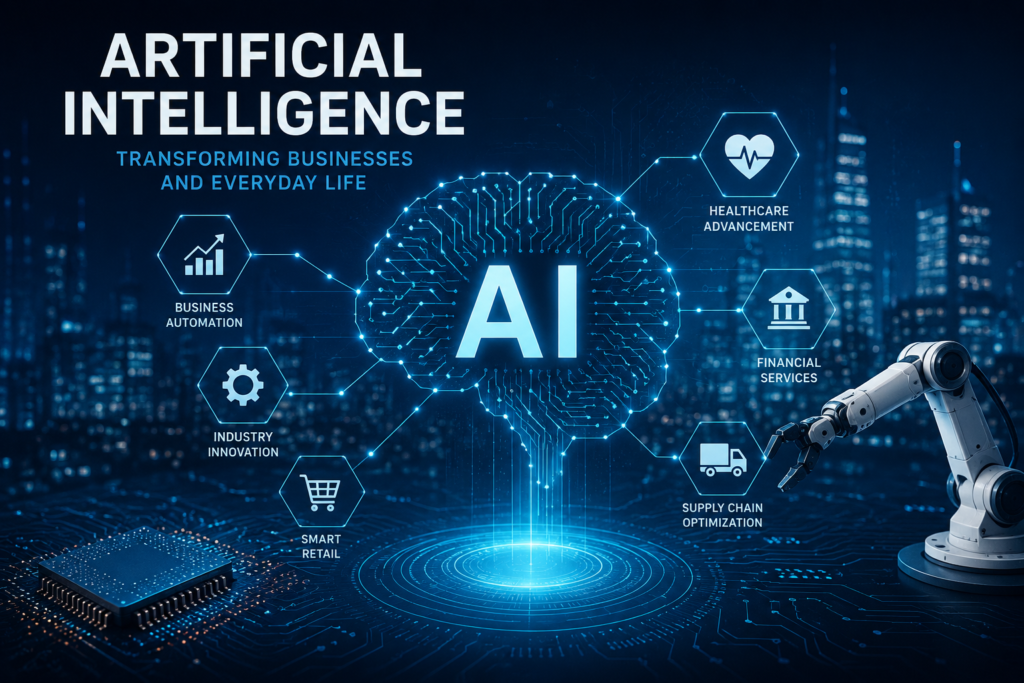
Artificial Intelligence (AI) has rapidly evolved from a futuristic concept into one of the most influential technologies shaping modern society. Today, AI powers virtual assistants, recommends products while shopping online, detects fraud in banking systems, improves medical diagnoses, and even helps businesses make better decisions through data analysis.
As organizations continue investing in AI technologies, businesses of all sizes are discovering new opportunities to increase efficiency, reduce operational costs, and provide better customer experiences. At the same time, consumers benefit from faster services, personalized recommendations, and smarter digital solutions that simplify everyday life.
Understanding how Artificial Intelligence works and its impact on different industries is becoming increasingly important for business owners, professionals, and technology enthusiasts.
What Is Artificial Intelligence?
Artificial Intelligence refers to computer systems designed to perform tasks that normally require human intelligence. These tasks include learning from experience, recognizing patterns, solving problems, understanding language, and making decisions.
Unlike traditional software that follows fixed instructions, AI systems improve their performance by analyzing large amounts of data and identifying relationships that humans may overlook.
Common examples of AI include:
- Voice assistants like Google Assistant and Siri
- Personalized recommendations on Netflix and YouTube
- Email spam filters
- AI-powered chatbots
- Facial recognition technology
- Online translation services
These technologies have become an essential part of daily life, often operating quietly in the background without users realizing how much AI is involved.
According to Google AI, machine learning enables computers to improve their performance by learning from data instead of relying entirely on manually programmed instructions.
Artificial Intelligence in Business
Businesses are among the biggest beneficiaries of Artificial Intelligence.
Companies use AI to automate repetitive tasks, analyze customer behavior, forecast market trends, improve marketing campaigns, and enhance customer support.
Some of the most common business applications include:
- Customer service chatbots
- Sales forecasting
- Marketing automation
- Inventory management
- Fraud detection
- Business intelligence
Instead of replacing employees, AI helps teams become more productive by handling repetitive work, allowing professionals to focus on creativity, innovation, and strategic planning.
Many organizations also rely on AI-powered analytics to identify growth opportunities and improve decision-making based on real-time business data.
AI Is Revolutionizing Healthcare
Healthcare has experienced remarkable improvements through Artificial Intelligence.
Doctors and hospitals increasingly rely on AI systems to analyze medical images, predict diseases, monitor patients, and recommend treatment options.
Artificial Intelligence helps healthcare professionals by:
- Detecting diseases earlier
- Improving medical imaging
- Monitoring patient conditions
- Supporting faster diagnosis
- Reducing administrative workloads
According to the World Health Organization (WHO), Artificial Intelligence has the potential to strengthen healthcare systems when implemented responsibly and ethically.
Rather than replacing healthcare professionals, AI supports doctors by providing valuable insights that improve patient care.
AI in Education
Education is becoming more personalized thanks to Artificial Intelligence.
Students can now learn at their own pace using AI-powered educational platforms that adjust lessons based on individual performance.
Educational institutions use AI for:
- Personalized learning
- Automated grading
- Intelligent tutoring systems
- Language learning
- Student performance analysis
Teachers also benefit because AI reduces administrative work, giving them more time to focus on classroom instruction and student development.
Artificial Intelligence in Finance
The financial industry relies heavily on Artificial Intelligence to improve security and efficiency.
Banks use AI to monitor millions of transactions every day and quickly detect suspicious activities that may indicate fraud.
Other financial applications include:
- Credit scoring
- Investment analysis
- Risk management
- Customer support
- Automated financial advice
AI allows financial institutions to process enormous amounts of information much faster than traditional methods while improving accuracy and customer service.
Improving Customer Experience
Today’s customers expect quick responses and personalized experiences.
Artificial Intelligence helps businesses deliver exactly that.
AI improves customer experience by:
- Providing 24/7 customer support
- Recommending products
- Personalizing shopping experiences
- Reducing response times
- Improving customer satisfaction
Businesses that combine AI technology with human customer service often create stronger relationships with their customers.
According to Microsoft AI, intelligent automation enables organizations to improve both efficiency and customer satisfaction.
Challenges of Artificial Intelligence
Despite its advantages, Artificial Intelligence also presents important challenges.
Some of the biggest concerns include:
- Data privacy
- Cybersecurity risks
- Algorithm bias
- Ethical AI development
- Workforce adaptation
Businesses must ensure AI systems remain transparent, secure, and aligned with ethical standards.
Responsible AI development requires continuous monitoring and human oversight.
The Future of Artificial Intelligence
Artificial Intelligence continues advancing at an incredible pace.
Future developments may include:
- Smarter healthcare systems
- More advanced robotics
- Autonomous transportation
- Intelligent cybersecurity
- Personalized education
- Scientific research acceleration
Rather than replacing humans entirely, AI will likely become a powerful partner that supports professionals across every industry.
Businesses that understand AI today will be better prepared for tomorrow’s digital economy.
Conclusion
Artificial Intelligence is transforming nearly every aspect of modern life. From business operations and healthcare to education, finance, and customer service, AI continues creating opportunities for innovation and growth.
Organizations that adopt Artificial Intelligence responsibly while maintaining a customer-focused approach will be better positioned to compete in the digital age.
Instead of fearing AI, businesses should learn how to use it strategically to improve productivity, deliver better customer experiences, and support long-term success.
Technology will continue evolving, but organizations that embrace continuous learning and innovation will remain ahead of the competition.
Frequently Asked Questions
What is Artificial Intelligence?
Artificial Intelligence is technology that enables computers to perform tasks that normally require human intelligence, including learning, reasoning, and decision-making.
How is AI used in business?
Businesses use AI for automation, customer support, marketing, fraud detection, forecasting, and business analytics.
Will Artificial Intelligence replace human jobs?
AI is expected to automate repetitive tasks while creating new opportunities that require creativity, leadership, and critical thinking.
Which industries benefit most from AI?
Healthcare, finance, education, manufacturing, retail, marketing, and transportation are among the industries benefiting significantly from AI.
Is Artificial Intelligence safe?
When developed responsibly with proper security measures, privacy protection, and ethical standards, AI can provide tremendous benefits for businesses and society.