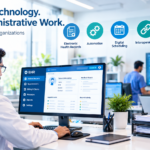

Healthcare organizations manage much more than appointments and patient care. Every healthcare system also depends on administrative processes such as scheduling, registration, documentation, billing, insurance communication, referrals, claims, and record management.
When too many of these activities depend on manual work, employees may spend significant time entering information, checking documents, communicating between systems, and following up on routine tasks.
Healthcare technology can help organizations make these processes more organized and efficient. Electronic health records, digital forms, automation, interoperability, patient portals, and electronic administrative transactions can reduce some repetitive work and improve the flow of information.
The purpose is not to replace healthcare professionals. Instead, technology can handle appropriate repetitive processes while staff focus on tasks that require human judgment, communication, and oversight.
What Is Administrative Work in Healthcare?
Administrative work includes many of the non-clinical activities required to operate hospitals, clinics, medical practices, laboratories, and other healthcare organizations.
Common examples include:
- Appointment scheduling
- Patient registration
- Insurance verification
- Billing and claims
- Documentation
- Referral management
- Prior authorization
- Data entry
- Record management
- Administrative communication
- Reporting and workflow coordination
These activities are essential, but some involve repetitive steps that can potentially be streamlined through digital systems.
The Centers for Medicare & Medicaid Services (CMS) describes administrative simplification as an effort to streamline healthcare transactions and establish standards for electronic health information.
1. Electronic Health Records Can Reduce Manual Record Management
Electronic health records (EHRs) allow healthcare organizations to manage patient information digitally.
Instead of relying primarily on paper files, authorized users can access information such as medical history, test results, prescriptions, insurance information, and other records through electronic systems.
The Office of the National Coordinator for Health Information Technology (ONC) notes that EHRs can reduce administrative burden, improve workflow efficiency, and support better coordination among healthcare professionals.
Digital records can also reduce certain repetitive activities, such as locating physical documents or manually transferring information between paper-based processes.
However, an EHR does not automatically make every process efficient. Poor system design, complicated workflows, or limited integration can create additional work. The technology must therefore be configured around practical organizational needs.
For a broader overview of how digital technologies are changing healthcare, readers can also explore [The Future of Healthcare: How Technology Is Improving Patient Care]. The Future of Healthcare: How Technology Is Improving Patient Care
2. Automation Can Handle Repetitive Tasks
Automation is one of the most practical applications of healthcare technology.
A healthcare organization may use automated workflows for tasks such as:
- Appointment reminders
- Routine notifications
- Document routing
- Task assignments
- Administrative status updates
- Data transfers
- Basic workflow alerts
- Repetitive reporting
For example, instead of an employee manually sending the same appointment reminder to every patient, a scheduling platform may send reminders automatically according to predefined rules.
Automation can therefore reduce repetitive workload without removing the need for human oversight.
The most appropriate tasks for automation are usually predictable, repetitive processes with clearly defined steps.
3. Digital Scheduling Can Simplify Appointment Management
Appointment scheduling can require significant communication between patients, staff, and healthcare providers.
Digital scheduling systems can allow patients to view available appointments, submit requests, receive reminders, and manage certain scheduling activities online.
For administrative teams, this can reduce some routine phone calls and manual scheduling tasks.
Digital scheduling may also improve consistency because appointment information can be generated and updated within a centralized system.
However, healthcare organizations still need alternative communication methods for people who cannot or do not want to use digital services.
4. Electronic Transactions Can Reduce Administrative Friction
Healthcare organizations exchange large amounts of administrative information involving claims, payments, referrals, eligibility, and other transactions.
Standardized electronic transactions can reduce some of the manual work associated with sending, receiving, and processing this information.
CMS’s Administrative Simplification program establishes standards for electronic healthcare transactions, with the goal of reducing administrative burden and improving efficiency.
As healthcare systems become increasingly digital, consistent transaction standards can help different participants handle information more efficiently.
5. Interoperability Helps Healthcare Systems Exchange Information
One of the challenges of healthcare technology is that organizations may rely on multiple software systems.
When systems do not communicate effectively, employees may have to enter the same information more than once or move files manually between platforms.
Interoperability refers to the ability of different systems to exchange and appropriately use health information.
ONC describes interoperability as an important component of modern healthcare and supports standards and initiatives designed to improve the exchange of electronic health information.
Better interoperability can reduce some administrative steps by allowing information to move between connected systems more efficiently.
This is especially important as healthcare organizations increasingly depend on EHRs, digital applications, payer systems, and other technology platforms.
6. Electronic Prior Authorization Can Improve Administrative Workflows
Prior authorization is another administrative process where healthcare technology is being used to improve information exchange.
CMS has established interoperability and prior-authorization requirements for certain impacted payers and continues to develop policies around electronic prior authorization. CMS also proposed additional changes in 2026 relating to electronic prior authorization for drugs.
Electronic workflows can help reduce some manual steps by allowing information to be exchanged digitally instead of relying entirely on disconnected processes.
The exact requirements and implementation methods can vary by program and organization, so healthcare providers and organizations should rely on current official requirements applicable to their situation.
7. Digital Forms Can Reduce Duplicate Data Entry
Paper forms often require several steps.
A patient may complete a form, staff may review it, and another employee may then enter the same information into a computer system.
Digital forms can capture information electronically from the beginning.
Examples include:
- Patient registration
- Contact details
- Insurance information
- Consent forms
- Appointment information
- Referral information
- Administrative questionnaires
When appropriately integrated, digital forms can route information into the correct workflow and reduce some duplicate data-entry work.
The quality of the form still matters. A poorly designed digital form can create frustration rather than efficiency.
8. Patient Portals Can Reduce Routine Administrative Communication
Patient portals can provide digital access to selected services and information.
Depending on the healthcare organization, a portal may support:
- Appointment requests
- Secure messages
- Forms
- Health information access
- Billing information
- Administrative updates
- Communication with healthcare teams
Moving appropriate routine interactions into a secure digital environment may reduce some administrative communication.
Patient portals should complement rather than completely replace traditional communication methods, particularly for individuals who face digital-access barriers.
9. Artificial Intelligence May Support Administrative Work
Artificial intelligence is also being explored for healthcare administration.
Potential administrative applications include:
- Organizing information
- Classifying documents
- Summarizing administrative records
- Routing requests
- Supporting scheduling workflows
- Extracting information from documents
- Assisting with repetitive communication tasks
Administrative AI applications should be distinguished from clinical applications. A system used to organize information is different from a system intended to support clinical decision-making.
Organizations should also consider privacy, security, accuracy, human oversight, and appropriate governance when introducing AI into healthcare workflows.
The broader use of AI across healthcare is discussed in [Artificial Intelligence: How AI Is Transforming Businesses and Everyday Life]. Artificial Intelligence: How AI Is Transforming Businesses and Everyday Life
10. Healthcare Technology Can Improve Administrative Communication
Healthcare organizations communicate with many different groups, including patients, healthcare professionals, insurers, laboratories, pharmacies, and internal departments.
Digital communication systems can help organize requests and make it easier to track routine administrative activities.
Automated notifications can also provide updates about appointments, documents, requests, and workflow status.
Better communication does not necessarily mean communicating more often. The goal is to make the right information available to the right people at the appropriate stage of a process.
11. Better Data Management Can Support Administrative Efficiency
Healthcare organizations generate large amounts of information.
Without good data management, staff may spend time searching for records, correcting duplicate information, or reconciling inconsistent data.
Technology can help organizations organize information through centralized databases, structured records, dashboards, and workflow systems.
Analytics tools can also help administrators understand operational patterns, such as appointment volumes, workflow delays, or administrative bottlenecks.
The value of these tools depends on the quality of the underlying data and how accurately the organization interprets the information.
12. Security Must Remain Part of Digital Healthcare
Reducing administrative workload should never mean reducing attention to information security.
Healthcare organizations manage sensitive information, including electronic protected health information (ePHI).
The U.S. Department of Health and Human Services explains that the HIPAA Security Rule requires regulated entities to use appropriate administrative, physical, and technical safeguards for protecting electronic protected health information.
This means healthcare technology should be implemented with appropriate access controls, authentication, security procedures, and safeguards.
For more general information about technology and preventive healthcare, readers can explore [Preventive Healthcare: Why It Matters and How It Can Improve Your Quality of Life]. Preventive Healthcare: Why It Matters and How It Can Improve Your Quality of Life
Benefits of Reducing Administrative Work
When technology is implemented effectively, reducing unnecessary administrative work may provide several operational benefits.
More efficient workflows
Employees may spend less time on repetitive manual processes.
Better information access
Digital systems can make relevant information easier for authorized users to locate and manage.
Less duplicate work
Integrated systems can reduce the need to enter the same information repeatedly.
Better communication
Automated notifications and centralized workflows can make administrative processes easier to track.
More time for higher-value activities
Reducing repetitive tasks can allow staff to focus on responsibilities that require human judgment, communication, and attention.
These benefits are not automatic. They depend on the quality of the technology, implementation, training, system integration, and organizational processes.
Challenges of Using Healthcare Technology
Healthcare technology can create new challenges when implementation is not carefully managed.
Integration problems
A new system may create additional work when it does not communicate properly with existing platforms.
Training requirements
Staff need sufficient training to use new systems effectively.
Implementation costs
Technology may involve software, infrastructure, integration, maintenance, training, and support costs.
Data privacy and security
Sensitive healthcare information must be handled using appropriate security measures and organizational controls.
Workflow disruption
Introducing new technology can temporarily increase workload while employees adjust to new processes.
For this reason, healthcare organizations should evaluate technology according to the complete workflow rather than assuming that every new digital tool will automatically improve efficiency.
How Healthcare Organizations Can Approach Administrative Automation
A practical approach is to start with processes that are highly repetitive and time-consuming.
Organizations can:
- Identify administrative tasks that consume significant staff time.
- Measure the existing workflow.
- Look for duplicate data entry and unnecessary manual steps.
- Identify systems that need better integration.
- Select appropriate processes for digitization or automation.
- Train employees before and during implementation.
- Monitor workflow performance after implementation.
- Review whether the technology is actually reducing unnecessary work.
The goal should be measurable operational improvement rather than simply adding more software to the organization.
The Future of Healthcare Administrative Technology
Healthcare administration is likely to become increasingly connected and digital.
CMS continues to work on administrative simplification, interoperability, and electronic healthcare transactions, while ONC continues advancing health IT standards and interoperability initiatives.
Artificial intelligence, workflow automation, digital records, electronic transactions, and connected systems may increasingly work together to manage routine administrative processes.
At the same time, technology will continue to require human oversight. Healthcare organizations will need to balance efficiency with privacy, security, accessibility, accuracy, and responsible implementation.
Conclusion
Healthcare technology can help reduce administrative work by streamlining repetitive processes and improving the movement of information.
Electronic health records, automation, digital forms, patient portals, interoperability, electronic transactions, and other technologies can support more organized healthcare workflows.
However, technology is only one part of the solution. Successful implementation also depends on good processes, appropriate training, secure systems, reliable data, and human oversight.
The objective should not be to automate everything. The objective is to use technology where it can reduce unnecessary administrative effort while allowing healthcare professionals and support teams to focus on work that requires human judgment and interaction.
Sources and Further Reading
CMS — Administrative Simplification CMS Administrative Simplification
ONC — Interoperability ONC Interoperability
HHS — Summary of the HIPAA Security Rule HHS HIPAA Security Rule
Editorial Note: This article is for general informational and educational purposes only. It does not provide medical, legal, regulatory, or professional advice. Healthcare organizations should consult qualified professionals and applicable official requirements for decisions relating to their specific circumstances.