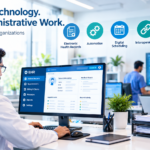

Healthcare organizations manage much more than patient appointments and clinical care. Behind every consultation, hospital visit, or medical service are numerous administrative tasks, including scheduling, registration, documentation, billing, insurance processing, communication, and record management. When these processes depend heavily on manual work, healthcare professionals and administrative staff can spend significant time handling repetitive tasks instead of focusing on higher-value responsibilities.
Modern healthcare technology is changing how these administrative activities are managed. Digital systems can help healthcare organizations organize information, automate routine processes, improve communication, and reduce unnecessary paperwork. When implemented carefully, technology can support both administrative teams and healthcare professionals while helping create smoother experiences for patients.
How Technology Reduces Repetitive Healthcare Tasks
One of the most important ways technology can reduce administrative work is by automating repetitive processes. Tasks that once required employees to enter information manually, check records, send reminders, or move documents between systems can increasingly be supported by digital tools.
Appointment Scheduling and Reminders
Appointment management is a major administrative responsibility for many healthcare organizations. Staff may need to answer calls, check availability, schedule appointments, reschedule visits, and send reminders.
Digital scheduling platforms can allow patients to view available appointment times and select a suitable option. Automated reminders can then be sent through email, text messages, or other communication channels.
This can reduce the number of routine scheduling interactions that staff need to handle manually. It may also make appointment information easier for patients to access.
Digital Registration and Information Collection
Traditional registration processes can involve paper forms and repeated data entry. Patients may provide similar information multiple times, while staff members may need to manually transfer information into different systems.
Digital registration tools can allow patients to enter information electronically before or during a healthcare visit. When systems are properly integrated, relevant information can move into the appropriate administrative or clinical workflow without unnecessary duplication.
This can save time and reduce the possibility of errors caused by repeated manual data entry.
Electronic Documentation
Documentation is another area where technology can support administrative efficiency. Electronic systems allow healthcare organizations to create, store, retrieve, and manage information digitally rather than relying primarily on paper records.
Electronic health record systems can make information easier to access across appropriate departments and can reduce the administrative burden associated with locating and maintaining physical documents.
However, digital documentation only provides these benefits when systems are properly designed, maintained, secured, and used by trained staff.
Automated Communication
Healthcare organizations communicate with patients about appointments, forms, follow-ups, billing information, and other administrative matters.
Automated communication systems can handle some routine messages without requiring staff to manually contact every patient. For example, a system may send an appointment reminder or notify a patient that a form needs to be completed.
This does not eliminate the need for human communication. Instead, it can allow staff to spend more time handling complex questions and situations that require personal attention.
How Digital Systems Improve Healthcare Administrative Workflows
Technology becomes particularly useful when different administrative processes can work together instead of operating as isolated systems. A healthcare organization may use separate platforms for appointments, patient records, billing, communication, and insurance-related processes. If these systems cannot exchange information effectively, staff may still have to perform manual work.
Improving healthcare interoperability can help systems exchange information more efficiently. Interoperable systems can reduce unnecessary duplication and make relevant information available to authorized users when and where it is needed.
Billing and Payment Administration
Billing can involve multiple steps, including collecting patient information, preparing claims, processing payments, and tracking outstanding balances.
Digital billing systems can organize these activities and reduce some repetitive administrative tasks. Automated notifications can also help communicate payment information to patients.
Technology can make billing workflows more organized, but healthcare organizations still need appropriate controls to protect financial and personal information.
Insurance and Authorization Processes
Insurance-related administrative work can consume substantial staff time. Healthcare workers may need to verify coverage, submit documentation, respond to requests, and monitor authorization status.
Electronic systems can help organize these processes and reduce some manual communication.
Electronic prior authorization is one area receiving increased attention. The Centers for Medicare & Medicaid Services has been working on electronic prior authorization and interoperability approaches intended to reduce manual processes and administrative burden.
Digital workflows can make it easier to track the status of administrative requests and identify tasks that require staff attention.
Centralized Information Management
Healthcare organizations generate large amounts of administrative information every day. Without an organized system, employees may need to search through multiple databases, documents, emails, and paper records.
Centralized digital platforms can provide authorized staff with a more organized way to access relevant information. This can reduce time spent searching for documents and can support more consistent administrative workflows.
The World Health Organization has emphasized the importance of integrated and interoperable digital health systems because fragmented systems can create additional administrative burdens.
Data Entry and Workflow Automation
Many administrative activities follow predictable steps. For example, information may be received, checked, entered into a system, assigned to a department, and then reviewed.
Workflow automation can help move information through these predefined steps. This can reduce the need for staff to perform every transition manually.
Automation can be particularly useful for repetitive administrative processes, but organizations should maintain appropriate human oversight. Automated systems need monitoring to identify errors, unexpected outcomes, or situations that require human intervention.
The Role of Technology in Creating More Efficient Healthcare Organizations
Reducing administrative work does not mean removing people from healthcare operations. Instead, the objective is to use technology to reduce unnecessary repetitive work while allowing employees to focus on tasks that require judgment, communication, problem-solving, and professional expertise.
Supporting Staff Rather Than Replacing Them
Technology can handle many repetitive administrative activities, but healthcare organizations still depend on people to manage complex situations.
For example, an automated scheduling system may arrange a routine appointment, but an unusual scheduling problem may require an employee to understand the patient’s circumstances and find an appropriate solution.
The same principle applies to billing, documentation, communication, and information management. Automation can support routine work while employees remain responsible for decisions that require human judgment.
Improving the Patient Experience
Administrative efficiency can also affect the patient experience. Long forms, repeated information requests, appointment delays, and confusing communication can make healthcare interactions more difficult.
Digital tools can provide patients with easier access to appointment information, electronic forms, reminders, and communication channels.
However, technology should be designed around patient needs. A digital system that is difficult to use or excludes people who have limited access to technology may create additional barriers instead of solving them.
Protecting Sensitive Information
Healthcare organizations manage highly sensitive information, so administrative technology must include strong privacy and security controls.
Organizations should consider access permissions, authentication, data protection, system monitoring, staff training, and appropriate cybersecurity practices when implementing digital tools.
Technology should not be adopted simply because it can automate a task. Healthcare organizations need to consider whether the system is secure, reliable, interoperable, accessible, and appropriate for the specific workflow.
Measuring Administrative Improvements
Healthcare organizations can evaluate technology projects by measuring relevant operational indicators. These may include appointment processing time, documentation time, administrative workload, claim-processing time, response times, and the number of manual steps required for a particular process.
Measuring these indicators before and after implementation can help organizations understand whether a technology solution is actually improving workflow efficiency.
Technology should therefore be treated as part of an ongoing improvement process rather than a one-time solution.
Conclusion
Healthcare technology can reduce administrative work by supporting appointment scheduling, digital registration, documentation, billing, communication, information management, and other repetitive processes. When different systems can communicate effectively, organizations can reduce unnecessary duplication and create more coordinated workflows.
The goal is not simply to automate as many tasks as possible. Effective healthcare technology should reduce avoidable administrative work while maintaining human oversight, protecting sensitive information, and supporting patients and healthcare professionals.
As healthcare organizations continue adopting digital tools, successful implementation will depend on choosing appropriate technologies, integrating systems effectively, training staff, protecting data, and continuously evaluating results. When these factors are addressed, technology can become an important part of building more efficient and patient-centered healthcare operations.
Healthcare Disclaimer: This article is for general educational and informational purposes only. It does not provide medical diagnosis, treatment, or individualized healthcare advice. AI tools and healthcare technologies can have limitations and should not replace advice from qualified healthcare professionals.