
Telemedicine is changing how patients and healthcare professionals communicate by allowing certain healthcare services to be delivered remotely through digital technologies. Instead of requiring every interaction to happen inside a hospital or clinic, some consultations, follow-ups, monitoring activities, and health-related services can take place through secure digital platforms.
The World Health Organization describes telemedicine as healthcare delivered over distance and notes that it can help extend healthcare coverage when it is appropriately planned and implemented. At the same time, telemedicine is not a replacement for every form of in-person healthcare. The type of care that can safely be delivered remotely depends on the patient’s situation, the healthcare service involved, available technology, and the professional judgment of the provider.
1. How Telemedicine Improves Access and Changes the Patient Experience
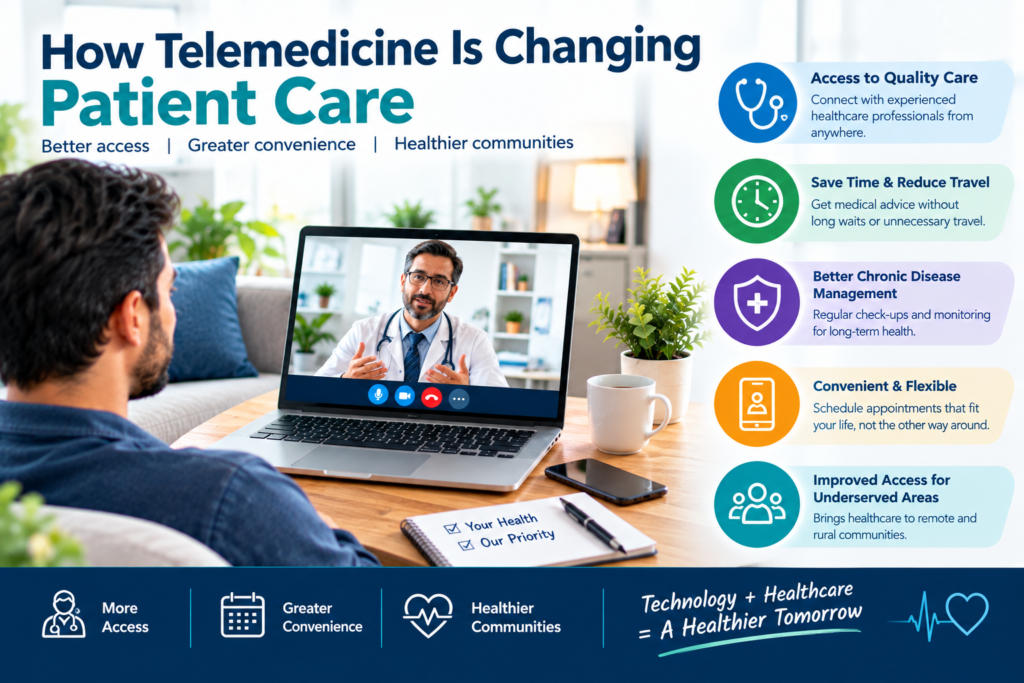
One of the most important changes created by telemedicine is the ability to connect patients with healthcare professionals without requiring every appointment to involve physical travel. A virtual appointment may be useful for certain consultations, follow-up discussions, reviewing test results, medication-related conversations, and other services that do not always require a physical examination.
This can be particularly relevant for people who live far from healthcare facilities or have difficulty traveling. Research on telemedicine in Pakistan has identified its potential to address geographical and logistical barriers, although infrastructure, implementation costs, internet access, and other challenges can affect how widely these services can be adopted.
Another important development is the growth of virtual care as part of broader healthcare delivery. Virtual care can include video consultations, telephone communication, secure messaging, digital follow-ups, and technology-supported monitoring. The exact services available depend on the healthcare provider and the technology being used.
For patients, convenience can be one of the most noticeable advantages. Telehealth services can reduce the need for travel and may make it easier to communicate with a healthcare professional from a suitable location. The U.S. Department of Health and Human Services notes that telehealth can save travel time, provide additional provider choices, and sometimes make appointments more accessible.
Telemedicine can also support continuity of communication between patients and providers. For example, after an in-person appointment, a healthcare professional may use a remote visit for an appropriate follow-up rather than requiring another physical visit.
However, convenience should not be confused with suitability for every medical situation. Some healthcare services require physical examination, diagnostic equipment, laboratory testing, procedures, or other forms of in-person assessment.
The patient experience also depends on technology. A stable internet connection, suitable device, clear communication, privacy, and a platform that is reasonably easy to use can all affect the quality of a virtual interaction.
Recent research on patient satisfaction suggests that satisfaction with telemedicine can be high, but experiences vary according to the service, provider relationship, technology, and circumstances of the consultation.
2. The Role of Remote Consultations, Hybrid Care, and Digital Communication
Remote consultations are becoming an important part of modern healthcare systems. They allow patients and healthcare professionals to communicate when an appointment can reasonably be conducted without a physical examination.
Depending on the service, remote consultations may involve video, telephone, secure messaging, or other approved communication methods. HHS guidance lists several examples of care that may be provided through telehealth, including reviewing test results, managing medicines, checking certain common health concerns, follow-up after surgery, and using remote monitoring tools.
A major development is the move toward hybrid care, which combines virtual and in-person healthcare rather than treating them as competing models.
For example, a patient may have an initial physical appointment and later use a virtual appointment for an appropriate follow-up. Another patient may begin with a remote consultation and then be directed to an in-person facility when physical assessment or additional testing is necessary.
This approach can give healthcare providers greater flexibility while allowing patients to use digital services when they are appropriate. HHS guidance emphasizes that patients should understand what can be handled remotely and when in-person care may be necessary.
Digital communication can also support healthcare coordination. A telemedicine platform may connect patients with providers, while other digital systems can support appointment scheduling, health records, remote monitoring, and communication.
However, effective telemedicine requires more than simply putting a doctor and patient on a video call. Healthcare organizations need appropriate technology, trained staff, reliable processes, privacy protections, technical support, and clear procedures for situations that require in-person assessment.
Research has also identified barriers such as limited digital literacy, poor internet connectivity, communication challenges, and difficulties accessing technology for certain patient groups. These issues are important because a digital healthcare system should not unintentionally make access harder for people who already face healthcare barriers.
The future of telemedicine is therefore likely to involve a combination of digital and traditional healthcare rather than a complete replacement of physical medical services.
3. Challenges, Privacy Considerations, and the Future of Telemedicine
Understanding telehealth limitations is just as important as understanding its potential benefits. Remote healthcare cannot provide every type of examination or procedure, and some situations require direct physical assessment.
Technology can also create barriers. Patients may experience weak internet connections, device problems, difficulty using digital platforms, or communication issues. Healthcare providers can face similar technical and administrative challenges.
Privacy is another important consideration. Healthcare information is sensitive, so organizations providing digital healthcare services need appropriate security measures and responsible data-handling practices. Patients should understand how a healthcare service communicates with them and how their information is handled.
Accessibility also remains an important issue. People without reliable internet access, suitable devices, digital skills, or private spaces may have more difficulty using telemedicine. Healthcare organizations therefore need to consider alternative communication methods and in-person options where appropriate.
Healthcare systems also need clear processes for escalation. If a remote consultation indicates that physical assessment or additional testing is necessary, the patient should be directed toward an appropriate in-person healthcare service rather than assuming that every issue can be managed digitally.
For these reasons, telemedicine works best when it is integrated into a broader healthcare system. WHO’s implementation guidance emphasizes planning, implementation, maintenance, evaluation, and consideration of the wider healthcare environment when scaling telemedicine services.
The future may bring more integration between telemedicine, electronic health records, remote monitoring, mobile health applications, artificial intelligence, and other digital healthcare technologies. These technologies can support communication and healthcare operations, but their effectiveness depends on appropriate implementation and professional oversight.
Telemedicine should therefore be viewed as one component of modern healthcare rather than a universal replacement for traditional medical care.
Conclusion
Telemedicine is changing patient care by making some healthcare interactions more flexible, accessible, and digitally connected. Remote consultations can reduce travel requirements for suitable services, while hybrid care can combine virtual and in-person appointments according to patient and provider needs.
At the same time, technology does not eliminate the need for physical healthcare. Privacy, accessibility, internet connectivity, digital literacy, clinical suitability, and appropriate escalation to in-person care remain important considerations.
The strongest future for telemedicine is likely to be one in which digital tools complement healthcare professionals and existing healthcare systems while keeping patient safety, privacy, accessibility, and quality of care at the center.