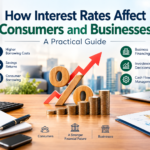

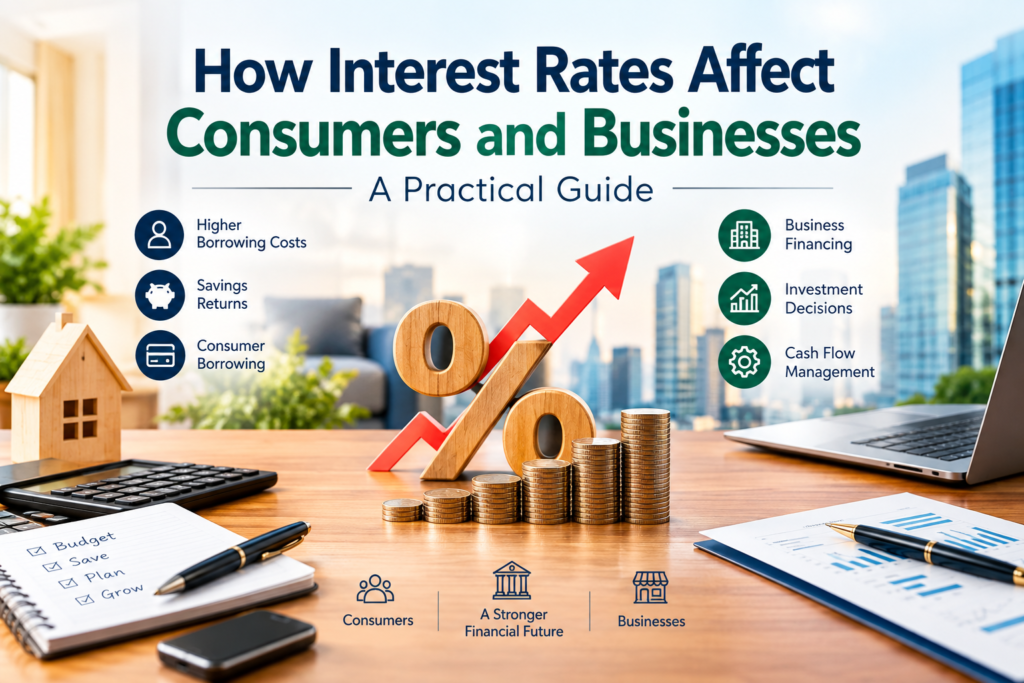
Interest rates are an important part of the financial system because they influence the cost of borrowing and the return earned on some types of savings. Changes in interest rates can affect consumers, businesses, lenders, financial markets, and the wider economy.
For consumers, interest rates can influence the cost of credit cards, personal loans, mortgages, and other forms of borrowing. For businesses, they can affect the cost of financing, investment decisions, expansion plans, and cash-flow management.
The effect is not always immediate or identical for everyone. A person with a fixed-rate loan may experience a different impact from someone with a variable-rate loan. Similarly, a business with substantial borrowing may respond differently from a business that relies mainly on internal cash flow.
Understanding these relationships can help consumers and businesses make more informed financial decisions without relying on short-term assumptions.
1. How Interest Rates Affect Consumers
The most direct way interest rates affect consumers is through borrowing costs. When an interest rate is applied to a loan or credit balance, it represents part of the cost of using borrowed money.
The Consumer Financial Protection Bureau explains that a credit card interest rate is the price paid for borrowing money, while the annual percentage rate (APR) provides a standard way to express and compare credit costs.
When interest rates increase, new borrowing can become more expensive. Depending on the type of financial product, consumers may face higher financing costs, which can influence decisions about borrowing for housing, vehicles, education, household purchases, or other needs.
However, the effect depends heavily on whether the interest rate is fixed or variable.
A fixed interest rate generally remains unchanged according to the terms of the agreement. A variable rate can change when the index or benchmark to which it is linked changes. The CFPB notes that variable credit-card APRs can change with an interest-rate index, while fixed APRs do not fluctuate in the same way.
This distinction is important when reviewing existing debt.
For example, someone with a fixed-rate loan may continue making payments according to the original interest-rate terms even when broader market rates change. Someone with a variable-rate product may experience changes in borrowing costs when the relevant rate or index changes.
Credit cards are another important area. Many credit cards have variable rates, so changes in benchmark rates can affect the interest charged to consumers who carry balances. The CFPB also explains that credit-card interest may be calculated daily, making the timing and amount of payments relevant to the interest ultimately charged.
Interest rates can also affect saving.
When rates offered on deposit accounts or other savings products change, the return available to savers can change as well. The relationship between market interest rates and deposit rates is not always immediate or identical across financial institutions, so consumers should understand the terms of their particular account rather than assuming every savings product will respond in exactly the same way.
This makes interest rates an important consideration when reviewing both borrowing and saving decisions.
Consumers can improve their financial awareness by regularly reviewing:
- Loan interest rates
- Whether rates are fixed or variable
- Credit-card APRs
- Loan repayment terms
- Fees associated with financial products
- Savings-account terms
- Minimum and required payments
- Changes to financial-product agreements
The objective is not to predict every future rate movement. Instead, consumers should understand how their existing financial products work and how a change in rates could affect their personal finances.
2. How Interest Rates Affect Businesses and Business Decisions
Businesses are also affected by interest rates because many companies use financing to support operations, purchase equipment, manage working capital, or expand their activities.
When borrowing costs change, the financial cost of a new loan or other financing arrangement may also change.
The Federal Reserve explains that interest rates influence borrowing costs and that higher rates can restrain business investment decisions, including expansion, equipment purchases, facility improvements, and hiring.
This does not mean every business will automatically reduce investment when rates rise. Business decisions depend on many factors, including expected demand, cash flow, profitability, competition, financing requirements, and the purpose of the investment.
A business with strong internal cash reserves may be less dependent on external borrowing than a business that regularly relies on loans or credit facilities.
Interest rates can therefore influence businesses through several channels.
Financing costs
Businesses that borrow money may have to consider interest expenses when evaluating financing options. Higher borrowing costs can affect the overall cost of a project or expansion.
Investment decisions
A company considering new equipment, technology, property, or expansion may compare the expected benefits of the investment with its financing costs.
When financing becomes more expensive, some projects may require additional analysis before a company commits resources.
Cash-flow management
Interest payments are part of a company’s financial obligations. Businesses therefore need to monitor how borrowing costs interact with operating cash flow.
A company with significant debt may pay closer attention to interest-rate changes than a company with minimal borrowing.
Working capital
Businesses sometimes use financing to manage inventory, supplier payments, operating expenses, or other short-term requirements. Changes in financing costs can influence how companies manage these needs.
Small businesses can be particularly sensitive to financing conditions because they may have fewer financing options or smaller financial reserves. The U.S. Small Business Administration notes that some business loan programs can have fixed or variable interest rates, and variable-rate loan payments can change when the interest rate changes.
This is why business financing should be considered as part of broader financial planning rather than as an isolated decision.
Businesses can monitor several areas when interest rates change:
- Existing loan terms
- Variable-rate exposure
- Financing requirements
- Debt repayment schedules
- Cash-flow forecasts
- Planned investments
- Working-capital requirements
- Expected operating costs
Businesses should also distinguish between the effect of an interest-rate change and other economic factors. Changes in consumer demand, inflation, exchange rates, labor costs, supply conditions, and competition can influence business performance at the same time.
Interest rates are therefore one part of a much larger economic environment.
3. Why Interest Rates Matter for Financial Planning
Interest rates are closely connected with broader economic activity. They can influence borrowing, saving, spending, and investment, but the effects can differ across households and businesses.
For consumers, understanding interest-rate exposure is an important part of financial planning.
Before taking on new debt, a consumer can review the interest rate, APR where applicable, repayment period, fees, and whether the rate is fixed or variable. Reading the financial agreement carefully can help identify conditions that may affect future payments.
Existing borrowers can also review their loan terms periodically. This is especially relevant when a financial product has a variable interest rate.
For people who use credit cards, understanding APRs and payment terms is particularly important. Paying attention to the interest rate and repayment conditions can help consumers understand the cost of carrying a balance. The CFPB provides consumer guidance explaining how credit-card interest works and how different APR categories can apply to different types of balances.
Businesses can take a similar approach.
A company can assess its current debt structure, identify variable-rate borrowing, review upcoming financing needs, and incorporate financing costs into its business planning.
Interest rates can also influence the way businesses evaluate future investments. A project may appear financially attractive under one set of financing conditions and require a different assessment when borrowing costs change.
This does not mean businesses should automatically stop investing when rates rise. Instead, management can compare expected costs, expected benefits, available cash, financing terms, and the company’s broader financial position.
Another important concept is the difference between short-term and long-term effects.
An interest-rate change may not immediately affect every existing financial obligation. Fixed-rate contracts can provide stability for their agreed period, while variable-rate arrangements may respond more quickly to changes in their underlying benchmark.
Consumers and businesses should therefore examine their individual agreements rather than assuming that a general change in interest rates will affect everyone in the same way.
Interest rates can also influence economic activity more broadly. When borrowing becomes more expensive, some consumers may become more cautious about taking new loans, while some businesses may reconsider certain investment projects. When borrowing costs decline, financing conditions may become more supportive for some forms of borrowing and investment. The Federal Reserve describes this relationship as one of the ways interest rates influence economic activity.
For this reason, understanding borrowing costs can improve financial decision-making even when a person or business does not actively follow monetary policy.
The most useful approach is to focus on factors that can actually be evaluated:
- Current financial obligations
- Fixed and variable rates
- Repayment schedules
- Cash-flow requirements
- Savings arrangements
- Future financing needs
- Financial goals
- Overall financial risk
Conclusion
Interest rates affect consumers and businesses primarily through borrowing costs, saving returns, financing decisions, and investment conditions. The impact varies according to the type of financial product, the terms of an agreement, the amount of borrowing, and the financial position of the individual or business.
Consumers can better understand their exposure by reviewing loan terms, APRs, fixed or variable rates, and repayment requirements. Businesses can evaluate debt, cash flow, financing needs, and investment decisions as part of their broader financial planning.
Understanding these relationships does not require predicting future interest rates. A strong financial approach focuses on understanding current conditions, reviewing financial agreements, and making decisions based on reliable information.