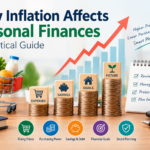

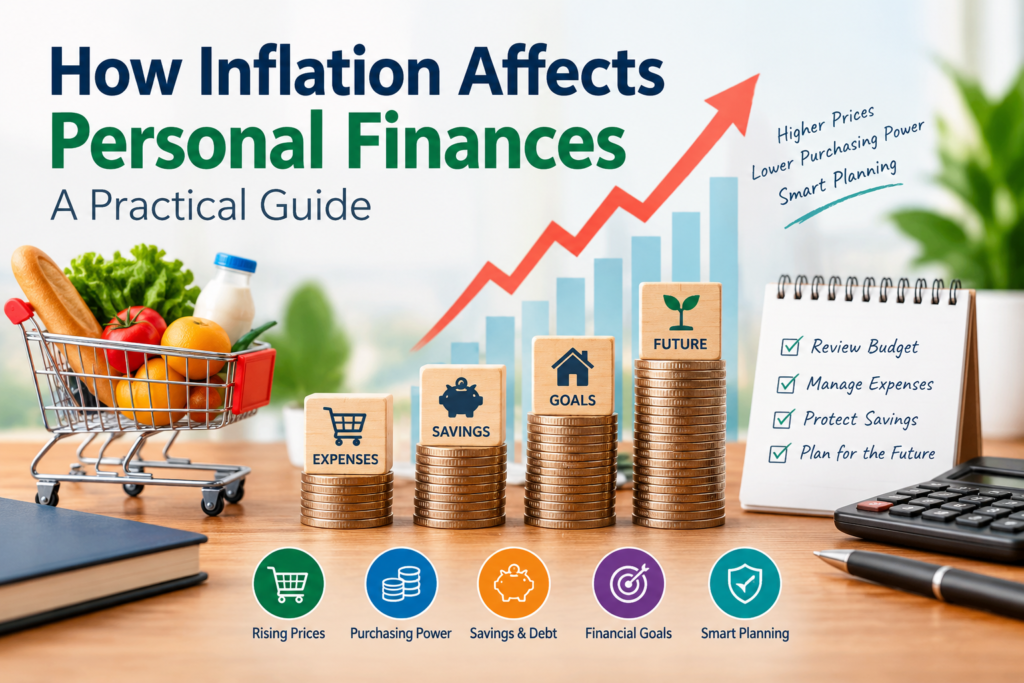
Inflation affects personal finances in ways that go beyond higher prices at the grocery store. When the cost of goods and services rises, the same amount of money may buy less than it did before. This can affect household budgets, savings, debt payments, financial goals, and long-term purchasing power.
Inflation does not affect every household in exactly the same way. Spending habits, income, location, debt, and the types of goods and services a person buys all influence the impact. The Consumer Price Index (CPI), for example, measures average changes in prices, but an individual’s experience can differ from the published average depending on their spending pattern.
Understanding how inflation affects personal finances can help people make more realistic budgets, review spending, protect savings, and adjust long-term financial plans.
1. How Inflation Affects Your Everyday Spending and Purchasing Power
The most noticeable effect of inflation is that everyday expenses can increase. Groceries, transportation, housing, utilities, healthcare, education, and other household costs may become more expensive over time.
When prices rise while income remains unchanged, households effectively have less purchasing power. Purchasing power refers to how much goods and services a specific amount of money can buy. As prices increase, the purchasing power of money generally declines.
For example, imagine a household previously spent $500 per month on a particular group of essential purchases. If the prices of those items increase, the household may need more than $500 to maintain the same spending pattern.
This does not necessarily mean every product becomes more expensive at the same rate. Inflation is based on changes across a broad basket of goods and services, while individual households have their own spending patterns. A family that spends a large percentage of its income on food and transportation may experience price pressure differently from someone who spends more on housing or other services.
This is why reviewing your actual expenses is important.
A monthly budget can help you identify where inflation is having the greatest effect. Instead of relying on an old spending plan, compare your current expenses with previous months and adjust categories when necessary.
Start by reviewing:
- Grocery and household costs
- Rent or mortgage payments
- Electricity and utility bills
- Transportation and fuel
- Insurance
- Healthcare expenses
- Education-related costs
- Subscriptions and memberships
- Dining and entertainment
- Debt payments
The goal is not to cut every expense whenever prices increase. Some expenses are essential and cannot easily be reduced. Instead, the purpose is to understand how changing prices affect your overall financial position.
Inflation can also make long-term financial goals more expensive. A future purchase that costs $10,000 today may require a larger amount of money several years from now if prices continue rising.
This is particularly important when planning for education, housing, retirement, business expenses, or other major financial commitments.
For households already operating with limited financial flexibility, inflation can be more difficult to absorb. The World Bank has noted that inflation can reduce household welfare through lower real purchasing power and declining real income, with poorer households often more exposed because they devote a larger share of their budgets to essential consumption.
That makes expense tracking and realistic financial planning especially important during periods of higher inflation.
2. How Inflation Affects Savings, Debt and Financial Goals
Inflation does not only affect spending. It can also influence the real value of savings and the cost of achieving future financial goals.
Suppose you keep $10,000 in cash for several years without earning any return. If prices rise during that period, the amount of goods and services that $10,000 can purchase may decline.
This does not mean that the number in your bank account automatically decreases. Instead, the purchasing power of that money can fall because prices have increased.
For this reason, inflation should be considered when setting long-term savings targets.
For example, someone saving for a future home, education, retirement, or business may need to periodically review whether the original savings target is still realistic.
Emergency savings require a similar review. An emergency fund should be based on realistic living expenses, and those expenses can change over time. If rent, food, transportation, or healthcare costs increase, the amount considered sufficient for emergencies may also need to be reconsidered.
At the same time, inflation can interact with debt in different ways.
Fixed-rate debt and variable-rate debt can behave differently when economic conditions change. The actual effect depends on the loan structure, interest rate, repayment terms, and broader economic conditions.
For anyone carrying debt, it is important to understand:
- Current interest rate
- Whether the rate is fixed or variable
- Minimum monthly payment
- Remaining balance
- Repayment period
- Fees and penalties
- Total expected repayment cost
Inflation can also create pressure when income does not increase as quickly as expenses. If wages remain relatively stable while essential costs rise, more of a person’s income may be required just to maintain their existing lifestyle.
This can leave less money available for savings, debt reduction, or other financial goals.
A practical response is to review financial priorities regularly rather than assuming that an old plan will continue working indefinitely.
For example, if your original plan was to save $300 per month but your essential expenses have increased substantially, you may need to temporarily adjust the target while looking for ways to improve income or reduce flexible expenses.
The important point is to avoid abandoning the goal completely.
Inflation also highlights the difference between nominal and real financial values. A salary increase may look positive in numerical terms, but if prices have increased by a similar or greater amount, the improvement in actual purchasing power may be limited.
The same principle applies to investment and savings returns. A return should be considered alongside inflation when evaluating how much purchasing power money may gain over time.
This is one reason long-term financial planning should account for changing prices rather than assuming today’s costs will remain unchanged.
Inflation does not mean that people should make rushed financial decisions. Instead, it provides a reason to regularly review savings targets, expenses, income, debt, and the expected cost of future goals.
3. Practical Ways to Protect Your Personal Finances From Inflation
You cannot control the overall inflation rate, but you can make your personal financial system more adaptable.
The first step is to regularly review your spending.
The Consumer Financial Protection Bureau recommends creating a realistic picture of current spending, including less frequent expenses, and comparing monthly spending with take-home income.
This becomes particularly useful when prices are changing.
Instead of using a budget created many months ago, update important categories based on your current expenses. If groceries have become more expensive, for example, your food budget may need to change.
The second step is to distinguish between essential and flexible expenses.
Essential costs may include housing, food, utilities, transportation, insurance, healthcare, and required debt payments. Flexible spending may include entertainment, subscriptions, dining out, shopping, and other discretionary purchases.
Reducing unnecessary spending does not require eliminating everything enjoyable. Even small changes in recurring expenses can create additional room in a household budget.
Review subscriptions, memberships, phone plans, insurance, transportation costs, and other recurring payments. If a service is rarely used or a lower-cost alternative provides similar value, changing it may help reduce financial pressure.
Another useful approach is to compare prices before making larger purchases. Inflation can make price comparison more valuable because small differences can accumulate across repeated purchases.
Your money management system should also include regular financial reviews.
Once a month, check:
- Did income change?
- Which expenses increased?
- Which expenses decreased?
- Are savings contributions still realistic?
- Are debt payments manageable?
- Are long-term goals still achievable?
- Is there anything unnecessary that can be reduced?
Income is another important part of the equation.
Reducing expenses has limits. There are only so many costs that a household can eliminate. Depending on a person’s circumstances, increasing income through additional work, freelancing, professional development, business activity, or other legitimate opportunities may provide another way to improve financial flexibility.
However, new income should not automatically lead to higher lifestyle spending.
When income increases, consider directing part of the additional money toward savings, debt reduction, or other financial priorities. This can help create a stronger buffer against future price increases.
It is also important to avoid reacting to inflation with high-risk financial decisions. People sometimes feel pressure to chase higher returns simply because they are worried about their money losing purchasing power.
Financial decisions should instead consider risk, time horizon, liquidity needs, fees, and personal circumstances.
For example, money needed for short-term living expenses should not automatically be treated the same way as money intended for a long-term financial objective.
Building a flexible financial system is generally more useful than trying to predict exactly what prices will do next.
For households in Pakistan and other economies that have experienced periods of elevated inflation, this issue can be particularly important. World Bank data show that Pakistan’s annual consumer-price inflation has varied considerably across recent years, demonstrating why financial plans may need periodic adjustment rather than being treated as fixed forever.
The broader objective is financial resilience.
A resilient personal finance system has several characteristics:
- Expenses are tracked regularly.
- The budget reflects current prices.
- Emergency savings are reviewed periodically.
- Debt is managed carefully.
- Income sources are monitored.
- Long-term goals are updated when circumstances change.
- Financial decisions are based on reliable information rather than panic.
Conclusion
Inflation affects personal finances by reducing purchasing power, increasing the cost of everyday living, changing the amount needed for future goals, and potentially putting pressure on household savings and cash flow.
The best response is not to panic but to stay informed and flexible. Review your spending, update your budget, protect essential savings, manage debt carefully, and regularly reassess your long-term financial goals.
Inflation is an economic condition that individuals cannot control directly, but better financial planning can help households adapt to changing prices and make more informed decisions about their money.