

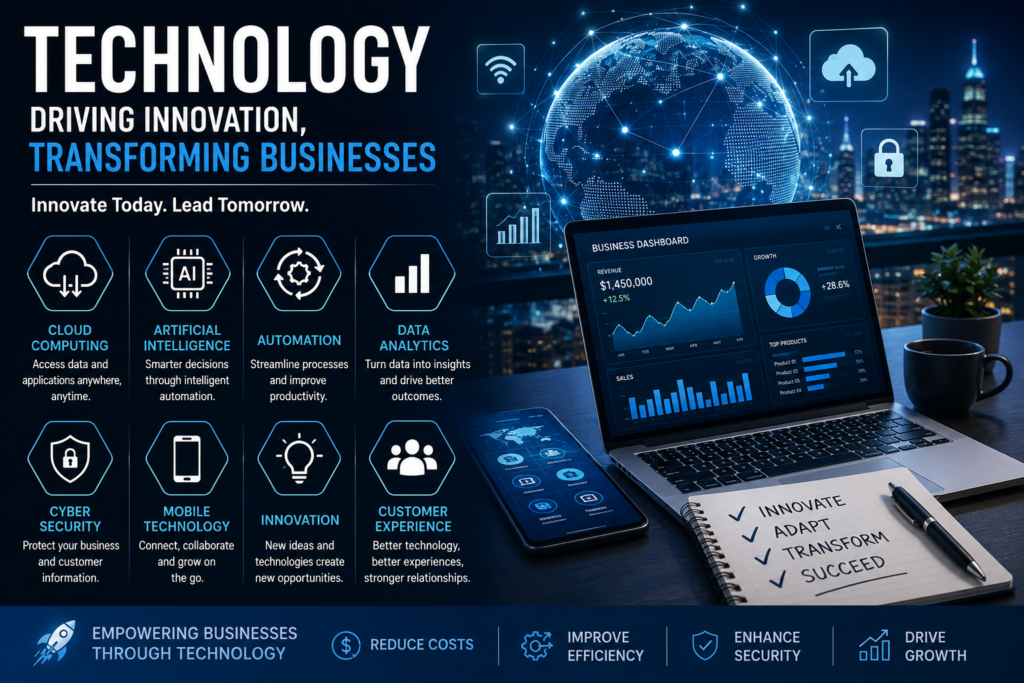
Technology has become an essential part of modern business. From cloud computing and artificial intelligence to automation and digital communication, technological innovation is changing how companies operate, serve customers, and compete in the marketplace.
Businesses of all sizes now use technology to improve efficiency, reduce costs, analyze information, and reach new audiences. A small company can use digital tools to compete with larger organizations, while established businesses can use innovation to improve their operations and create new opportunities.
However, technology is not valuable simply because it is new. The most successful companies are those that use technology to solve real problems and create meaningful value for customers.
Digital Tools Are Improving Business Efficiency
One of the biggest advantages of technology is its ability to improve business efficiency. Many repetitive tasks that once required significant time can now be managed through digital tools and automation.
Businesses can use software to manage accounting, customer relationships, inventory, communication, scheduling, and project management. Automation can reduce manual work and allow employees to focus on more strategic responsibilities.
Cloud computing has also changed how companies store and access information. Instead of relying only on physical servers, businesses can use cloud-based platforms to securely access data and applications from different locations.
This has made remote work and collaboration easier for many organizations.
Digital communication tools also help teams work together more effectively. Employees can communicate through video meetings, messaging platforms, project management systems, and shared digital workspaces.
For businesses, improved communication can reduce delays and help teams complete projects more efficiently.
Technology can also help companies make better decisions. Business analytics tools allow organizations to examine sales, customer behavior, website traffic, and operational performance.
By studying this information, businesses can identify trends and make more informed decisions.
Companies should choose technology based on their specific needs. Investing in too many tools without a clear strategy can create unnecessary costs and complexity.
The most effective technology investments are those that solve a clear business problem.
Artificial Intelligence and Automation Are Creating New Opportunities
Artificial intelligence is becoming one of the most important technological developments for businesses.
AI systems can analyze large amounts of information, identify patterns, generate content, support customer service, and assist with many business processes.
Companies are using AI to improve productivity and provide faster services. Customer support systems can help answer common questions, while AI-powered tools can assist employees with research, data analysis, and routine tasks.
Automation can also help businesses reduce repetitive work. Tasks such as email responses, appointment scheduling, data entry, and reporting may be partially automated through digital systems.
This allows employees to spend more time on work that requires creativity, communication, and strategic thinking.
However, businesses must use artificial intelligence responsibly. Technology should support human decision-making rather than remove the need for human judgment in situations that require experience and context.
Data privacy and security are also important considerations. Companies must protect sensitive information and ensure that technology is used responsibly.
The businesses that benefit most from AI and automation will likely be those that combine technological capabilities with strong human expertise.
Technology can improve efficiency, but people remain essential for creativity, leadership, relationships, and complex decision-making.
Digital Innovation Is Changing Customer Experiences
Technology has also transformed the way businesses interact with customers.
Consumers can now discover products, compare services, communicate with companies, and complete purchases through digital platforms.
A professional website is often one of the first places customers interact with a business. Websites should provide clear information, easy navigation, fast performance, and a smooth user experience.
Social media has also created new opportunities for businesses to build relationships with their audiences. Companies can share information, answer questions, introduce products, and communicate directly with customers.
Mobile technology has further increased the importance of digital accessibility. Customers increasingly expect websites and services to work effectively on smartphones and other devices.
Personalization is another area where technology is creating new opportunities. Businesses can use customer data to provide more relevant recommendations, content, and communication.
However, personalization must be balanced with privacy. Customers should understand how their information is collected and used.
Digital innovation is most effective when it improves the customer experience. Technology should make services more convenient, communication clearer, and solutions more valuable.
Conclusion
Technology is transforming modern business by improving efficiency, supporting innovation, and changing how companies interact with customers.
Cloud computing, automation, artificial intelligence, data analytics, and digital communication tools provide businesses with powerful opportunities to grow and compete.
However, successful technology adoption requires a clear strategy. Companies should focus on solving real problems rather than adopting technology simply because it is popular.
The future of business will likely depend on the ability to combine technology with human creativity, expertise, and decision-making.
Businesses that adapt to technological change while maintaining a strong focus on customer needs will be better positioned to succeed in an increasingly digital marketplace.