
Technology is evolving at an unprecedented pace, and among the most exciting innovations is quantum computing. While artificial intelligence and cloud computing continue to dominate headlines, quantum computing is quietly advancing toward becoming one of the most transformative technologies of the decade.
In 2026, major technology companies, research institutions, and governments are investing billions of dollars into quantum computing development. Although still in its early stages, the technology has the potential to solve complex problems that traditional computers cannot handle efficiently.
What Is Quantum Computing?
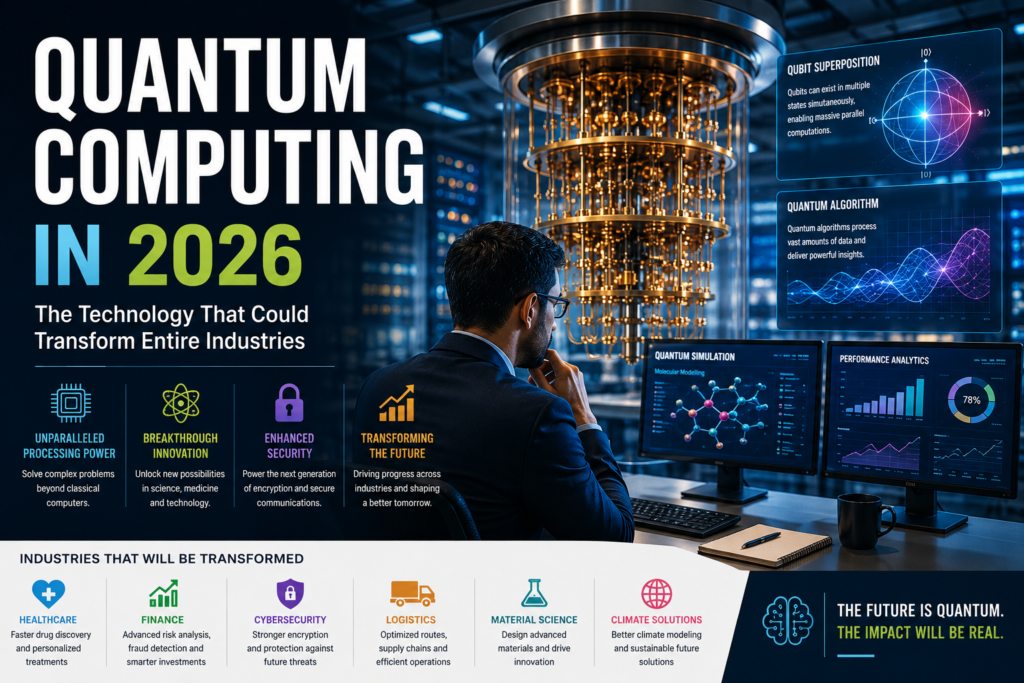
Traditional computers process information using bits that exist as either 0 or 1. Quantum computers use quantum bits, known as qubits, which can exist in multiple states simultaneously through a phenomenon called superposition.
This unique capability allows quantum computers to perform certain calculations exponentially faster than conventional systems.
Quantum computing also leverages another quantum phenomenon known as entanglement, enabling qubits to work together in ways that dramatically increase computational power.
Why Quantum Computing Matters
The world’s most challenging problems often require enormous computational resources. Quantum computing could help solve these challenges significantly faster.
Potential applications include:
- Advanced medical research
- Drug discovery
- Financial modeling
- Climate prediction
- Cybersecurity
- Logistics optimization
- Artificial intelligence enhancement
- Material science innovation
Organizations that successfully leverage quantum computing may gain substantial competitive advantages in the future.
Impact on Healthcare
Healthcare is expected to be one of the biggest beneficiaries of quantum technology.
Researchers can use quantum systems to simulate complex molecular interactions, potentially reducing the time required to discover new medicines and treatments.
This could lead to:
- Faster drug development
- More accurate disease prediction
- Personalized treatment plans
- Improved medical research outcomes
Revolutionizing Financial Services
Financial institutions process massive amounts of data daily.
Quantum computing may improve:
- Risk assessment
- Fraud detection
- Portfolio optimization
- Market forecasting
- Investment strategies
Banks and financial firms are already exploring quantum algorithms to enhance decision-making and operational efficiency.
The Future of Cybersecurity
Quantum computing presents both opportunities and challenges for cybersecurity.
While quantum systems may eventually break some existing encryption methods, they are also driving the development of quantum-resistant security technologies.
Organizations are increasingly preparing for a future where quantum-safe encryption becomes essential.
Challenges Slowing Adoption
Despite its enormous potential, quantum computing still faces several obstacles.
Key challenges include:
Hardware Limitations
Quantum computers remain expensive and technically difficult to build and maintain.
Error Rates
Qubits are highly sensitive to environmental disturbances, which can affect calculation accuracy.
Talent Shortage
The industry faces a shortage of professionals with expertise in quantum physics, mathematics, and computer science.
Commercial Readiness
Many practical business applications are still under development and may take years to become mainstream.
How Businesses Should Prepare
Although widespread adoption may still be years away, organizations can begin preparing today.
Business leaders should:
- Monitor quantum technology developments
- Invest in workforce education
- Explore potential use cases
- Build innovation partnerships
- Develop long-term technology strategies
Early preparation can help companies remain competitive as the technology matures.
The Road Ahead
Industry experts believe the next decade could mark a turning point for quantum computing. Continued advancements in hardware, software, and research are bringing practical applications closer to reality.
While quantum computing will not replace traditional computers, it is expected to work alongside existing technologies to solve problems previously considered impossible.
Conclusion
Quantum computing represents one of the most significant technological breakthroughs of the modern era. Its ability to process complex calculations at extraordinary speeds could transform healthcare, finance, cybersecurity, logistics, and many other industries.
As investment and innovation continue to accelerate, businesses that understand and prepare for quantum computing today may become tomorrow’s industry leaders.