

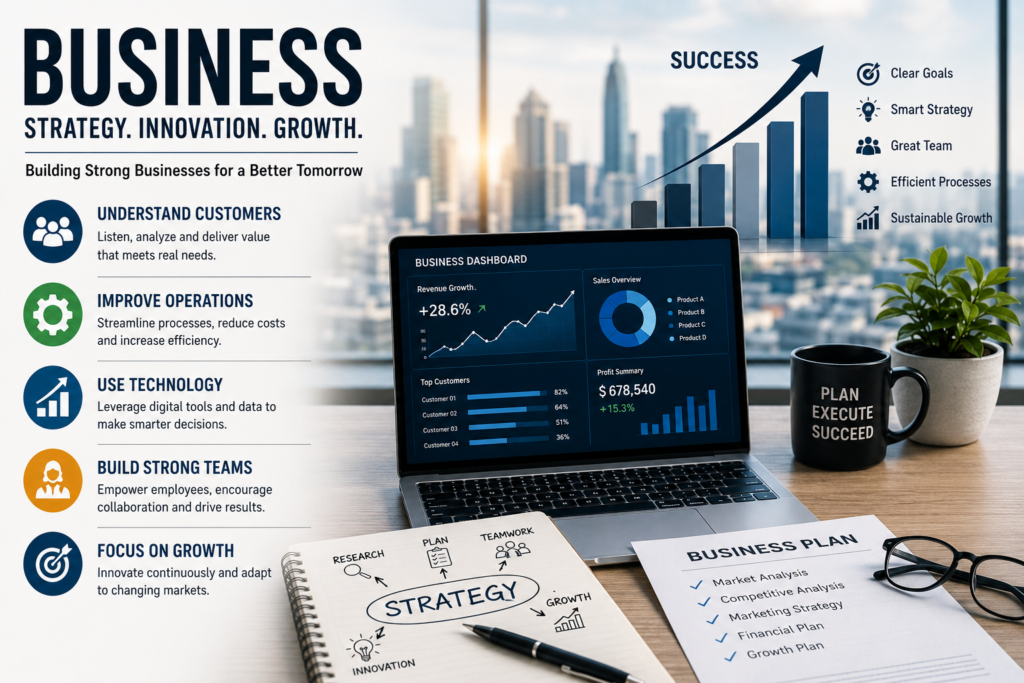
Building a successful business requires more than offering a good product or service. In competitive markets, companies must continuously understand their customers, improve their operations, adapt to change, and create value that competitors cannot easily replicate.
Many businesses focus heavily on increasing sales, but long-term success depends on a broader strategy. A company needs strong customer relationships, efficient processes, a reliable team, effective financial management, and the ability to respond to new opportunities.
Businesses that focus on sustainable growth are often better prepared to handle challenges and remain competitive over time.
Understanding Customers Helps Businesses Create Greater Value
Customers are at the center of every successful business. Companies that understand their customers are more likely to develop products and services that meet real needs.
Customer expectations can change quickly. People may want faster service, better quality, more convenient purchasing options, or stronger communication from businesses.
For this reason, companies should regularly collect and analyze customer feedback.
Reviews, surveys, direct conversations, support requests, and online discussions can provide valuable insights into what customers like and where improvements are needed.
A business should ask important questions such as:
What problem is the customer trying to solve?
Why do customers choose this company?
What causes customers to choose competitors?
What improvements would make the experience better?
This information can help businesses improve their products and services.
Customer experience is also becoming an important competitive advantage. Customers are more likely to remain loyal to businesses that provide reliable service, clear communication, and consistent quality.
A company that responds quickly to problems and treats customers professionally can build stronger relationships.
Customer loyalty can also support long-term growth. Returning customers may purchase more frequently and recommend a business to others.
However, customer relationships must be earned through consistent value. Marketing can attract attention, but the quality of the actual customer experience determines whether people return.
Technology and Efficient Operations Support Business Growth
Technology has become an important part of modern business operations. Digital tools can help companies improve productivity, manage information, communicate with teams, and serve customers more effectively.
Businesses can use software for accounting, customer relationship management, project management, inventory control, marketing, and communication.
Automation can also reduce the time employees spend on repetitive tasks. This allows teams to focus on responsibilities that require creativity, decision-making, and customer interaction.
Data can help businesses make more informed decisions. Companies can analyze sales performance, customer behavior, marketing results, and operational costs.
This information can help identify opportunities and potential problems.
For example, a business may discover that a particular product generates strong demand while another product creates high costs but produces limited results.
Businesses can then use this information to improve their strategies.
Technology should always be connected to a clear business objective. Companies should not invest in digital tools simply because they are popular.
The best technology investments are those that improve efficiency, reduce unnecessary costs, enhance customer experiences, or support business growth.
Efficient operations are also important. Businesses should regularly review their processes and identify unnecessary delays or expenses.
Small improvements in daily operations can create significant results over time.
Strong Leadership and Adaptability Create Long-Term Success
Leadership plays an important role in business growth. Strong leaders provide direction, communicate clearly, and help teams work toward common goals.
Employees are more likely to perform effectively when they understand their responsibilities and see how their work contributes to the company’s objectives.
A positive workplace culture can also improve productivity and employee retention. Businesses that value communication, professional development, and teamwork may be better positioned to attract and retain talented employees.
Adaptability is another important business advantage.
Markets can change because of new technology, changing customer behavior, economic conditions, and increased competition.
Businesses that refuse to adapt may lose opportunities.
Companies should be willing to review their strategies and make changes when necessary. This does not mean changing direction constantly. Instead, it means being willing to learn from results and respond to new information.
Financial management is also essential for long-term business stability.
A company should carefully monitor revenue, expenses, cash flow, and profitability. Strong sales do not always guarantee financial success if costs are not properly controlled.
Businesses should also prepare for unexpected challenges. Maintaining financial reserves and managing expenses carefully can provide greater stability during difficult periods.
The strongest businesses are often those that combine ambitious goals with careful planning.
Conclusion
Building a strong business in a competitive market requires a combination of customer understanding, efficient operations, technology, strong leadership, and adaptability.
Companies that focus only on short-term sales may struggle to maintain growth. Long-term success depends on creating genuine customer value and building a strong foundation.
Businesses should regularly listen to customers, improve their processes, use technology strategically, support their teams, and monitor financial performance.
The business environment will continue to change, but companies that remain flexible and focused on continuous improvement can create stronger opportunities for sustainable growth.
A successful business is not built through one decision. It is built through consistent improvements, informed decisions, and a clear commitment to delivering value.