
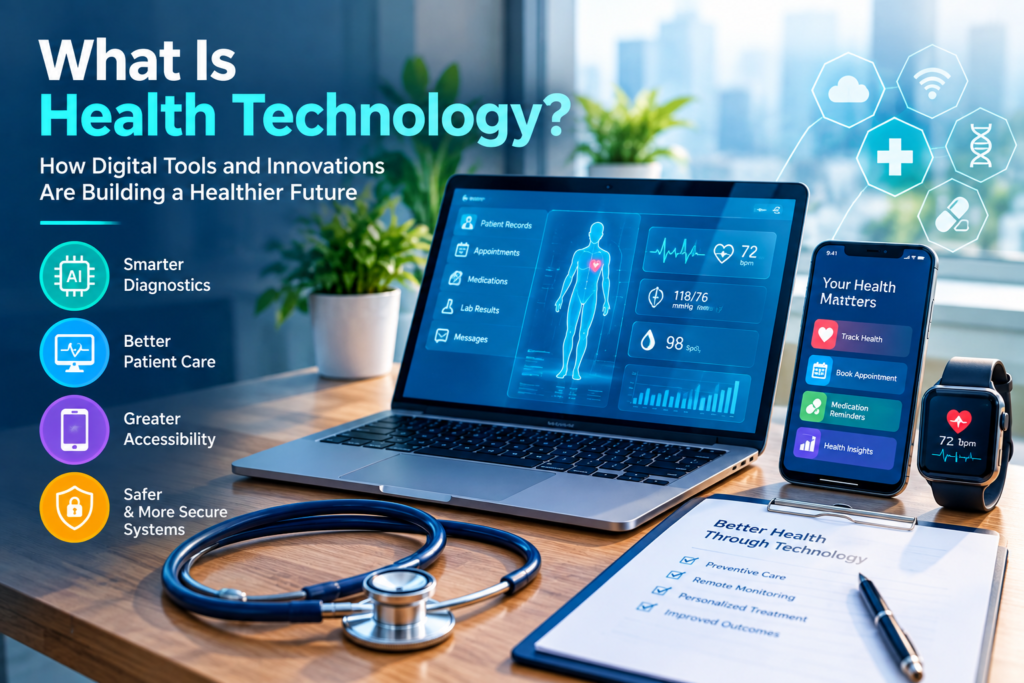
Healthcare has changed significantly as technology has become part of everyday medical services. Hospitals, clinics, researchers, healthcare professionals, and patients now use different technologies to collect information, communicate, monitor health, organize records, and support healthcare delivery.
The term health technology is broader than smartphones, health apps, or wearable devices. The World Health Organization (WHO) defines health technology as the application of organized knowledge and skills through devices, medicines, vaccines, procedures, and systems developed to address health problems and improve quality of life.
This broad definition shows that healthcare technology can include both traditional medical technologies and newer digital tools. Understanding the different categories helps patients, healthcare professionals, businesses, and policymakers understand how technology is changing modern healthcare.
1. What Is Health Technology and What Does It Include?
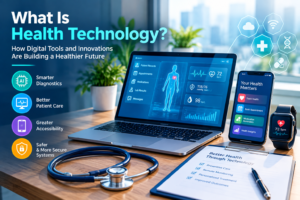
Health technology refers to technologies, systems, products, procedures, and knowledge used to support health and healthcare. It can be used in prevention, diagnosis, monitoring, treatment, rehabilitation, healthcare administration, research, and public health.
The concept therefore covers much more than digital healthcare.
Traditional examples include medical imaging equipment, laboratory systems, surgical equipment, vaccines, medicines, and diagnostic devices. Modern technology adds software, connected devices, electronic records, mobile applications, telehealth platforms, artificial intelligence, and data systems.
One important category is digital health, which broadly involves the use of information and communication technologies in healthcare. The U.S. Food and Drug Administration (FDA) describes digital health as a broad field that includes mobile health, health information technology, wearable devices, telehealth, telemedicine, personalized medicine, and related technologies.
Another important area is health information technology, which includes the hardware, software, and systems used to collect, transmit, store, process, and analyze healthcare information. These systems can be used by patients, healthcare professionals, researchers, public health organizations, and other healthcare stakeholders.
Medical devices are another major part of healthcare technology. They can range from relatively simple equipment to sophisticated diagnostic and monitoring systems. The specific regulatory classification of a technology can vary depending on what it does and how it is intended to be used.
Health technology also includes technologies that may not look like conventional medical equipment. For example, a connected wearable device may collect health-related information, while a secure software platform may help healthcare professionals access patient information.
This broad scope is important because technology in healthcare is not one single industry or product category. It is an ecosystem of different technologies serving different healthcare needs.
2. How Technology Is Used Across Modern Healthcare
Technology is increasingly being used to support different parts of the healthcare process. Its role can range from helping organizations manage information to giving patients new ways to communicate with healthcare professionals.
One major area is health information management. Electronic systems can organize patient information and make it easier for authorized healthcare professionals to access relevant records. Properly designed information systems can also support communication between different parts of a healthcare organization.
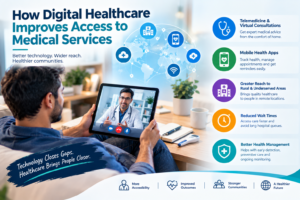
Another area is remote healthcare. Telehealth and telemedicine technologies can allow healthcare professionals and patients to communicate without requiring every interaction to take place in the same physical location. The exact services available depend on the healthcare provider, technology, regulations, and the patient’s circumstances.
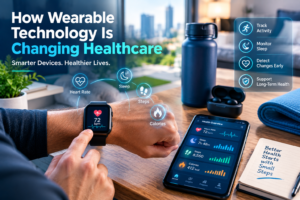
Wearable devices represent another growing area. Modern wearable technology can use sensors to collect information such as activity, heart rate, sleep-related measurements, or other health and wellness data. The FDA notes that digital health technologies can use computing platforms, connectivity, software, and sensors for healthcare-related purposes.
These devices can provide information that may be useful for personal tracking or, in appropriate regulated settings, healthcare-related monitoring. However, a consumer device’s measurement should not automatically be treated as a medical diagnosis. The purpose, accuracy, validation, and regulatory status of a particular device matter.
Artificial intelligence is another important area. AI systems can process large amounts of information and may support tasks such as medical research, image analysis, administrative work, and decision-support applications. The FDA’s digital health resources describe how AI and machine learning are becoming part of the broader digital health landscape.
Healthcare technology is also important for research. Digital tools can help researchers collect information, analyze datasets, monitor participants remotely, and study new approaches to healthcare delivery.
Technology can also support preventive healthcare by helping people and healthcare organizations collect health information, communicate with professionals, schedule services, and monitor certain health-related indicators. Digital health technologies are increasingly being studied and used across prevention, monitoring, and healthcare delivery.
The important point is that technology generally works as part of a larger healthcare system. Its usefulness depends on the quality of the technology, the information being collected, the people using it, healthcare processes, and appropriate professional oversight.
3. Benefits, Challenges, and the Future of Health Technology
Health technology can offer several potential benefits when it is properly designed, evaluated, implemented, and used.
One potential benefit is improved access to information and healthcare services. Digital platforms can make communication and certain healthcare services more convenient, particularly when distance or mobility creates barriers.
Another potential benefit is better organization of healthcare information. Digital systems can make information easier to store, retrieve, and analyze compared with systems that depend entirely on paper-based processes.
Technology can also support more continuous health monitoring. Sensors and connected devices may collect information outside traditional clinical settings, creating additional data that can sometimes support healthcare professionals or personal health management. The FDA describes digital health technologies as tools that can help move certain healthcare activities beyond traditional clinical settings.
However, healthcare technology also creates important challenges.
Privacy and cybersecurity are major considerations because healthcare information can be highly sensitive. Organizations need appropriate security controls, access management, data protection practices, and governance processes.
Accuracy and reliability are also important. A technology that produces inaccurate or poorly interpreted information can create confusion. This is one reason why technologies intended for medical purposes may be subject to specific regulatory requirements and evaluation.
Digital inequality is another concern. Not every patient has the same access to smartphones, reliable internet connections, digital services, or the technical skills required to use them. The WHO’s digital-health classification work recognizes equity as an important healthcare-system consideration.
There are also questions around interoperability. Healthcare organizations may use different systems that do not always communicate smoothly with each other. Improving the ability of systems to exchange and use information appropriately remains an important part of health technology development.
The future of health technology is likely to involve greater connectivity between people, devices, software, healthcare organizations, and research systems. AI, remote monitoring, digital records, connected devices, telehealth, and data analytics are likely to remain important areas of development.
At the same time, technological progress does not remove the need for healthcare professionals, evidence-based evaluation, patient privacy, safety standards, and responsible implementation.
Conclusion: Health technology is a broad field that includes medical devices, medicines, procedures, information systems, digital platforms, connected devices, and other technologies used to support health and healthcare. Its role is expanding from hospitals and laboratories into homes, workplaces, research environments, and community settings.
For patients and the general public, understanding health technology is useful because it helps distinguish between general wellness tools, digital healthcare services, and technologies designed for specific medical purposes. For healthcare organizations, responsible implementation requires attention to safety, privacy, accessibility, evidence, regulation, and the needs of patients.
Technology can support better healthcare, but its value ultimately depends on how responsibly it is designed, evaluated, implemented, and used.