
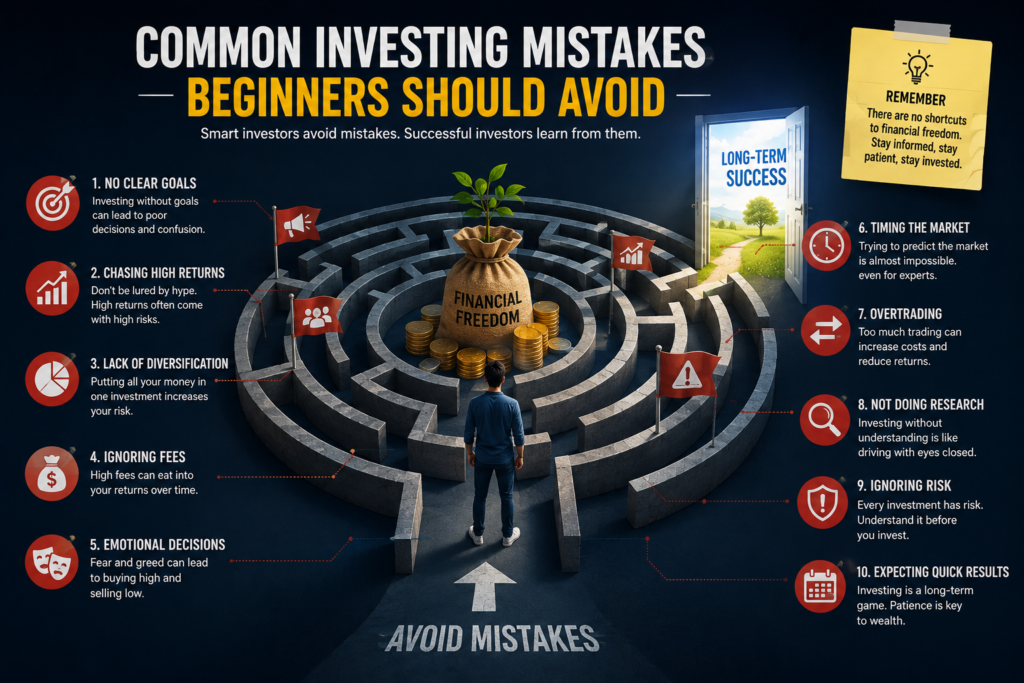
Investing can be an effective part of a long-term financial plan, but beginners can easily make mistakes when they are unfamiliar with markets, investment products, fees, and risk.
One of the biggest mistakes is believing that investing is simply about finding an asset that will increase in value. In reality, successful investing decisions involve understanding risk, setting appropriate goals, controlling costs, diversifying where appropriate, and making decisions based on reliable information.
There is also no investment that can guarantee a specific return without risk. Investments can lose value, and past performance does not guarantee future results.
For beginners, avoiding common mistakes can be just as important as learning how to choose investments.
1. Avoid Investing Before Understanding Your Financial Situation
One of the most common mistakes beginners make is rushing into investments without first understanding their overall financial position.
Before investing, review your income, regular expenses, emergency savings, existing debt, and financial goals.
Money needed for immediate expenses or emergencies may need to remain accessible rather than being placed into investments that can fluctuate in value.
A strong financial foundation can make it easier to maintain a long-term investment strategy without being forced to sell investments because of an unexpected expense.
Our Smart Money Management guide can help you organize your income, expenses, savings, and financial priorities.
Mistake #1: Investing Money You May Need Soon
Investments can rise and fall in value.
If you invest money that you may need in the near future, a market decline could leave you with less money at the exact time you need it.
For example, someone saving for an expense that is only a few months away may have different financial needs from someone investing for a retirement goal several decades in the future.
The appropriate approach depends on the goal, timeframe, and individual’s circumstances.
Mistake #2: Ignoring High-Interest Debt
Another mistake is focusing heavily on investing while carrying expensive debt.
High-interest debt can create significant financial costs. Depending on the circumstances, reducing expensive debt may be an important financial priority before increasing investment contributions.
This does not mean every person needs to eliminate every debt before investing. Different types of debt have different costs and purposes.
The important point is to understand your debt and compare its cost with your broader financial goals.
Our How to Create a Debt Repayment Strategy guide explains how to organize debts and approach repayment systematically.
Mistake #3: Not Having an Emergency Fund
Unexpected expenses can happen at any time.
Without accessible emergency savings, a person may have to use credit or sell investments when money is urgently needed.
An emergency fund is intended to provide a financial buffer for unexpected costs.
The appropriate amount depends on your income, expenses, job stability, family situation, and other circumstances.
You can learn more in our How to Build an Emergency Fund guide.
Mistake #4: Investing Without a Clear Goal
Investing without a specific objective can make it difficult to determine how much risk is appropriate.
Before investing, ask:
- What am I investing for?
- When will I need the money?
- How much can I realistically contribute?
- How much loss could I financially tolerate?
- What type of investment am I considering?
- What fees will I pay?
A long-term goal can require a different approach from a short-term goal.
Investor.gov explains that asset allocation depends partly on an investor’s time horizon and risk tolerance.
Creating a broader financial plan can also help connect investment decisions with other goals. Our Smart Financial Planning Guide provides a framework for organizing those priorities.
2. Avoid Emotional Decisions, Lack of Diversification, and Ignoring Costs
Once beginners start investing, another group of mistakes can occur because of emotions and incomplete information.
Markets can move quickly. Prices may rise sharply, fall suddenly, or remain volatile for extended periods.
Reacting emotionally to every market movement can make it difficult to follow a consistent long-term plan.
Mistake #5: Chasing Hot Investments
An investment that has recently increased significantly can attract attention.
Beginners may see other people discussing an asset online and assume that recent performance will continue indefinitely.
But past performance does not guarantee future results.
Investor.gov specifically warns investors against focusing too heavily on past performance when evaluating investments.
Instead of asking only, “How much has this investment increased?”, consider:
- What does the investment actually own?
- What risks does it carry?
- Why has its price changed?
- What are the fees?
- Does it fit my investment goal?
- Could I tolerate a significant decline?
Mistake #6: Putting Too Much Money Into One Investment
Concentration can create additional risk.
If most of your portfolio depends on a single company, industry, asset type, or market, poor performance in that area can have a large effect on your overall portfolio.
Diversification means spreading investments among different assets rather than relying heavily on one investment.
Diversification can help reduce overall portfolio risk, although it cannot eliminate the possibility of losses.
A diversified fund can sometimes make it easier to own multiple investments, but investors should still check what the fund actually holds. A narrowly focused fund may not provide broad diversification.
Mistake #7: Ignoring Investment Fees
Investment fees can look small, especially when shown as percentages.
However, recurring fees reduce the amount of money that remains invested and can affect long-term results.
Depending on the product or service, investors may pay:
- Account fees
- Fund expenses
- Management fees
- Trading costs
- Sales charges
- Other administrative costs
The SEC’s Investor.gov explains that even relatively small differences in investment costs can have a meaningful effect over time.
Before investing, read the available fee information and understand what you are actually paying.
Do not choose an investment only because its recent return looks attractive.
Mistake #8: Trading Too Frequently
Some beginners believe that frequent buying and selling will allow them to take advantage of every market movement.
In practice, frequent trading can increase transaction costs and may encourage emotional decisions.
Investor.gov notes that active trading and certain common investing behaviors can undermine investment performance.
A long-term investor does not necessarily need to react to every daily price movement.
The appropriate amount of trading depends on the investment strategy, account, costs, taxes, and individual circumstances.
Mistake #9: Confusing Diversification With Guaranteed Safety
Diversification can reduce concentration risk, but it does not guarantee profits or prevent losses.
If many markets decline at the same time, a diversified portfolio can still lose value.
This distinction is important because beginners sometimes hear that diversification makes an investment “safe.”
A more accurate way to describe diversification is that it can help spread risk across different investments.
3. Avoid Social Media Hype, Scams, and Decisions You Don’t Understand
The internet has made financial information easier to access, but it has also created new risks.
Anyone can publish an investment opinion online. A person may have professional qualifications, limited experience, or no relevant expertise at all.
This makes it important to evaluate the source before acting on financial information.
Mistake #10: Following Investment Tips Without Research
A social media post, video, message, or online community may present an investment as an opportunity that cannot be missed.
But popularity is not evidence that an investment is appropriate for you.
Investor.gov advises investors to use caution with investment information from social media because these platforms can also be used for fraud and market manipulation.
Before investing, research the investment independently and understand what you are buying.
Mistake #11: Believing Guaranteed High Returns
One of the clearest warning signs of investment fraud is a promise of high returns with little or no risk.
Legitimate investments involve risk. A person promising that you cannot lose money should immediately raise questions.
Investor.gov identifies promises of guaranteed returns, pressure to invest immediately, unlicensed professionals, and offers that sound too good to be true as potential warning signs of investment fraud.
Never allow urgency to replace research.
Mistake #12: Sending Money Before Verifying the Opportunity
Be especially careful if someone contacts you unexpectedly and asks you to send money quickly.
Fraudsters may use fake websites, impersonate professionals, create false testimonials, or claim to have exclusive investment opportunities.
The SEC recommends researching investment opportunities thoroughly and checking the background of investment professionals where applicable.
Do not assume an opportunity is legitimate simply because the website looks professional.
Mistake #13: Investing in Something You Don’t Understand
A complicated investment is not necessarily a better investment.
If you cannot explain what an investment does, how it may generate returns, what risks it carries, and what fees apply, consider learning more before investing.
Investor.gov’s guidance emphasizes understanding an investment before making a decision.
It is better to take time to learn than to invest simply because someone else tells you to.
Mistake #14: Ignoring Taxes and Local Rules
Taxes can affect investment results.
The rules depend on your country, investment type, account structure, holding period, and other factors.
Do not assume that tax information from another country applies to your situation.
If you have a significant or complicated investment portfolio, consider consulting a qualified financial or tax professional who understands the rules in your jurisdiction.
Mistake #15: Checking Your Portfolio Constantly
Watching investments every few minutes can increase anxiety and encourage emotional decisions.
For long-term investors, constantly reacting to short-term market movements may distract from the original financial objective.
Instead, establish a reasonable review process based on your goals and strategy.
Reviewing your portfolio does not necessarily mean constantly buying and selling.
Final Thoughts
Learning about common investing mistakes beginners should avoid can help you approach investing more carefully.
The biggest lessons are straightforward: understand your financial situation, establish clear goals, consider your time horizon and risk tolerance, maintain appropriate emergency savings, understand your debt, diversify where appropriate, and pay attention to fees.
Avoid making investment decisions simply because an asset is popular or has recently performed well. Be especially cautious of anyone promising high returns with little or no risk.
Investment decisions should be based on reliable information and your own financial circumstances rather than pressure, hype, or social media trends.
Most importantly, remember that investing involves risk. There is no guaranteed method for making money in the market, and past performance does not guarantee future results.
A patient, informed, and disciplined approach can help beginners make better financial decisions while recognizing that every investment carries its own risks.