

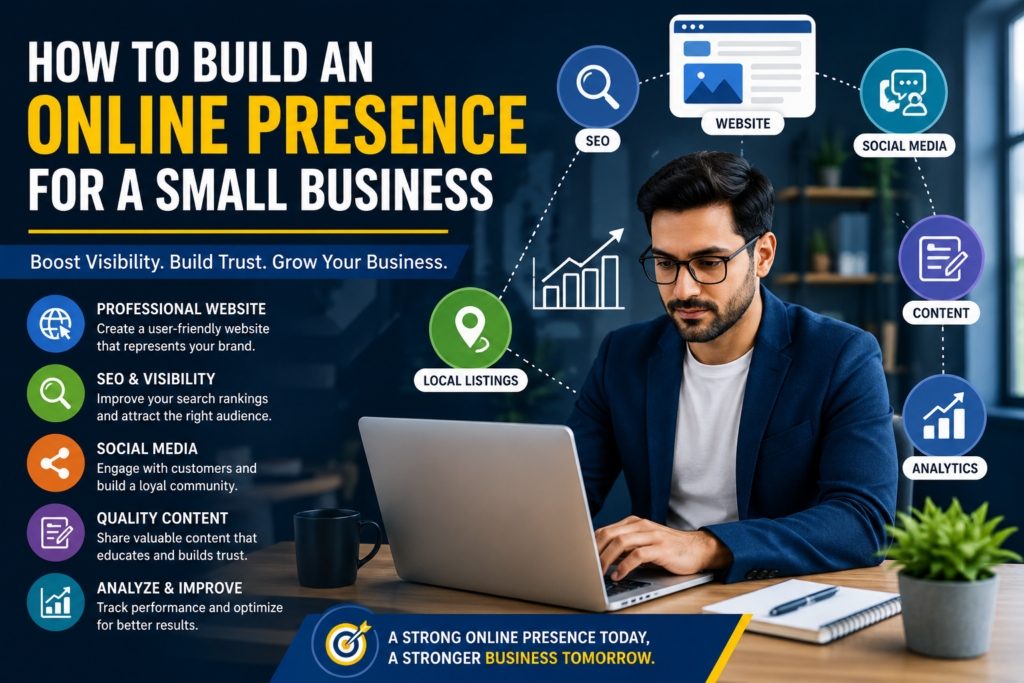
For most small businesses, being visible online is essential. Customers increasingly use search engines, business directories, social media, and company websites to research products and services before making a decision. A business that is difficult to find online can lose potential customers to competitors that provide clearer information and easier ways to get in touch.
Building an online presence does not mean a small business needs to be active on every platform or spend a large amount of money on advertising. A better approach is to create a strong digital foundation and then expand it according to the needs of the business and its target audience.
A professional website, search engine optimization, accurate business listings, useful content, social media, and consistent branding can work together to improve visibility and credibility. The most effective strategy is one that focuses on the channels where potential customers are actually looking.
1. Create a Strong Website and Establish a Clear Digital Foundation
A website should be the center of your online presence. Social media accounts and business directories can help people discover your company, but your website gives you greater control over your information, branding, content, and customer experience.
Start by choosing a professional domain name that is easy to remember and relevant to your business. Your website should also be responsive so that it works properly on desktop computers, tablets, and smartphones.
Your homepage should quickly explain what the business does, who it serves, and what visitors should do next. Use clear headings, readable text, professional images, and visible calls to action. Customers should not have to search through several pages to find your contact information or understand your main services.
A basic small business website will usually need a homepage, about page, service or product pages, contact page, and relevant location information. Depending on the type of business, you may also need pricing information, FAQs, testimonials, case studies, or a blog.
Website performance is another important consideration. Slow-loading pages can create a poor user experience and make it harder for visitors to find the information they need. Compress large images, remove unnecessary plugins, keep software updated, and regularly check important pages.
Search engine optimization should also be part of the website from the beginning. Use descriptive page titles, relevant headings, useful content, logical URLs, optimized images, and internal links. Each page should have a clear purpose and should answer a genuine customer need.
Local businesses should pay particular attention to local search visibility. Make sure your business name, address, phone number, website, opening hours, and other important details are accurate wherever your company appears online.
Understanding your audience should come before deciding what your website should say. Your messaging, services, content, and calls to action should reflect the needs of the people you want to attract. Your existing How to Identify Your Target Market article can provide additional guidance on this process.
Security is also part of maintaining a professional website. Use HTTPS, strong passwords, two-factor authentication where available, regular backups, and updated website software. If customers submit personal or payment information, make sure those processes are handled securely.
2. Improve Visibility Through SEO, Business Listings, Social Media, and Content
A website alone does not guarantee visitors. Small businesses need a strategy for helping potential customers discover their website and other digital channels.
SEO is one of the most useful long-term methods for increasing organic visibility. Begin with keyword research to understand what your potential customers search for. Focus on relevant terms connected to your products, services, location, and customer problems.
Use keywords naturally throughout your website. Avoid repeating the same phrase excessively. Search engines are designed to understand content and user intent, so useful and well-organized information should be the priority.
Official guidance from Google Search Central can help website owners understand how Google Search works and how to improve search visibility.
Business listings are another useful part of an online presence. Claim relevant profiles and make sure your information is accurate and consistent. For local businesses, a Google Business Profile can help potential customers find important information through Google Search and Maps.
Keep your business name, address, phone number, website, opening hours, and services consistent across important platforms. Regularly check listings because outdated information can create confusion and cause customers to contact the wrong number or visit an incorrect location.
Social media can support your online presence, but businesses do not need to join every platform. Select the channels that match your target audience.
For example, a B2B company may benefit from LinkedIn, while a business that relies heavily on visual products may find platforms such as Instagram or YouTube more useful.
Focus on providing useful information rather than constantly promoting products. Content can include answers to common questions, educational posts, product demonstrations, industry information, customer FAQs, tips, and company updates.
Content marketing can also support SEO by creating additional opportunities to appear in search results. Before publishing an article, identify the question or problem it will address and make sure the content provides a useful answer.
Internal linking is particularly valuable when building a content library. Related articles should connect naturally so visitors can move from one topic to another. It also helps search engines understand the relationship between pages.
For example, a business website article about online visibility can naturally connect with How to Start a Small Business With Limited Money when discussing the importance of building a cost-effective digital strategy.
The same principle applies to digital marketing. A business can combine SEO, content marketing, social media, email marketing, and other channels instead of relying entirely on paid advertising. Your Digital Marketing for Small Businesses article can be used as a related resource if it is already published on Global Business Times.
Do not expect immediate results from every channel. SEO may take time to produce significant organic traffic, while social media results can vary depending on the platform and audience. Track performance and focus more resources on channels that generate meaningful results.
3. Build Trust, Measure Performance, and Keep Improving
Visibility is only one part of an effective online presence. Once people discover your business, they need enough information to trust it.
Start by keeping your website and business profiles accurate. Make sure customers can easily find contact information, services, pricing where appropriate, business hours, location details, and other information relevant to their decision.
Customer reviews can also influence trust. Encourage genuine customers to leave honest reviews on appropriate platforms. Never create fake reviews or use misleading testimonials.
Respond to customer reviews professionally, including negative ones. A thoughtful response can show potential customers that the business takes feedback seriously and is willing to resolve problems.
Brand consistency is another important factor. Your website, social media profiles, business listings, email communications, and other digital channels should present a consistent identity.
Use the same business name, logo, core messaging, and general visual style wherever practical. Consistency makes it easier for customers to recognize your company across different platforms.
As your online presence develops, your brand may also need more structure. A useful next step is How to Build a Strong Business Brand From Scratch, which can help connect your digital visibility with a stronger overall brand strategy.
Small businesses should also monitor their online performance. Tools such as Google Analytics and Google Search Console can provide useful information about website traffic, search queries, popular pages, and user behavior.
Do not focus only on traffic numbers. Look at business outcomes such as qualified leads, inquiries, phone calls, purchases, newsletter sign-ups, and conversion rates.
For example, a page may receive thousands of visitors but produce very few inquiries. Another page may receive less traffic but generate a higher percentage of customers. The second page may therefore be more valuable to the business.
Review your online performance regularly and make improvements based on the data.
Update old content, improve underperforming pages, fix broken links, replace outdated information, and expand useful articles when necessary.
Cybersecurity should also remain part of your ongoing digital strategy. Use strong unique passwords, enable two-factor authentication, keep software updated, restrict administrative access, and maintain regular backups.
The National Institute of Standards and Technology provides practical cybersecurity resources through its Cybersecurity Framework.
Finally, avoid depending entirely on one platform. Social media algorithms, advertising costs, search rankings, and platform policies can change. Your website, content, customer relationships, and email database provide more control over your long-term online presence.
Building an online presence is therefore an ongoing process rather than a one-time task. As customer behavior and technology change, your business should continue testing, measuring, and improving its digital strategy.
Conclusion
A strong online presence can help a small business become easier to discover, build customer trust, and generate consistent opportunities.
The process starts with a professional, mobile-friendly website and accurate business information. From there, SEO, business listings, social media, and useful content can increase visibility and bring potential customers into the business.
The most important step is to focus on quality rather than trying to be everywhere. Choose digital channels that match your target audience, provide useful information, maintain consistent branding, and measure the results.
With regular improvements and a clear strategy, an online presence can become an important long-term asset for a small business and support sustainable business growth.