
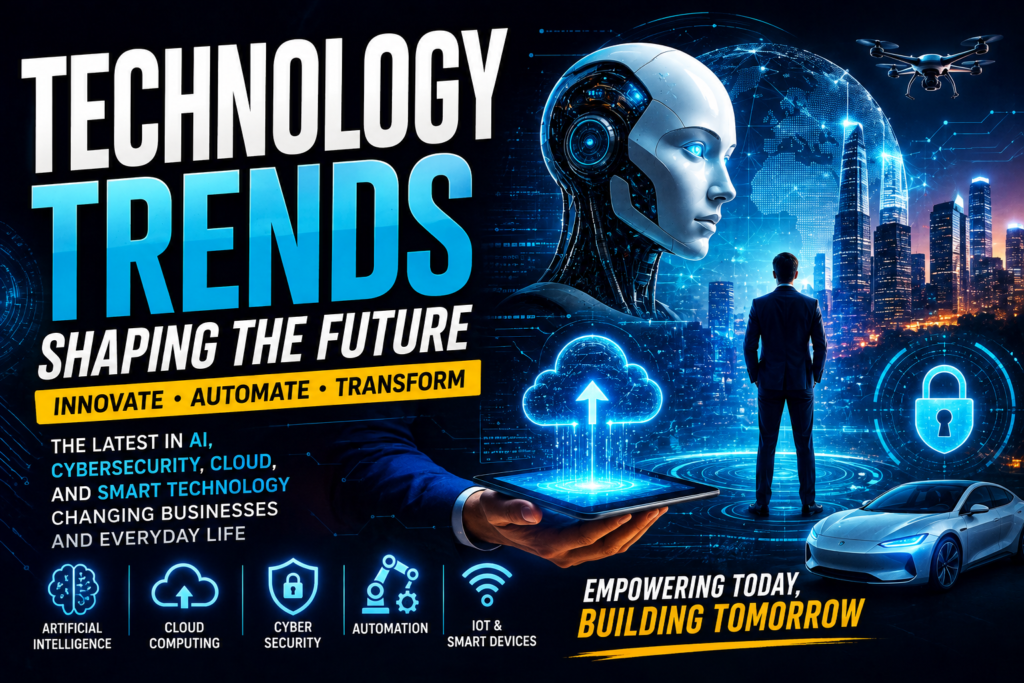
Technology is no longer something that simply supports modern life it has become one of the biggest forces shaping how people work, communicate, shop, learn, and run businesses. From artificial intelligence and automation to cloud computing, cybersecurity, and smart devices, technology continues to transform industries at an incredible pace.
For businesses, adopting the right technology can improve productivity, reduce costs, strengthen customer relationships, and create new opportunities for growth. For individuals, technology provides faster access to information, digital services, entertainment, education, and communication.
As innovation continues to accelerate, understanding the latest technology trends is becoming increasingly important for businesses, entrepreneurs, professionals, and everyday users.
1. Artificial Intelligence and Automation Are Transforming Technology
Artificial intelligence has become one of the most influential developments in modern technology. AI-powered systems can analyze large amounts of information, recognize patterns, generate content, assist customers, automate repetitive tasks, and support decision-making.
Businesses are increasingly using AI to improve customer service, marketing, sales, data analysis, and internal operations. Instead of spending hours performing repetitive activities, employees can use automation tools to handle routine processes and focus on more strategic work.
AI is also changing the way people search for information online. Traditional search engines are increasingly being complemented by AI-powered assistants that can understand questions, summarize information, and provide personalized answers.
For startups and small businesses, this development creates major opportunities. Companies can use affordable AI tools for tasks such as content research, customer support, social media management, data analysis, and workflow automation.
The growth of AI also connects closely with startup business ideas, because entrepreneurs can build new products and services around artificial intelligence. Many successful technology startups are focusing on specialized AI solutions for healthcare, finance, education, marketing, cybersecurity, and other industries.
Automation is another major part of this transformation. Businesses can automate email marketing, appointment scheduling, inventory management, reporting, customer communication, and many other processes.
However, technology should not simply be adopted because it is popular. Companies should first identify a real business problem and then choose technology that provides a measurable solution.
The most successful organizations will likely be those that combine human creativity and judgment with the speed and efficiency of AI-powered technology.
2. Cloud Computing, Cybersecurity and Smart Technology Are Becoming Essential
Another major shift in technology is the rapid adoption of cloud computing. Instead of keeping all software, files, and business systems on local computers, organizations can access computing resources and data through internet-based platforms.
Cloud technology makes it easier for businesses to collaborate, store information, operate applications, and scale their digital infrastructure. Employees can work from different locations while accessing the same systems and files.
For growing companies, this flexibility can be particularly valuable. A startup can begin with relatively limited infrastructure and increase its technology resources as the business expands.
At the same time, the growth of digital services creates a greater need for cybersecurity.
Cyberattacks, phishing attempts, data theft, account compromises, and other digital threats can affect businesses of every size. A strong cybersecurity strategy should therefore be considered an essential part of modern business operations rather than an optional investment.
Businesses should use strong passwords, multi-factor authentication, secure backups, software updates, access controls, and employee security training to reduce unnecessary risks.
Website owners should also pay attention to technical security. Maintaining an SSL certificate, keeping WordPress and plugins updated, monitoring vulnerabilities, and regularly backing up a website can help protect valuable digital assets.
This is especially important for businesses investing in SEO and digital marketing, because a website represents both a marketing asset and an important part of the company’s online reputation.
Smart technology is also becoming more common in homes, offices, transportation, healthcare, and manufacturing. Internet-connected devices can collect information, communicate with other systems, and perform tasks automatically.
From smart security systems and connected appliances to wearable devices and industrial sensors, the Internet of Things is creating increasingly connected environments.
The combination of cloud computing, cybersecurity, AI, and connected devices is creating a technology ecosystem in which digital systems can communicate, learn, and respond more intelligently.
3. The Future of Technology Will Create New Opportunities for Businesses and Consumers
Technology is likely to continue changing rapidly over the coming years. Emerging developments in artificial intelligence, robotics, digital payments, automation, extended reality, biotechnology, and advanced computing could introduce entirely new products and services.
One of the biggest opportunities will be digital transformation. Businesses that once relied heavily on traditional processes can use modern technology to improve efficiency and reach customers through digital channels.
For example, a small local company can create an online store, use social media to reach new customers, implement digital payment systems, use analytics to understand customer behavior, and apply automation to improve its daily operations.
Technology is also changing employment and professional skills. Workers increasingly need digital literacy, data analysis, cybersecurity awareness, AI skills, and the ability to work with modern software platforms.
This does not necessarily mean technology will replace every traditional job. Instead, many roles are likely to change as technology takes over repetitive tasks while humans focus more on creativity, communication, strategy, problem-solving, and decision-making.
Entrepreneurs should pay close attention to these changes. New technology often creates new markets, and businesses that identify emerging customer needs early can gain a significant competitive advantage.
For consumers, the future could bring more personalized digital experiences, smarter devices, faster services, and increasingly connected environments. However, convenience must be balanced with privacy and security.
People should understand how their personal information is collected, stored, and used by digital platforms. Businesses, meanwhile, have a responsibility to handle customer data responsibly and maintain appropriate security standards.
Ultimately, technology is not simply about having the newest device or software. The real value of technology comes from using innovation to solve problems, improve experiences, and create meaningful opportunities.
As the digital economy continues to expand, businesses and individuals that remain adaptable will be better prepared for the future. Whether it is digital marketing, artificial intelligence, cybersecurity, cloud computing, or automation, technology will remain a central part of economic and social development.
The future belongs not necessarily to those who adopt every new technology, but to those who understand which technologies can create real value and use them strategically.