

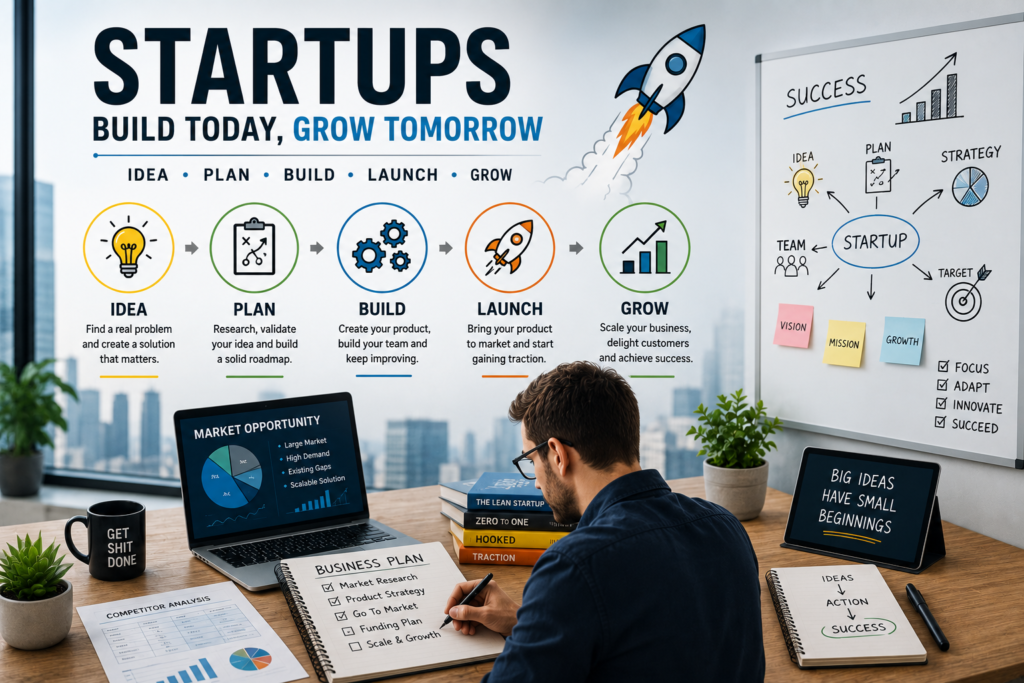
Startups often begin with a simple idea: solve a problem, create something valuable, and build a successful business. However, turning an idea into a sustainable company requires much more than enthusiasm and innovation.
Many startups fail not because their founders lack ambition, but because they struggle to understand customer needs, manage resources, build the right team, or create a sustainable business model.
A successful startup is built through continuous learning and improvement. Founders must be willing to test ideas, listen to customers, respond to market changes, and make informed decisions.
While every startup is different, several fundamental principles can help new businesses create a stronger foundation for long-term success.
Solving a Real Problem Is the Foundation of a Successful Startup
One of the most important factors behind startup success is solving a genuine problem.
Many entrepreneurs begin with a product idea and immediately start building it. However, a product can only become successful if people actually need or want it.
Before investing significant time and resources, founders should understand the problem they are trying to solve.
Important questions include:
- Who experiences this problem?
- How frequently does the problem occur?
- How are people currently solving it?
- Is the existing solution expensive, slow, or inconvenient?
- Would customers be willing to pay for a better solution?
Customer research can help founders answer these questions. Conversations, surveys, interviews, online discussions, and market research can provide valuable insights.
The goal is not to receive compliments about an idea. The goal is to understand whether the problem is serious enough for customers to seek a solution.
A startup should also remain open to changing its original idea. Sometimes customer feedback reveals that the most valuable opportunity is different from the initial concept.
This process of adjusting a product or business model based on customer feedback is often essential for startup development.
The most successful startups tend to focus on customer problems rather than simply trying to create impressive technology.
Innovation becomes valuable when it improves people’s lives, reduces costs, saves time, or solves a problem more effectively.
Building the Right Team and Business Model
A strong team can significantly influence a startup’s ability to grow.
Founders cannot always manage every part of a business alone. As a startup develops, it may require expertise in product development, marketing, sales, finance, customer support, and operations.
Hiring the right people is therefore an important decision.
Startups should look for individuals who not only possess technical skills but also demonstrate adaptability and a willingness to learn. Early-stage companies often change direction quickly, so employees must be comfortable working in uncertain environments.
Company culture also begins developing at an early stage. Founders should encourage communication, accountability, and collaboration.
A healthy company culture can help attract talented employees and improve employee retention.
The business model is equally important. A startup needs to understand how it will generate revenue and maintain financial sustainability.
Some startups rely on direct product sales, while others use subscriptions, advertising, commissions, licensing, or other revenue models.
A good business model should clearly explain:
- Who pays for the product or service?
- What value does the customer receive?
- How much does it cost to deliver the product?
- Can the company generate sustainable profit?
- How can the business grow efficiently?
Startups should also monitor their spending carefully. High expenses and uncontrolled growth can create financial pressure.
Growth is valuable, but it should be supported by a sustainable business model.
Using Technology and Data to Support Startup Growth
Technology has made it easier for startups to build products, reach customers, and manage operations.
Cloud-based tools allow small teams to access powerful software without making large investments in physical infrastructure.
Digital marketing platforms can help startups reach specific audiences. Search engine optimization, content marketing, social media, email campaigns, and online advertising can all support customer acquisition.
However, startups should focus on the channels that are most relevant to their target customers.
Data can also support better decision-making. Startups can analyze customer behavior, sales performance, website traffic, product usage, and marketing results.
This information can help founders understand what is working and where improvements are needed.
Artificial intelligence and automation are also becoming increasingly useful for startups. Businesses can use digital tools to automate repetitive tasks, analyze information, improve customer support, and increase productivity.
However, technology should support the business strategy rather than become the strategy itself.
Startups should avoid adopting tools simply because they are popular. Every technology investment should contribute to a clear business objective.
Testing and experimentation are also important. Startups can launch smaller versions of products, collect feedback, and improve their offerings over time.
This approach can reduce unnecessary investment and help companies understand what customers actually value.
A startup’s ability to learn quickly can become a major competitive advantage.
Conclusion
Building a successful startup requires more than a creative idea. Founders must understand real customer problems, create valuable solutions, build capable teams, develop sustainable business models, and use technology effectively.
The startup journey often involves uncertainty and challenges. Businesses may need to change their strategies, improve their products, or rethink their original assumptions.
This flexibility is an important part of entrepreneurship.
Startups that listen to customers, manage resources carefully, measure performance, and continue learning are better positioned to build long-term success.
The strongest businesses are not always those that grow the fastest. They are often the companies that create genuine value and build a strong foundation for sustainable growth.