

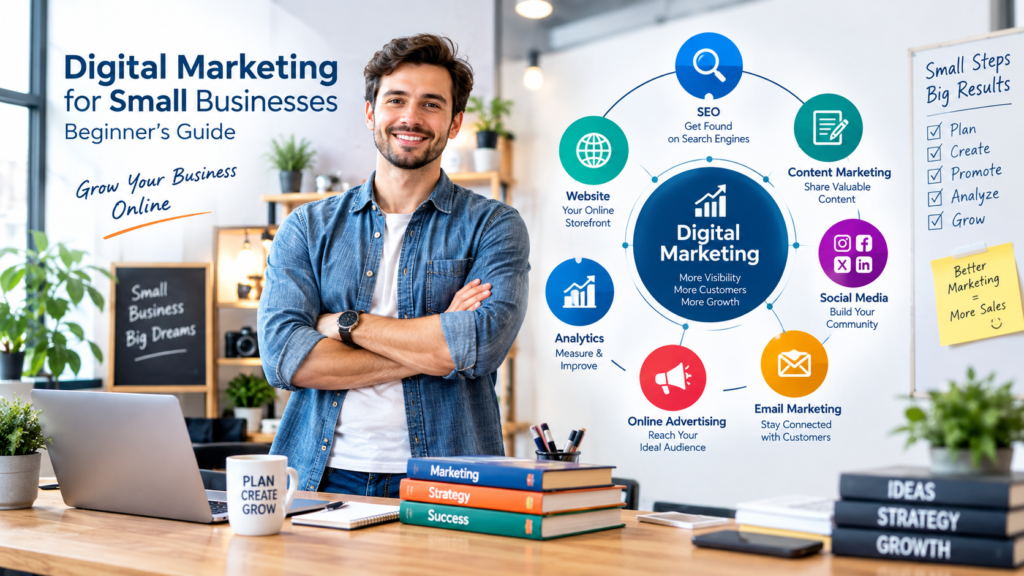
Digital marketing has become an important way for small businesses to reach potential customers, build brand awareness, and communicate with their audiences online. Instead of depending only on traditional advertising, businesses can use websites, search engines, social media, email, online advertising, and useful content.
For small businesses, digital marketing can look complicated because there are many platforms and strategies available. However, a business does not need to use every channel at the same time.
A practical approach is to understand the available options, identify the right audience, establish an online presence, create useful content, and measure performance over time.
The main objective is to build a digital marketing system that matches the business, its customers, and its available resources.
What Is Digital Marketing for Small Businesses?
Digital marketing refers to marketing activities that use online channels and digital technologies to communicate with current and potential customers.
A small business may use its website as the center of its online activities and then use search engines, social media, email, content, or paid advertising to attract visitors.
The first step is understanding the target audience. A business should know who it wants to reach, what those people are interested in, what questions they have, and where they usually search for information.
A clear understanding of the audience can help businesses create more relevant website pages, marketing messages, and content.
A professional website is also an important part of digital marketing. The website should clearly explain what the business offers, who it serves, and how visitors can contact the company or learn more about its products and services.
Search engine optimization can then help search engines understand the website and help users discover relevant pages through search.
Content is another important component. Businesses can publish articles, guides, FAQs, videos, educational resources, and other materials that answer questions or provide useful information.
The U.S. Small Business Administration recommends considering areas such as target market, competitive advantage, marketing goals, action plans, budget, and measurement when developing a marketing plan.
Important Digital Marketing Channels
Small businesses can use several digital marketing channels, but the right combination depends on the business model, audience, industry, and available resources.
Search engine optimization, or SEO, focuses on helping search engines understand website content while making pages useful for people. Google’s SEO Starter Guide explains that SEO can help search engines crawl, index, and understand website content.
A well-planned SEO strategy may include creating useful content, improving page titles, organizing website navigation, using descriptive URLs, improving internal linking, and maintaining a technically accessible website.
Content marketing works closely with SEO. Businesses can create useful resources around topics that matter to their customers instead of publishing random content.
Social media is another option. A business can use relevant platforms to share updates, educational information, products, services, customer-focused content, and company news.
Email marketing can help businesses communicate with people who have chosen to receive messages. Newsletters, announcements, educational content, and product information are common examples.
Paid advertising can also be used through search engines, social platforms, and other digital channels. Paid campaigns can be useful for specific goals, but they require budgeting and ongoing monitoring.
A strong online presence combines these channels with consistent business information and branding. A website, social profiles, business listings, content, and customer communication should provide accurate and consistent information.
For local businesses, location-based digital marketing can also be relevant. Business information such as name, address, phone number, opening hours, and services should be accurate across important online platforms.
How to Build a Simple Digital Marketing Strategy
Small businesses do not need a complicated strategy to begin.
The first step is to establish clear goals. A business may want to increase website visibility, generate inquiries, build an email audience, promote a service, or improve awareness of its brand.
Next, businesses should understand how customers discover information. This includes the search terms they use, websites they visit, social platforms they prefer, and questions they ask before making a purchasing decision.
This is where content marketing can become useful.
Instead of creating content simply to publish something new, businesses can develop articles, videos, guides, and other resources around genuine customer questions.
For example, an accounting business could create educational content about bookkeeping and cash flow. A local restaurant could publish information about its menu, location, events, and customer experience.
Keyword research can help businesses understand how people search for information, but keywords should be used naturally and should match the purpose of the page.
Businesses should also consider mobile users. Websites need to be easy to read and navigate on smartphones and tablets.
Consistency matters as well. Business information, branding, services, and contact details should remain accurate across important digital channels.
Measurement should be part of the strategy from the beginning.
Depending on the business, useful metrics can include search impressions, website traffic, clicks, inquiries, email subscriptions, engagement, advertising costs, and conversions.
Not every metric needs to be tracked. The most useful measurements are those connected to the business’s actual objectives.
The business can then use the results to refine its strategy. For example, it might update an underperforming page, create more content around a useful topic, adjust an advertising campaign, or focus more attention on a channel that is relevant to its audience.
A practical marketing plan should therefore be flexible and capable of changing as the business learns more.
Common Digital Marketing Mistakes
One common mistake is trying to use every available digital channel at once.
A small business with limited time or budget may find it more practical to concentrate on a few channels that are relevant to its customers.
Another mistake is publishing large amounts of low-value content. More content does not automatically mean better marketing. Content should be useful, relevant, accurate, and created primarily for people.
Businesses should also avoid unrealistic marketing claims. Statements about products, services, pricing, performance, or customer results should be accurate and supportable.
Ignoring existing customers can also limit a digital marketing strategy. Online marketing can be used not only to attract new customers but also to communicate with existing audiences.
Another common problem is inconsistent business information. Incorrect contact details, outdated service information, or different branding across platforms can create confusion.
Businesses should also monitor their performance regularly. Without measurement, it can be difficult to understand whether a digital activity is producing meaningful results.
Organic activities such as SEO and content marketing also require patience. They are generally ongoing processes rather than one-time campaigns.
A sustainable strategy is often easier to maintain when businesses start with manageable activities and expand as they gain experience.
Conclusion
Digital marketing gives small businesses multiple ways to reach potential customers, communicate their value, and build a stronger online presence.
The process begins with understanding the target audience and creating a reliable digital foundation. Businesses can then use SEO, content marketing, social media, email, local search, and paid advertising according to their goals and resources.
A successful strategy does not require every digital platform. It requires clear objectives, useful content, consistent communication, realistic expectations, measurement, and continuous improvement.
Small businesses can start with a few relevant channels, learn from the results, and gradually build a broader digital marketing system over time.
Editorial Note: This article is intended for general informational and educational purposes only. Marketing results can vary based on industry, audience, competition, budget, business model, and other factors.