
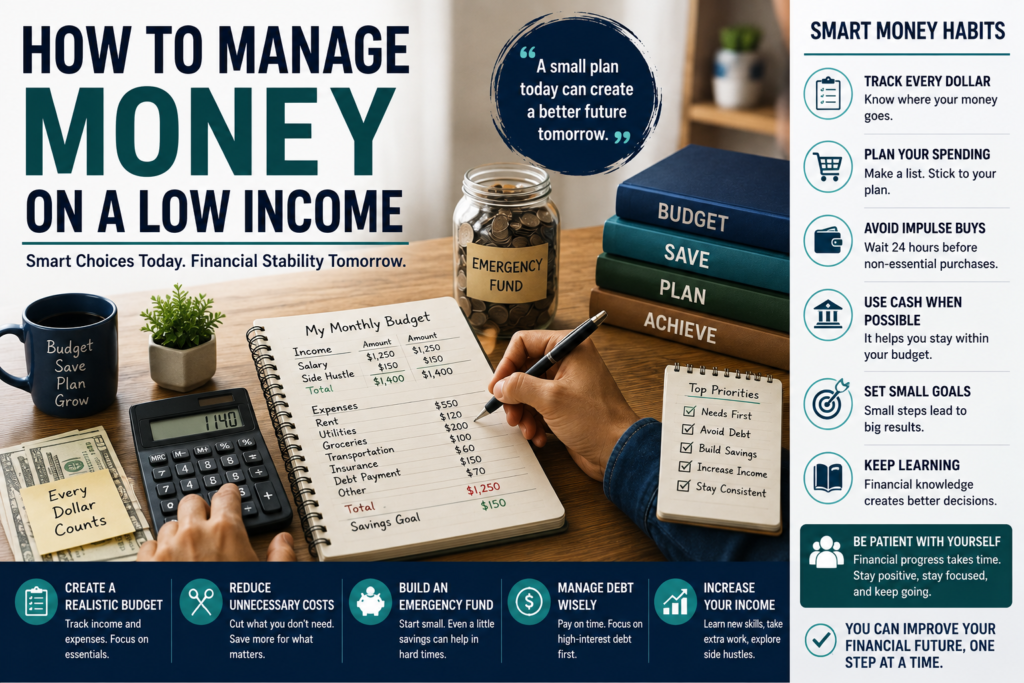
Managing money on a low income can be challenging, especially when essential expenses consume most of the money coming into the household. Housing, food, transportation, utilities, debt payments, and other necessary costs can leave little room for savings or unexpected expenses.
However, effective money management is not only about how much money someone earns. It is also about understanding where money goes, prioritizing essential expenses, reducing avoidable costs, creating realistic financial goals, and making careful decisions about debt and savings.
When income is limited, the goal should not be to follow an unrealistic financial plan. Instead, the focus should be on creating a system that works with the money available today while gradually improving financial stability.
A practical approach begins with understanding income and expenses. From there, individuals can prioritize necessities, identify expenses that can be reduced, build even a small emergency reserve, manage debt carefully, and look for realistic ways to increase income.
Financial management should also be flexible. Income can change because of employment, freelance work, seasonal opportunities, family responsibilities, or unexpected expenses. A good financial plan should therefore be reviewed regularly rather than treated as a permanent set of rules.
1. Build a Realistic Budget Around Your Essential Expenses
The first step in managing money on a low income is knowing exactly how much money comes in and where it goes.
Start by calculating your average monthly income. Include regular wages, freelance income, business income, benefits, and other reliable sources. If income changes from month to month, use a conservative estimate rather than assuming that every month will be your best month.
Next, list your expenses.
Divide them into three broad groups:
- Essential expenses
- Flexible expenses
- Financial priorities
Essential expenses may include housing, basic food, utilities, transportation, insurance, required debt payments, and other costs that are necessary for daily life.
Flexible expenses may include entertainment, subscriptions, restaurant meals, shopping, and other spending that can potentially be adjusted.
Financial priorities may include emergency savings, debt reduction, and longer-term financial goals.
This process helps reveal where the available money is going. The FDIC’s Money Smart resources similarly emphasize tracking income and expenses and developing a spending and saving plan, including prioritizing spending when money is limited.
A useful starting point is Smart Money Management, which covers budgeting, emergency savings, debt management, and other basic financial habits.
The objective is not to create a perfect budget that looks good on paper but cannot be followed. A realistic budget should reflect actual circumstances.
For example, if groceries regularly cost more than expected, reducing the budget to an unrealistically low amount will not solve the problem. Instead, look for practical ways to reduce the cost while maintaining essential needs.
Review recurring expenses carefully. Small monthly payments can become significant over an entire year. Streaming services, unused memberships, unnecessary subscriptions, premium plans, and other recurring costs may be worth reviewing.
This does not mean eliminating everything enjoyable. A sustainable budget should leave some room for personal spending when possible. A financial plan that is excessively restrictive may be difficult to maintain.
Another useful strategy is separating needs from wants.
A need is generally something required for basic living or an important obligation. A want is something that improves convenience, entertainment, or lifestyle but may be postponed when money is tight.
This distinction can help when deciding which expenses should receive priority.
For additional planning ideas, Smart Financial Planning explains how budgeting, saving, debt management, investing, and long-term financial goals can work together as part of a broader financial plan.
People with irregular income should also consider using a variable-income budget. Instead of spending based on the highest amount earned in a good month, base essential commitments on a conservative income estimate.
When additional income arrives, it can then be assigned to priorities such as overdue expenses, emergency savings, debt reduction, or future needs.
Tracking expenses is equally important. A simple spreadsheet, budgeting application, notebook, or banking tool can be enough.
The important thing is consistency.
Reviewing expenses once a month can help identify patterns. You may discover that transportation costs are higher than expected, certain subscriptions are rarely used, or frequent small purchases are affecting the monthly budget.
Once these patterns become visible, decisions become easier.
2. Reduce Financial Pressure Without Sacrificing Essential Needs
When income is limited, reducing expenses can create immediate financial breathing room. However, cost-cutting should be strategic rather than extreme.
Start with expenses that can be reduced without creating new problems.
For example, compare prices for insurance, phone plans, internet services, transportation options, household products, and other recurring expenses. Ask whether a less expensive option provides most of the same value.
Food is another area where planning can make a difference. Preparing meals at home, planning purchases, comparing prices, reducing food waste, and using existing ingredients before buying more can help control spending.
However, avoid unrealistic strategies that ignore the cost of time, transportation, or basic nutrition. The objective is to manage expenses responsibly, not simply to reduce every possible cost.
The same principle applies to transportation. If possible, compare the cost of public transportation, carpooling, walking, cycling, or combining multiple errands into one trip. The best option will depend on location, work requirements, safety, and accessibility.
Debt deserves special attention.
When money is limited, high-interest debt can make it difficult to improve financial stability because a significant portion of future income may already be committed to repayments.
Make required payments on time whenever possible and understand the interest rates, fees, balances, and due dates associated with each debt.
If several debts exist, creating a clear repayment plan can make the situation easier to manage. However, individuals should be cautious about taking on new loans simply to cover everyday spending unless they fully understand the costs and repayment requirements.
For people struggling with debt, reputable nonprofit or government financial education resources may be more useful than companies promising quick financial solutions.
Another important priority is avoiding unnecessary financial fees. Review bank account charges, late fees, subscription renewals, overdraft costs, and other avoidable expenses.
Automated reminders or calendar alerts can help prevent missed payment dates.
At the same time, do not cut expenses that protect basic financial stability. Cancelling necessary insurance, skipping essential maintenance, or ignoring important bills may create larger costs later.
When money is tight, prioritize expenses according to their importance and consequences.
The FDIC recommends reviewing recurring expenses and considering whether costs can be eliminated, reduced, or replaced with better-value alternatives.
Building savings can also be difficult on a low income, but the absence of a large amount of disposable income does not necessarily mean saving is impossible.
If circumstances allow, start with a small amount.
The first objective can be creating a modest emergency reserve rather than immediately trying to save a large amount. Even a small reserve can provide some protection against minor unexpected expenses.
The FDIC’s financial education resources include guidance on savings, spending plans, emergency preparation, and prioritizing financial goals.
An emergency fund should generally be kept somewhere accessible and separate enough from everyday spending that it is not accidentally used for routine purchases.
However, financial goals should be realistic. Someone dealing with insufficient income and essential expenses should not feel pressured to save large amounts immediately. Stabilizing essential finances may need to come first.
Another way to create breathing room is to increase income.
Expense reduction has a limit. There are only so many costs that can be removed, but income may have more potential to change over time.
Depending on skills and circumstances, possible options could include additional work hours, freelancing, selling unused items, developing a marketable skill, taking on contract work, or building a small side business.
The right option depends on available time, skills, transportation, family responsibilities, and local opportunities.
If someone is starting a business with limited resources, How to Start a Small Business With Limited Money provides practical ideas for controlling startup costs and testing demand before making larger investments.
The key is to avoid spending money in the hope that a new income opportunity will definitely succeed. Be cautious with expensive courses, high-cost business opportunities, and programs that promise guaranteed income.
Improving income should strengthen financial stability rather than create additional financial pressure.
3. Create a Long-Term Plan and Make Financial Progress Gradually
Managing money on a low income is not only about surviving from one month to the next. When possible, the goal should also be to gradually create greater financial stability.
Start by identifying the most important financial problem that needs attention.
For one person, that may be overdue bills. For another, it may be high-interest debt. Someone else may need to build a small emergency reserve or stabilize an unpredictable income.
Trying to solve every financial problem simultaneously can become overwhelming. A better approach is to prioritize.
A simple order might be:
- Cover essential living expenses.
- Keep important bills and required debt payments current.
- Reduce avoidable expenses.
- Build a small emergency reserve when possible.
- Address expensive debt.
- Increase income where realistic.
- Work toward longer-term financial goals.
The exact order can change depending on personal circumstances.
Financial goals should also be specific. Instead of saying “I want to save money,” define what the money is for.
Examples include:
- Building an emergency reserve
- Paying off a specific debt
- Saving for education
- Replacing an essential vehicle
- Moving to a more affordable home
- Starting a business
- Preparing for retirement
Clear goals make it easier to decide what to do with additional income.
Long-term planning is also important because financial circumstances can change. A person may eventually earn more, change jobs, start a business, or experience different household expenses.
When income increases, avoid automatically increasing every category of spending.
This is sometimes called lifestyle inflation. If expenses rise at the same speed as income, financial improvement may be limited.
Instead, consider directing at least part of additional income toward financial priorities.
For example, an increase in income could be divided between necessary lifestyle improvements, savings, debt reduction, and future goals.
Financial education can make these decisions easier. The FDIC’s Money Smart program provides educational resources covering topics including income and expenses, spending and saving plans, savings, borrowing, and financial protection.
Government resources can also provide reliable financial information. MyMoney.gov brings together financial education resources from multiple U.S. government agencies, while the Consumer Financial Protection Bureau provides consumer-focused financial education and tools.
When researching financial advice online, pay attention to the quality of the source. Financial information should be based on clear evidence rather than promises of guaranteed returns or instant wealth.
This is especially important when considering investments.
People managing a low income may feel pressure to make risky investments because they want their money to grow quickly. However, taking excessive financial risk with money needed for essential expenses can make financial problems worse.
Before considering an investment, make sure basic financial needs are being addressed and understand the potential risks, fees, time horizon, and possibility of losing money.
There is no single financial strategy that works for everyone.
Location, household size, income stability, debt, employment, housing costs, and other circumstances can significantly change what is practical.
For this reason, personal finance advice should be adapted to individual circumstances rather than followed blindly.
Another useful habit is conducting a monthly financial review.
At the end of each month, ask:
- Did income match expectations?
- Which expenses were higher than expected?
- Which expenses could be reduced?
- Did I make progress toward my financial priority?
- Did any unexpected expense appear?
- What needs to change next month?
This review turns budgeting into an ongoing process rather than a one-time activity.
It can also help identify gradual improvements.
Perhaps a recurring expense was cancelled, a debt balance decreased, a small emergency reserve was created, or an additional income source became available. These may seem like small achievements individually, but consistent improvements can strengthen financial stability over time.
For broader financial planning, businesses and individuals can also learn from Common Small Business Mistakes and How to Avoid Them, particularly the sections discussing financial planning, operating costs, cash flow, and avoiding decisions based only on assumptions.
Managing money on a low income requires patience and realistic expectations.
There may be months when savings are impossible because of an unexpected expense. There may be periods when income falls or essential costs increase. Financial progress is not always a straight line.
The important thing is to return to the plan when circumstances improve.
A strong financial system does not require perfection. It requires awareness, prioritization, and consistency.
Over time, better expense tracking can reveal opportunities to save. A small emergency reserve can reduce reliance on expensive borrowing. Debt management can free future income. Skills and additional income can improve earning potential. Better financial knowledge can support more informed decisions.
These improvements can reinforce one another.
Ultimately, managing money on a low income is about making the most effective use of available resources while working toward greater financial stability.
The goal is not to compare your financial situation with someone else’s. The goal is to understand your own circumstances, make practical decisions, and improve your position gradually.
With a realistic budget, controlled expenses, careful debt management, modest savings when possible, and a focus on sustainable income growth, individuals can create a stronger financial foundation even when money is limited.