

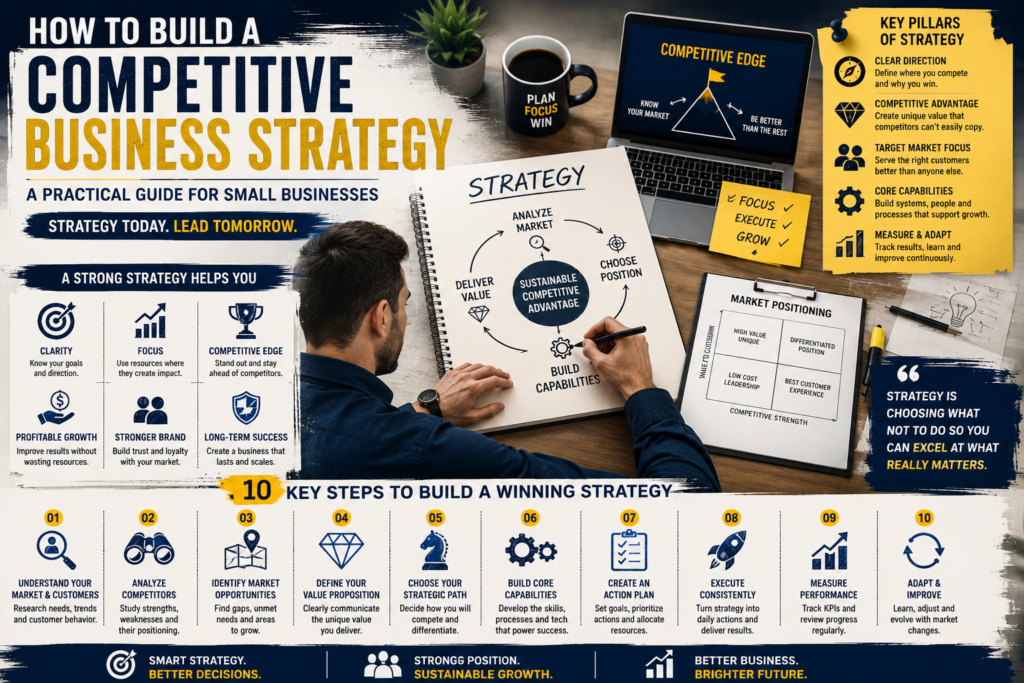
A strong business strategy helps a company decide where to compete, which customers to serve, how to differentiate its offer, and how to use its limited resources effectively. Without a clear strategy, businesses can spend money on activities that create attention but do not produce sustainable results.
A competitive business strategy should give a company a clear position in the market. It should explain what the business does better, who it serves, how it creates value, and why customers should choose it over competitors.
For small businesses, strategy is particularly important because resources are often limited. Instead of trying to compete everywhere, a smaller company can focus on a specific market, build specialist expertise, improve customer experience, and use technology efficiently.
1. Define Your Market Position and Competitive Advantage
The first step in building a competitive strategy is deciding where your business wants to compete.
A company should clearly define:
- Its target customers
- The problem it solves
- Its products or services
- Its market
- Its key competitors
- Its unique value proposition
A clear target market allows a business to focus its resources on customers who are most likely to need and buy its products or services.
Instead of targeting everyone, identify a specific group with a strong problem or need. This can make marketing, product development and sales more efficient.
For example, a business providing digital services could focus on small eCommerce companies rather than every business category. Specialization can make the company easier to understand and differentiate.
The next step is identifying your competitive advantage.
A competitive advantage is something that allows a business to create more value for customers or operate more effectively than competitors.
It could come from:
- Lower costs
- Better quality
- Faster delivery
- Specialist expertise
- Strong customer support
- Better technology
- Local knowledge
- Stronger relationships
- Convenience
- Product differentiation
Your advantage should be meaningful to customers. Having a feature that customers do not care about will not create a useful competitive position.
The World Bank’s work on private-sector development emphasizes the importance of productivity, innovation, competition and business capabilities in creating stronger firms and markets. World Bank resources on business competitiveness and private-sector development provide useful broader context for understanding how companies can strengthen their position.
Your existing How to Identify Your Target Market article can help you define the audience before developing the strategy.
2. Analyze Competitors and Identify Market Opportunities
A competitive strategy requires a realistic understanding of competitors.
Begin by identifying direct competitors that offer a similar product or service. Then look at indirect competitors that solve the same customer problem in a different way.
For each major competitor, examine:
- Products or services
- Pricing
- Target customers
- Marketing channels
- Website experience
- Customer reviews
- Strengths
- Weaknesses
- Reputation
- Delivery or support process
Do not copy competitors. The purpose of competitor analysis is to identify market gaps and understand how customers evaluate existing solutions.
Customer reviews can be especially useful because they reveal common complaints and unmet needs.
For example, customers may complain that a competitor is:
- Too expensive
- Difficult to contact
- Slow to deliver
- Complicated to use
- Poor at communication
- Missing an important feature
Any repeated weakness can become a potential opportunity.
Market trends should also be considered. Changes in technology, consumer behavior, regulations, demographics and purchasing patterns can create new demand.
The OECD’s work on SMEs and entrepreneurship examines how small and medium-sized businesses respond to changing markets, innovation and digitalization. OECD resources on SMEs and entrepreneurship can provide additional international context when researching market conditions.
A good strategy should identify not only where the market is today, but also where it is moving.
However, avoid assuming that every emerging trend represents an opportunity. Evaluate whether there is actual customer demand and whether your business has the capabilities to serve it.
3. Choose the Right Strategy for Growth and Long-Term Success
Once you understand the market and your competitors, decide how your business will compete.
A company generally needs to make clear choices rather than attempting to be everything to everyone.
One option is cost efficiency. A company may focus on delivering a useful product or service at a competitive price by controlling expenses and improving operations.
Another option is differentiation. A business may compete through higher quality, specialist expertise, design, technology, convenience or superior service.
A third approach is specialization. A company may focus on a narrow customer segment and become highly relevant to that audience.
For a small business, specialization can often be more realistic than trying to compete directly with large companies across an entire market.
Your business strategy should also determine which activities deserve investment.
For example, if search engines consistently bring qualified customers, SEO may deserve greater attention. If referrals produce the highest-value customers, the business may want to strengthen its referral process.
Use evidence instead of assumptions.
Set measurable strategic goals such as:
- Increasing qualified leads
- Improving customer retention
- Increasing average order value
- Entering a new market
- Improving conversion rates
- Reducing operating costs
- Increasing recurring revenue
Then decide how those goals will be achieved.
Your existing business growth strategy article can provide additional guidance on connecting competitive positioning with revenue, technology, customer relationships and long-term growth.
A strategy should also consider resources.
Ask:
- Do we have the right skills?
- Do we have enough capital?
- Can our technology support the plan?
- Can our team handle additional customers?
- Can our suppliers support expansion?
- Which activities should we stop doing?
Strategic focus often means saying no to opportunities that do not fit the business.
A new project may sound attractive but still distract the company from its strongest market position.
4. Build the Capabilities That Support Your Strategy
A strategy only works when the organization can execute it.
If your strategy depends on superior customer service, employees need the training and systems to deliver it.
If your strategy depends on technology, the company needs appropriate software, processes and technical skills.
If your strategy depends on content and SEO, the business needs a consistent system for creating useful content and measuring performance.
This is why business capabilities are an important part of competitive strategy.
Key capabilities can include:
- Sales
- Marketing
- Customer service
- Product development
- Operations
- Data analysis
- Technology
- Financial management
- Leadership
Small businesses should identify the capabilities that directly support their competitive position and prioritize investments in those areas.
Technology can also improve efficiency. Automation, cloud software, analytics and artificial intelligence can reduce repetitive work and help employees focus on higher-value tasks.
However, technology should support the strategy rather than replace it.
Buying expensive software without a clear business purpose does not create a competitive advantage.
The same applies to AI. Businesses should identify specific use cases where AI can improve productivity, customer experience or decision-making.
Training is equally important. A business strategy may fail if employees do not understand the goals or how their work contributes to them.
Communicate the strategy in simple terms.
Everyone should understand:
Who are we serving?
What value are we providing?
Why are customers choosing us?
What are our most important priorities?
5. Measure Results, Adapt to Change and Protect Your Position
A competitive business strategy should evolve as the market changes.
Review your performance regularly and compare actual results with strategic objectives.
Useful business performance metrics can include:
- Revenue growth
- Profit margin
- Customer acquisition cost
- Customer retention rate
- Conversion rate
- Market share
- Repeat purchases
- Average order value
- Employee productivity
Metrics should help you understand whether your strategy is actually producing results.
For example, a business may increase website traffic while generating fewer qualified leads. In that case, the strategy may need to focus more on audience quality and conversion rather than traffic volume.
Businesses should also monitor changes in the competitive landscape.
A competitor may launch a new product, lower prices, enter your market or adopt a new technology.
Customer expectations can change just as quickly.
A strong strategy therefore includes regular strategic reviews.
Consider asking every quarter:
- What is working?
- What is not working?
- What has changed?
- What are competitors doing?
- What are customers asking for?
- Where are new opportunities?
- Which activities should we stop?
- What should we test next?
Innovation should be part of this process.
Innovation does not necessarily mean inventing a revolutionary product. It can mean improving an existing process, making a service easier to use, developing a better offer, or finding a new way to reach customers.
Businesses should also protect their competitive position.
That can involve:
- Developing specialist knowledge
- Building strong customer relationships
- Creating efficient processes
- Protecting intellectual property
- Strengthening supplier relationships
- Investing in employee skills
- Maintaining reliable technology
- Building a trusted brand
A sustainable advantage is usually difficult for competitors to copy quickly.
For a small company, relationships and specialist expertise can become valuable assets that take years for competitors to replicate.
Your existing How Small Businesses Can Compete With Larger Companies article explores practical ways smaller businesses can use specialization, customer relationships, speed, technology and innovation to compete more effectively.
A competitive strategy should ultimately create a clear path from positioning to execution.
The business should know which market it wants to serve, how it will differentiate itself, what capabilities it needs, how it will measure progress, and how it will respond when conditions change.
Conclusion
Building a competitive business strategy requires more than writing a mission statement or listing business goals.
Start by identifying a clear target market and defining the value your company provides. Then analyze competitors, identify market opportunities and choose a realistic way to compete.
For small businesses, specialization, customer experience, technology, efficiency and strong relationships can provide meaningful advantages without requiring the resources of large corporations.
Once the strategy is established, build the capabilities needed to execute it. Invest in people, processes and technology that directly support your competitive position.
Finally, measure results and adapt. Markets change, competitors evolve and customer expectations develop over time.
The strongest strategies are therefore not rigid plans. They are clear frameworks that help businesses make better decisions, focus resources and respond intelligently to change.
A small business that understands its market, knows its strengths and consistently creates value for customers can build a competitive position that supports sustainable growth over the long term.