
Artificial Intelligence has evolved rapidly over the past few years, but 2026 is shaping up to be the year of AI agents. Unlike traditional AI tools that require constant human input, AI agents can perform tasks autonomously, make decisions, and complete complex workflows with minimal supervision. As businesses seek greater efficiency and productivity, AI agents are becoming one of the most important technologies driving digital transformation.
What Are AI Agents?
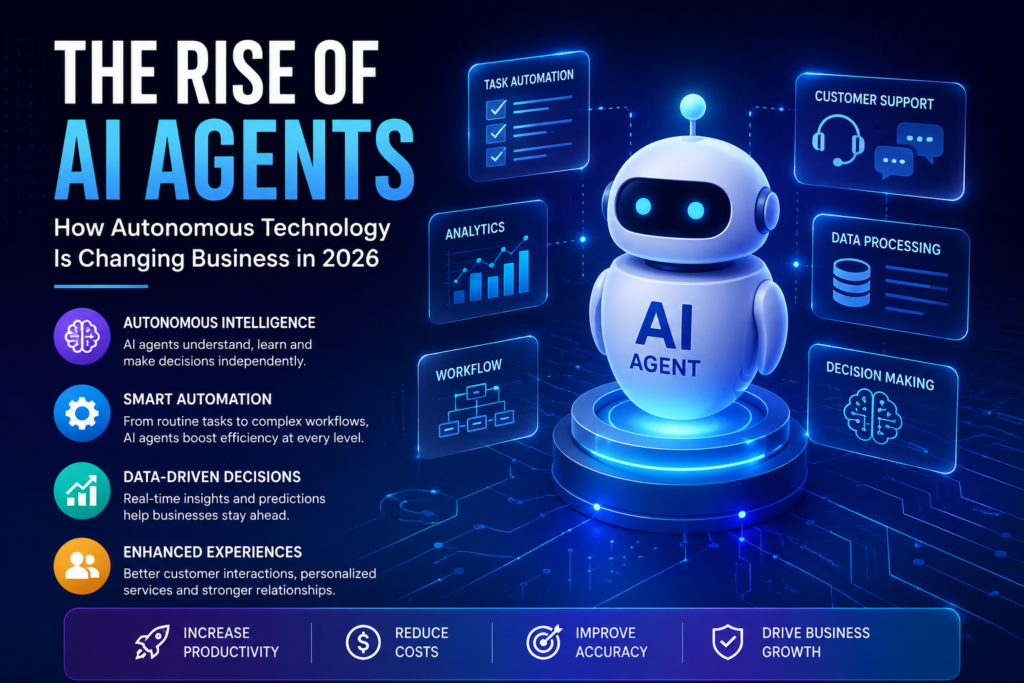
AI agents are intelligent software systems capable of understanding goals, analyzing information, making decisions, and taking actions to achieve specific objectives. They can interact with applications, databases, websites, and even other AI systems to complete tasks automatically.
Examples of AI agents include:
- Customer support assistants
- Sales automation agents
- AI research assistants
- Marketing campaign managers
- Financial analysis tools
- Software development assistants
Unlike simple chatbots, AI agents can execute multi-step tasks and continuously improve their performance through learning and feedback.
Why Businesses Are Adopting AI Agents
Organizations across industries are investing heavily in AI-powered automation. AI agents help businesses reduce operational costs, improve accuracy, and increase productivity.
Key benefits include:
Increased Efficiency
AI agents can work 24/7 without fatigue, allowing businesses to automate repetitive and time-consuming tasks.
Faster Decision-Making
By analyzing large amounts of data in real time, AI agents provide insights that help businesses make informed decisions quickly.
Improved Customer Experience
AI-powered support systems can respond instantly to customer inquiries, reducing wait times and improving satisfaction.
Cost Reduction
Automation reduces the need for manual labor in many operational processes, helping companies lower expenses.
Industries Being Transformed by AI Agents
Finance
Financial institutions are using AI agents for fraud detection, risk analysis, customer support, and investment management.
Healthcare
Healthcare providers use AI systems to assist with diagnostics, patient monitoring, medical documentation, and treatment recommendations.
E-Commerce
Online retailers leverage AI agents to personalize shopping experiences, manage inventory, and optimize pricing strategies.
Software Development
Developers are increasingly using AI coding assistants to write, review, and optimize software code more efficiently.
Challenges and Risks
Despite their advantages, AI agents also present challenges.
Some concerns include:
- Data privacy and security
- Regulatory compliance
- Ethical decision-making
- Job displacement fears
- Dependence on automated systems
Businesses must establish proper governance frameworks to ensure AI is deployed responsibly.
The Future of AI Agents
Industry experts predict that AI agents will become standard tools in businesses of all sizes over the next few years. As technology continues to advance, these systems will become more capable, reliable, and accessible.
Organizations that embrace AI agents early may gain significant competitive advantages through improved efficiency, innovation, and customer engagement.
Conclusion
AI agents represent the next major evolution in artificial intelligence. By automating complex workflows and supporting smarter decision-making, they are transforming how businesses operate. As adoption accelerates in 2026 and beyond, AI agents are expected to play a central role in shaping the future of work and digital business.
Companies that successfully integrate AI agents into their operations will be better positioned to adapt, compete, and thrive in an increasingly technology-driven world.