

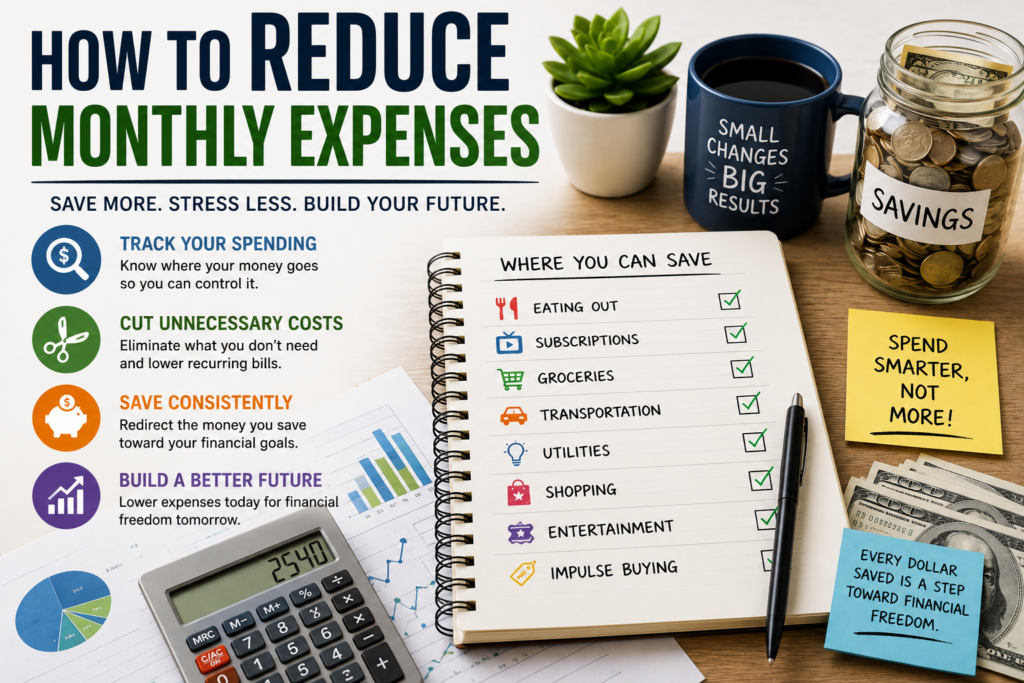
Reducing monthly expenses is one of the most practical ways to improve personal finances without necessarily increasing your income. When everyday spending is under control, more money can be directed toward savings, emergency funds, debt repayment, and long-term financial goals.
Many people try to reduce expenses by cutting everything at once. That approach often becomes difficult to maintain. A better strategy is to understand where your money is going, identify unnecessary or flexible expenses, and make targeted changes that can continue month after month.
Whether you are trying to save money on a low income, pay off debt, build an emergency fund, or simply improve your monthly budget, reducing unnecessary expenses can create more financial flexibility.
1. Understand Where Your Money Is Going Before Cutting Expenses
The first step to reducing monthly expenses is understanding your current spending. You cannot make an effective savings plan if you do not know which expenses are consuming most of your income.
Start by reviewing your bank statements, credit card statements, bills, receipts, and digital payment history. Look at several months rather than only one month because some expenses occur less frequently.
Create categories such as:
- Housing
- Utilities
- Groceries
- Transportation
- Healthcare
- Insurance
- Debt payments
- Subscriptions
- Dining out
- Entertainment
- Shopping
- Personal expenses
- Savings
Once expenses are organized, separate them into fixed and variable expenses.
Fixed expenses are costs that usually remain relatively stable, such as rent, mortgage payments, insurance premiums, or certain loan payments. Variable expenses can change from month to month and may provide more opportunities to reduce spending.
The Consumer Financial Protection Bureau recommends creating an accurate picture of current spending rather than estimating what you think you spend. Reviewing several months can also help identify irregular costs that might otherwise be missed.
For a practical foundation, see Smart Money Management, which covers budgeting, saving, debt management, and other financial habits.
Next, compare total monthly expenses with take-home income. If your expenses regularly consume nearly all of your income, even small reductions can create additional financial room.
Do not immediately cut every expense. Instead, identify the categories where a reduction is realistic.
For example, reducing a $500 grocery budget by $50 may be more sustainable than attempting to eliminate all restaurant meals. Similarly, canceling unused subscriptions may be easier than dramatically changing essential household expenses.
A useful monthly expense audit can ask five questions:
- Do I actually need this?
- Do I use it regularly?
- Can I get the same value for less money?
- Can I negotiate the cost?
- Can I eliminate or reduce it without creating another problem?
This process turns expense reduction into a financial decision rather than a temporary spending restriction.
2. Reduce Everyday Spending Without Making Your Budget Miserable
Once you understand your spending patterns, focus on everyday expenses that can be adjusted.
Groceries are often a good place to start. Plan meals before shopping, create a shopping list, compare prices, and avoid buying unnecessary items simply because they are discounted.
Buying something at a lower price is not automatically saving money if you did not need it. The real financial benefit comes when reduced spending remains in your budget or is transferred into savings.
Eating out and food delivery can also become significant monthly expenses. You do not necessarily need to stop eating out completely. Instead, set a specific monthly limit and track it.
For example, if you normally spend $250 per month on restaurants and delivery, reducing that amount to $175 would free up $75 without completely eliminating the activity.
Subscriptions are another common source of recurring expenses. Review streaming services, software, memberships, cloud storage, fitness subscriptions, apps, and other recurring payments.
Cancel anything you no longer use. For services you still want, check whether a cheaper plan is available.
Transportation can also offer opportunities to reduce monthly costs. Compare fuel expenses, public transportation, ride-sharing, parking, insurance, and vehicle maintenance. Combining trips and maintaining a vehicle properly can help prevent avoidable costs.
Utility expenses should also be reviewed. Depending on your location and household situation, reducing unnecessary electricity, heating, cooling, water, or other usage may lower monthly bills.
Another effective strategy is to reduce impulse spending.
Impulse purchases often seem small individually but can become significant when repeated. Before buying something that was not planned, wait and ask whether it fits your current financial priorities.
A 24-hour waiting period for non-essential purchases can provide enough time to decide whether the item is genuinely necessary.
You should also review fees. Bank fees, late-payment charges, delivery fees, service fees, and other small charges can quietly increase monthly spending.
Paying bills on time and reviewing account statements can help identify unnecessary charges.
The CFPB also recommends distinguishing needs and obligations from wants when reviewing spending. This can make it easier to prioritize essential expenses while finding areas where spending can be reduced.
Another powerful technique is to negotiate recurring bills. Depending on the provider and service, you may be able to ask about lower-cost plans, promotional rates, discounts, or alternative packages.
Consider reviewing:
- Internet plans
- Mobile phone plans
- Insurance
- Cable or streaming packages
- Software subscriptions
- Memberships
- Banking services
Do not assume that the first price you receive is always the only available option.
You can also create spending limits for flexible categories. Instead of simply saying “I need to spend less,” give yourself a specific monthly amount for groceries, entertainment, shopping, or dining.
A clear limit makes your budget easier to follow and measure.
For additional guidance on building a complete financial strategy, see Smart Financial Planning.
3. Turn Lower Expenses Into Long-Term Financial Progress
Reducing expenses is only half of the process. The next step is deciding what to do with the money you no longer spend.
This is where many people make a mistake. They reduce spending in one category but eventually spend the extra money somewhere else.
For example, suppose you reduce your monthly expenses by $200. If that $200 simply disappears into other purchases, your financial situation may not improve significantly.
Instead, give every dollar a purpose.
You could direct the extra money toward:
- Emergency savings
- Debt repayment
- Short-term financial goals
- Retirement savings
- Future major expenses
- Business savings
- Other planned financial priorities
If you are currently building an emergency fund, directing part of your monthly savings toward that goal can help create a stronger financial safety net.
Consumer.gov explains that a budget can help people understand how much money they make, how much they spend, and where they may be able to reduce expenses or increase savings.
A useful approach is to create a “money saved” category in your budget.
For example:
Original monthly expenses: $3,000
Expense reductions: $200
New monthly expenses: $2,800
Instead of treating the $200 as extra spending money, automatically transfer it to your chosen financial goal.
You can also track your monthly savings over time. If you save $200 in one month, $175 in another, and $225 in the next, you can see how expense reductions are contributing to your financial progress.
Automation can make this easier. If your bank allows automatic transfers, schedule a transfer shortly after receiving your income.
Another important step is reviewing your budget every month. Expense reduction should be an ongoing process because your financial situation changes.
Rent may increase. Insurance premiums may change. A subscription may become unnecessary. Your income may change. Your family responsibilities may increase.
Review your expenses regularly and adjust your budget accordingly.
It is also important not to reduce essential expenses in ways that create larger costs later. For example, skipping necessary healthcare, insurance, maintenance, or essential repairs simply to make a budget look smaller may create greater financial problems.
The goal is not to spend as little money as possible. The goal is to spend money intentionally.
You should also avoid unrealistic financial rules. A savings target that is impossible to maintain may cause frustration and eventually lead to abandoning the entire plan. Your expense-reduction strategy should match your income, obligations, household needs, and financial goals.
If your income is limited, start with the expenses that provide the easiest opportunities for reduction. Even modest monthly changes can create additional financial flexibility when maintained consistently.
For example, reducing expenses by:
$50 per month = $600 per year
$100 per month = $1,200 per year
$200 per month = $2,400 per year
These amounts are simple illustrations, but they demonstrate why recurring monthly savings can matter over time.
The most effective approach is therefore to combine expense reduction with a broader financial plan. Track spending, eliminate unnecessary recurring costs, control flexible categories, review bills, automate savings, and regularly evaluate your progress.
Reducing monthly expenses does not mean removing every enjoyable activity from your life. It means making deliberate choices about where your money provides the most value.
When your spending reflects your priorities, you can create more room for savings, reduce financial stress, strengthen your emergency fund, and work toward longer-term financial stability.
The key is consistency. A small expense reduction that you maintain for twelve months can be more valuable than an extreme budget that lasts only a few weeks.