

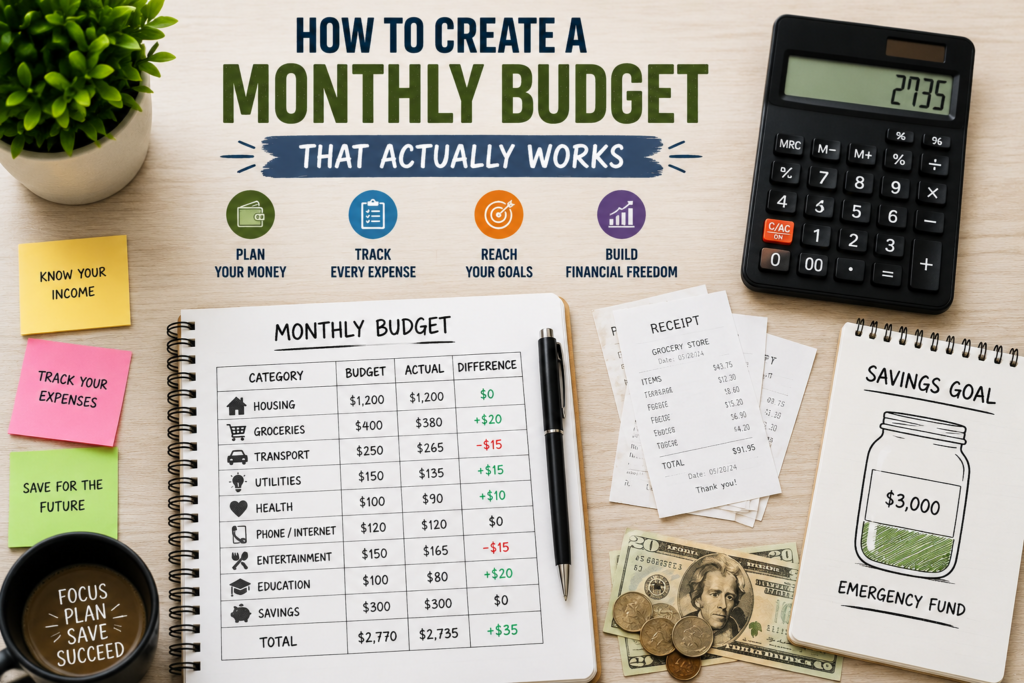
Creating a monthly budget is one of the simplest ways to gain control over your finances. A budget shows how much money comes in, where it goes, and whether there is enough left for saving, debt payments, and future goals.
The problem is that many people create a budget that looks good on paper but becomes difficult to follow in real life. They may set unrealistic spending limits, forget irregular expenses, or leave no room for unexpected costs.
A practical budget should reflect your actual income and spending habits. It should help you make better decisions without making everyday life unnecessarily complicated.
A good monthly budget is not about avoiding every purchase. It is about giving your money a clear purpose and making sure your spending supports your priorities.
1. Understand Your Income and Track Every Expense
The first step in creating a workable monthly budget is knowing exactly how much money you have available.
Start by calculating your monthly income. If you receive a fixed salary, this may be relatively straightforward. If your income changes from month to month because you are self-employed, freelance, or earn commissions, use a conservative estimate based on your recent income rather than assuming you will have an unusually strong month.
Next, list your expenses.
Separate expenses into fixed and variable categories.
Fixed expenses are payments that generally remain similar each month. Examples include:
- Rent or mortgage
- Insurance
- Loan payments
- Internet
- Phone bills
- Subscriptions
Variable expenses can change from month to month. These may include:
- Groceries
- Transportation
- Electricity
- Entertainment
- Clothing
- Dining out
- Personal expenses
You should also account for irregular expenses. Some costs do not occur every month but still need to be included in your financial planning. Car maintenance, annual insurance payments, school expenses, gifts, holidays, and home repairs are examples.
One practical approach is to review your spending from the previous two or three months. Bank statements, credit card statements, receipts, and payment applications can help you identify where your money actually went.
The Federal Trade Commission’s Making a Budget resource also recommends listing income and expenses and comparing the two to determine whether your spending is sustainable.
Do not rely entirely on memory. Small purchases can add up significantly over a month.
For example, spending $5 or $10 several times a week may not seem important individually, but the combined amount can become a meaningful part of your monthly spending.
Once you have listed everything, calculate:
Monthly income − Monthly expenses = Money remaining
If the result is positive, you have money available for savings, debt reduction, investing, or additional spending.
If the result is negative, your expenses are higher than your income. That is a signal to review your spending and identify areas that can be reduced.
Your Smart Money Management guide also emphasizes budgeting, expense control, savings, debt management, and financial planning as important parts of building long-term financial stability.
A budget becomes much more useful when it is based on real numbers rather than guesses.
2. Give Your Money a Purpose and Make the Budget Flexible
After understanding your income and expenses, organize your money around priorities.
Start with essential expenses. Housing, food, utilities, transportation, insurance, and required debt payments generally deserve priority.
Then consider savings and financial goals.
Savings should not simply be whatever remains at the end of the month. If possible, include savings as a planned part of your budget.
You might create separate targets for:
- Emergency savings
- Short-term purchases
- Debt repayment
- Retirement
- Education
- Travel
- Other financial goals
The Smart Financial Planning guide explains why budgeting, emergency savings, responsible debt management, and long-term goals are important parts of a broader financial plan.
A useful budgeting system should also leave some room for discretionary spending. Completely eliminating entertainment, dining out, hobbies, or other personal spending can make a budget difficult to maintain.
Instead of creating an extremely restrictive plan, set a reasonable limit for these categories.
One common framework is the 50/30/20 approach, where income is broadly divided between needs, wants, and savings or debt goals. It is not a rule that works perfectly for every household, but it can provide a starting point for organizing spending.
Your actual percentages may need to be different because housing costs, income levels, family responsibilities, debt, and local living costs vary.
The Consumer Financial Protection Bureau provides budgeting resources that encourage people to track income and spending and create a realistic working budget.
Flexibility is especially important.
Suppose your electricity bill is higher than expected during one month. Instead of abandoning the entire budget, reduce spending in another flexible category or adjust the plan.
The purpose of a budget is to guide decisions, not punish you for expenses that are difficult to predict.
You should also create a small category for unexpected expenses. This can prevent every surprise bill from becoming a financial crisis.
If you have debt, include required payments in your monthly plan. Once minimum payments are covered, you can decide how much additional money to direct toward debt reduction.
A budget can also help prevent unnecessary borrowing because you can see how much money is available before making a purchase.
For people with irregular income, flexibility becomes even more important. During stronger months, you may be able to increase savings or reduce debt. During weaker months, you may need to limit discretionary spending and focus on essential costs.
The goal is to create a system that can survive changes in income and expenses.
3. Review Your Budget Every Month and Improve It
A budget should not be created once and forgotten.
At the beginning of each month, create a spending plan based on expected income and expenses. During the month, track actual spending.
At the end of the month, compare what you planned with what actually happened.
Look for three things:
- Where did you spend more than expected?
- Where did you spend less than expected?
- What should change next month?
For example, suppose you planned to spend $400 on groceries but actually spent $480. Instead of simply writing “overspending” in your notes, investigate why.
Maybe food prices increased. Perhaps you were buying more meals for guests. Or maybe frequent small purchases at convenience stores were responsible.
Understanding the reason is more useful than simply recording the difference.
The Consumer.gov Budget Worksheet provides a practical structure for recording income, expenses, savings, debt payments, and other financial categories.
Technology can make tracking easier. Many banking applications categorize transactions automatically, while spreadsheets and budgeting applications can provide a clearer monthly overview.
However, you do not need expensive software. A simple spreadsheet can be enough if you update it consistently.
Another important step is checking your recurring expenses.
Review subscriptions, memberships, insurance costs, phone plans, and other regular payments. Cancel services you no longer use and compare prices when appropriate.
Small recurring expenses can quietly increase over time.
You should also update your budget whenever your financial situation changes.
A new job, salary increase, reduced income, new loan, major purchase, marriage, child, relocation, or change in housing costs can all affect your monthly plan.
Do not be afraid to rebuild the budget when necessary.
A successful budget should also connect with your long-term financial goals. If you want to build an emergency fund, save for a major purchase, reduce debt, or invest for retirement, your monthly budget should show how today’s spending contributes to those objectives.
For example, if your goal is to build an emergency fund of $3,000 and you can consistently save $250 each month, your budget gives you a practical path toward that goal.
As your financial situation improves, review your savings rate and consider increasing contributions rather than automatically increasing lifestyle spending.
The Personal Finance and Financial Planning: Complete Guide can serve as the broader foundation for connecting monthly budgeting with emergency savings, debt management, investing, and long-term financial planning.
Most importantly, do not expect your first budget to be perfect.
The first month is often a learning period. You may underestimate groceries, forget annual expenses, or discover that certain categories require more money than expected.
Use that information to improve the next month’s plan.
A budget becomes effective through regular adjustment. Over time, you should become better at predicting expenses, controlling unnecessary spending, and allocating money toward meaningful goals.
Conclusion
A monthly budget works best when it reflects real life.
Start by calculating your income, tracking your actual expenses, and separating essential costs from discretionary spending. Include irregular expenses and leave room for unexpected costs.
Then give your money a purpose by planning for savings, debt payments, and other financial goals while keeping reasonable flexibility for everyday life.
Finally, review the budget every month. Compare planned spending with actual spending, identify problems, and make adjustments.
A budget is not a restriction on your money. It is a system that helps you decide where your money should go before it disappears through unplanned spending.
With consistent tracking and realistic targets, a monthly budget can become a practical foundation for stronger financial management and long-term financial stability.