
Healthcare has become increasingly dependent on digital systems. Hospitals, clinics, laboratories, health apps, electronic health records, wearable devices, and remote monitoring platforms all create or handle sensitive information. As more healthcare services become digital, protecting that information has become an important part of modern healthcare operations.
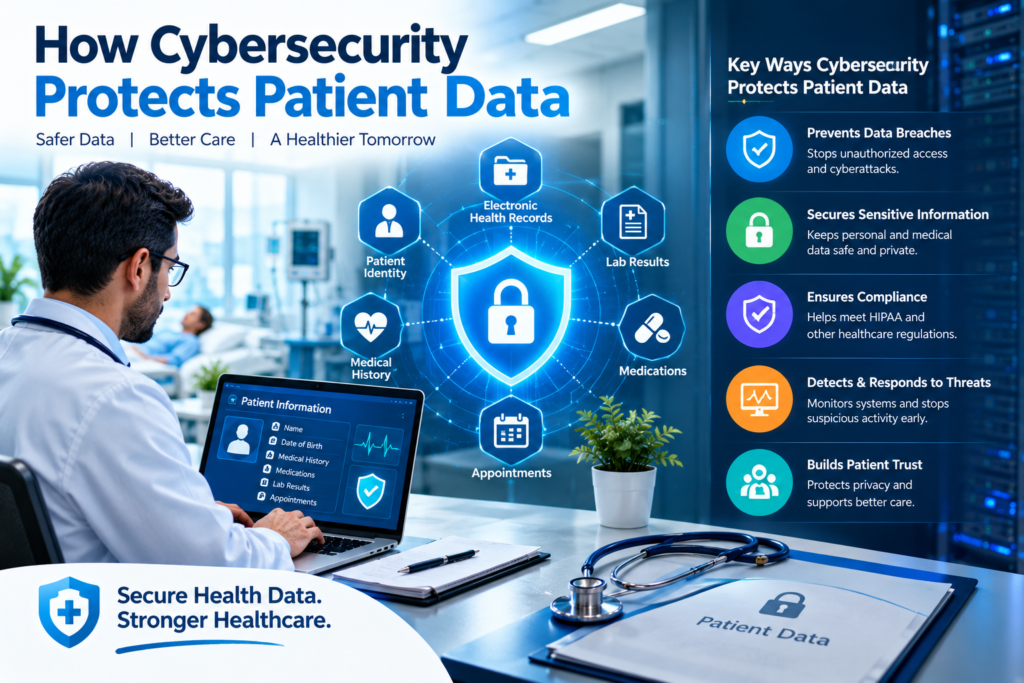
Patient information can include medical histories, laboratory results, prescriptions, diagnoses, identification details, insurance information, and other sensitive records. When such information is stored or transmitted electronically, healthcare organizations need appropriate safeguards to reduce the risk of unauthorized access, alteration, loss, or disclosure.
Healthcare cybersecurity is therefore not only an IT issue. It is closely connected with patient privacy, operational continuity, data integrity, and trust in digital healthcare services.
1. Why Patient Data Security Matters in Digital Healthcare
Modern healthcare organizations use many connected systems to store and exchange information. Electronic health records allow authorized healthcare professionals to access patient information more efficiently, while remote monitoring systems can transmit health-related information from a patient’s home to healthcare providers.
This growing digital environment creates a larger responsibility for patient data security.
The type of information involved makes healthcare data particularly sensitive. Electronic health information may include prescriptions, laboratory results, vaccination records, hospital visits, diagnoses, and other information connected with an individual.
NIST explains that healthcare organizations need standards and guidelines to protect the confidentiality, integrity, and availability of health information and health information systems.
Healthcare organizations also need to consider the systems connected to patient information. A security weakness in one part of a digital environment can potentially affect other connected systems. This is particularly relevant as healthcare organizations increasingly use cloud services, mobile devices, telehealth platforms, connected medical devices, and remote monitoring technologies.
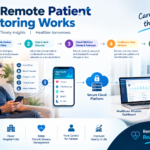
For example, remote patient monitoring can extend healthcare beyond hospitals and clinics, but the technology also introduces additional security and privacy considerations because monitoring equipment may be located in a patient’s home. NIST specifically identifies cybersecurity and privacy considerations for telehealth and remote patient monitoring environments.
The importance of security also applies to electronic health records. When healthcare organizations use digital records, protecting access to those systems becomes an important part of maintaining patient privacy and reliable healthcare operations.
Cybersecurity is therefore connected to more than preventing unauthorized access. It also involves making sure information remains accurate and available to authorized users when it is needed.
2. How Healthcare Organizations Protect Digital Patient Information
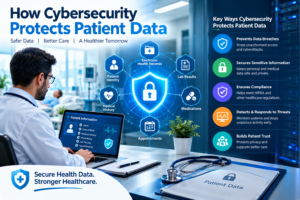
Healthcare cybersecurity generally involves multiple layers of protection rather than a single technology.
One important area is access controls. Healthcare organizations need procedures that determine who can access particular information and systems. Access should be appropriate to a person’s responsibilities and role.
The U.S. Department of Health and Human Services explains that the HIPAA Security Rule requires regulated entities to implement appropriate administrative, physical, and technical safeguards for electronic protected health information. The Security Rule also addresses access control, authentication, audit controls, and transmission security.
Authentication is another important protection. Systems can use mechanisms designed to verify that a person requesting access is authorized to use the system. Strong authentication can reduce the likelihood that compromised credentials alone will provide unauthorized access.
Data encryption is another commonly used security measure. Encryption can help protect information while it is stored or transmitted by making the information difficult for unauthorized parties to read without the appropriate key or mechanism.
However, encryption is only one part of a broader security strategy. Healthcare organizations also need appropriate policies, employee awareness, system monitoring, backups, software updates, and procedures for responding to security incidents.
NIST’s healthcare cybersecurity guidance describes approaches that organizations can use to understand and implement safeguards associated with the HIPAA Security Rule.
A further component is security risk assessment. Organizations need to understand which systems contain sensitive information, where vulnerabilities may exist, what threats are relevant, and what safeguards are appropriate for their environment.
HHS states that regulated entities should perform an accurate and thorough assessment of potential risks and vulnerabilities to electronic protected health information and manage identified risks through appropriate security measures.
Healthcare organizations also need to consider workforce practices. Employees may interact with patient information through computers, mobile devices, email systems, clinical applications, and other technologies. Security awareness and appropriate access procedures can therefore be an important part of an organization’s overall cybersecurity program.
The objective is not to eliminate every possible cybersecurity risk. Instead, organizations need to identify relevant risks and implement reasonable and appropriate safeguards based on their systems, resources, and environment.
3. Cybersecurity Challenges and the Future of Patient Data Protection
Healthcare cybersecurity continues to evolve as healthcare technology becomes more connected.
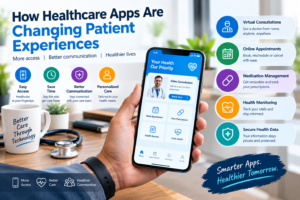
Cloud-based systems, mobile healthcare applications, connected medical devices, telehealth services, wearable technology, and remote patient monitoring can provide useful capabilities, but each technology can introduce additional security and privacy considerations.
Healthcare organizations therefore need to consider security throughout the technology lifecycle. Security should not be treated as something that is added only after a system has been deployed.
Regular reviews can help organizations identify changes in their technology environment and reassess security measures. HHS notes that regulated entities should periodically evaluate the effectiveness of security measures and modify them when necessary.
Another challenge is maintaining security while allowing appropriate access to information. Healthcare professionals need access to relevant information to perform their responsibilities, but unnecessary access can increase privacy and security risks. The HHS Privacy Rule includes a minimum-necessary principle intended to limit unnecessary uses and disclosures of protected health information.
Cybersecurity also becomes increasingly important as healthcare organizations connect more devices and systems. Wearables, remote monitoring platforms, electronic records, and digital healthcare services can create multiple points where information is collected, processed, stored, or transmitted.
This makes electronic health information protection an ongoing process rather than a one-time technical project.
Future healthcare cybersecurity efforts are likely to place greater emphasis on risk assessment, stronger authentication, secure system configurations, monitoring, incident response, employee awareness, and protection of connected healthcare technologies.
Healthcare organizations may also need to adapt as regulatory expectations and cybersecurity guidance evolve. HHS has proposed updates to the HIPAA Security Rule intended to strengthen protections for electronic protected health information in response to changing cybersecurity threats. Because regulatory proposals can change before becoming final requirements, organizations should rely on current official guidance when determining their specific compliance obligations.
Conclusion
Protecting patient information is an essential part of digital healthcare. As healthcare organizations adopt electronic records, telehealth, wearable technology, remote monitoring, and other digital systems, cybersecurity needs to remain part of responsible technology management.
A strong approach combines access controls, authentication, encryption, risk assessment, employee awareness, system monitoring, appropriate policies, and ongoing security reviews.
Cybersecurity cannot guarantee that every incident will be prevented. Its purpose is to identify risks, reduce vulnerabilities, protect sensitive information, and support the confidentiality, integrity, and availability of electronic health information.
Editorial disclaimer: This article is for general educational and informational purposes only. It is not legal, regulatory, medical, cybersecurity, or compliance advice. Healthcare organizations should consult qualified professionals and current official requirements for their specific circumstances.