

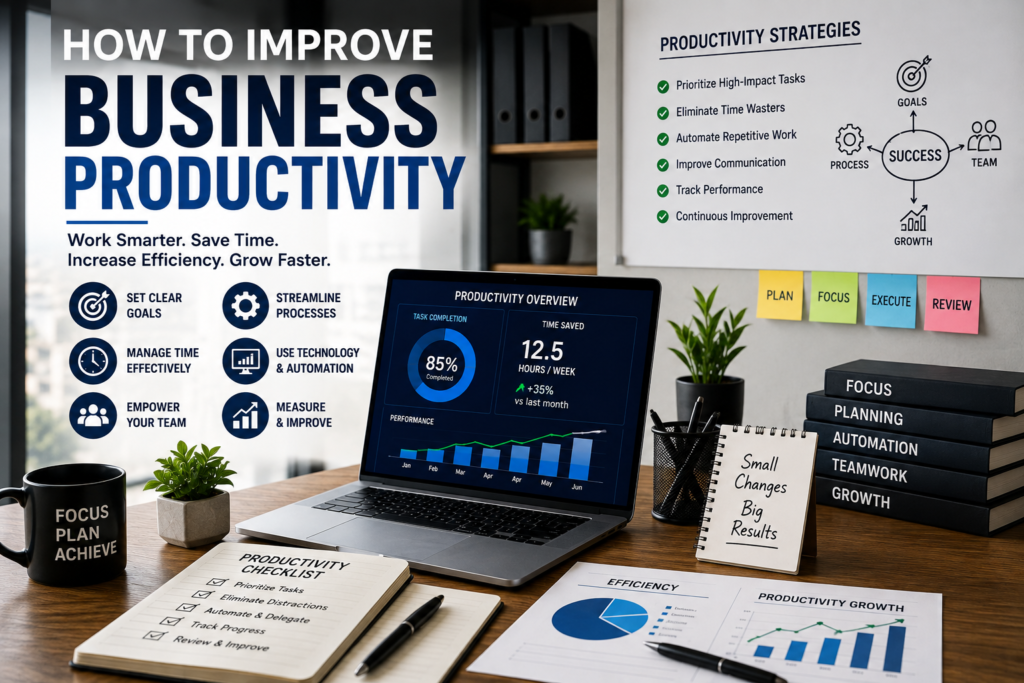
Business productivity plays an important role in profitability, customer satisfaction, and long-term growth. A productive business is not simply one where employees work longer hours. True productivity means using time, people, technology, and resources efficiently to produce valuable results.
Small businesses often face productivity challenges because owners and employees have to manage multiple responsibilities at the same time. Sales, customer service, marketing, accounting, operations, and administration can compete for attention. Without clear systems, employees may spend too much time on repetitive tasks, unnecessary meetings, manual processes, or activities that do not directly contribute to business goals.
Improving productivity starts with understanding where time and resources are being lost. Businesses can then simplify processes, establish priorities, use appropriate technology, improve communication, and measure performance. The objective is not to make employees work continuously but to create an environment where important work can be completed more efficiently.
1. Identify Productivity Problems and Improve Business Processes
The first step toward improving business productivity is identifying what is slowing the business down. Many companies try to introduce new software or hire additional employees before understanding the actual problem.
Start by reviewing how work is completed from beginning to end. Look at common activities such as customer inquiries, sales, order processing, invoicing, marketing, reporting, meetings, employee communication, and customer support.
Ask simple questions:
- Which tasks take the most time?
- Which activities are repeated every day?
- Where do employees experience delays?
- Which processes require unnecessary approvals?
- Which tasks frequently contain errors?
- Which activities could be simplified or automated?
Creating a simple process map can reveal bottlenecks that are difficult to notice during daily operations.
For example, if employees spend several hours each week manually entering customer information into multiple systems, the business may be able to connect its software or automate part of the process. If employees spend too much time searching for documents, a centralized cloud storage system with clear file structures may solve the problem.
Small businesses can also benefit from understanding how technology supports competitiveness. How Small Businesses Can Compete With Larger Companies explains how technology, automation, specialization, and faster decision-making can help smaller companies operate more effectively.
Standardizing repetitive processes is another useful strategy. When the same task is performed differently by every employee, mistakes and delays become more likely. Written procedures, checklists, templates, and standard operating procedures can create greater consistency.
For example, a business could create standard procedures for onboarding a new customer, processing an order, publishing content, handling complaints, or sending invoices.
Documentation also makes employee training easier. New employees can learn established procedures instead of relying entirely on another employee to explain every task.
Businesses should also eliminate unnecessary steps. A process that was useful several years ago may no longer be necessary. Companies should regularly review procedures and remove activities that do not create meaningful value.
This is especially important as businesses grow. More employees and customers can expose weaknesses in systems that were manageable when the company was smaller.
A scalable operation should be able to handle increasing demand without creating unnecessary administrative work. How to Build a Scalable Business Model provides additional guidance on creating repeatable systems, improving operations, and preparing a business for growth.
Productivity should also be connected to business goals. Employees should understand which activities have the greatest impact on customers, revenue, quality, and growth. Completing a large number of low-value tasks is not necessarily productive if important business priorities are being neglected.
2. Use Technology, Automation, and Better Time Management
Technology can significantly improve business productivity when it is used to solve real operational problems.
Small businesses can use cloud-based software for communication, file storage, project management, accounting, customer relationship management, scheduling, marketing, and collaboration.
For example, Google Workspace provides small businesses with tools such as Gmail, Drive, Meet, Calendar, Docs, Sheets, and Chat that can support communication, collaboration, file sharing, and time management. Google Workspace for Small Businesses provides more information about these productivity and collaboration tools.
The goal should not be to purchase every available software product. Too many disconnected tools can actually make productivity worse.
Businesses should select technology based on specific needs.
If employees need to communicate quickly, a team messaging platform may help. If projects are difficult to track, project management software could provide better visibility. If customer information is scattered across spreadsheets and emails, a customer relationship management system may be useful.
Automation can be particularly valuable for repetitive tasks.
Businesses may automate:
- Appointment reminders
- Email follow-ups
- Invoice notifications
- Data entry
- Reporting
- Marketing workflows
- Customer support responses
- Document generation
- Task assignments
- Internal notifications
Microsoft also highlights how AI productivity tools can automate repetitive tasks such as data entry, document processing, and customer support, allowing employees to spend more time on higher-value activities. AI Productivity for Small Businesses provides additional information about using AI for productivity.
However, automation should be implemented carefully. Automating a poorly designed process does not necessarily make it better. Businesses should first simplify the process and then determine whether automation can improve it.
Time management is another important factor. Employees should understand their most important responsibilities and have enough uninterrupted time to complete them.
Constant notifications, unnecessary meetings, frequent messages, and interruptions can reduce concentration. Businesses can improve productivity by establishing clear communication practices and reducing unnecessary interruptions.
Meetings should also have a clear purpose. Before scheduling a meeting, consider whether the issue could be handled through an email, shared document, or short message. When a meeting is necessary, establish an agenda and define the desired outcome.
Task prioritization can help employees focus on high-value work. A simple system can divide tasks into urgent, important, routine, and low-priority activities.
Employees should also avoid trying to complete too many tasks simultaneously. Switching constantly between different activities can make it harder to maintain concentration and complete complex work efficiently.
Managers can help by setting clear deadlines, defining responsibilities, and avoiding unnecessary changes in priorities.
Remote and hybrid teams may require additional structure. Shared calendars, project management tools, communication platforms, and clearly documented processes can help employees understand what needs to be completed and when.
Productivity also depends on having reliable systems. If software frequently crashes, employees cannot access important documents, or different teams use incompatible tools, valuable time can be lost.
Technology should make work easier rather than creating another layer of complexity.
3. Improve People, Communication, and Performance Measurement
Technology alone cannot solve every productivity problem. Employees are one of the most important parts of a productive business.
Clear responsibilities are essential. Employees should understand what they are responsible for, what results are expected, and how their work contributes to wider business goals.
When responsibilities overlap, tasks can be duplicated or ignored. A clear division of responsibilities can reduce confusion and improve accountability.
Training can also improve productivity. Employees who understand the tools, systems, products, and processes they use can usually complete tasks more confidently and efficiently.
Training should not only happen when someone joins the company. Businesses can provide ongoing learning when new software, processes, products, or customer requirements are introduced.
Communication is another major factor.
Poor communication can lead to:
- Repeated work
- Missed deadlines
- Incorrect information
- Customer service problems
- Confusion about responsibilities
- Delayed decisions
Businesses should establish clear communication channels. Employees should know where to ask questions, where documents are stored, how urgent issues should be communicated, and which information should be recorded.
A centralized knowledge base can be useful for frequently asked questions, procedures, policies, templates, and internal resources.
Employee feedback can also reveal productivity problems that management may not see. Employees performing a task every day often know exactly where unnecessary steps or delays occur.
Managers should therefore ask employees questions such as:
“What is taking more time than it should?”
“Which process causes the most frustration?”
“Which task would you automate if you could?”
“What information is difficult to find?”
“What prevents you from completing your most important work?”
The answers can provide practical ideas for improving operations.
Businesses should also measure productivity using meaningful performance indicators. The right metrics depend on the type of business.
Possible measurements include:
- Revenue per employee
- Customer response time
- Order processing time
- Project completion time
- Customer retention
- Conversion rate
- Error rate
- Production output
- Customer satisfaction
- Operating costs
The goal is not to monitor employees constantly. Metrics should help management understand whether business processes are producing better results.
For example, if customer response time falls from two days to four hours after a process improvement, that is useful evidence that the change worked.
Similarly, if automation reduces administrative hours without reducing quality, the business can consider applying similar improvements elsewhere.
Businesses should also connect productivity improvements to growth. More efficient operations can free resources for marketing, product development, customer service, and expansion.
A company that reduces unnecessary costs and improves processes may be able to invest more confidently in customer acquisition or new products. Business Growth Strategies in 2026 provides broader ideas for connecting operational improvements with long-term business growth.
Security should also be considered when improving productivity. Businesses should not sacrifice data protection simply to make processes faster. The Federal Trade Commission recommends measures such as keeping software updated, backing up important information, using strong passwords, and enabling multi-factor authentication for small businesses. Cybersecurity for Small Business provides practical guidance on protecting business systems and data.
Finally, productivity should be treated as an ongoing process rather than a one-time project.
Markets change, businesses grow, employees change roles, and technology develops. A process that works well today may become inefficient later.
Businesses should regularly review their systems and ask whether there is a simpler, faster, or more reliable way to achieve the same result.
The best productivity improvements are usually practical. They may involve removing an unnecessary meeting, creating a useful template, automating a repetitive task, reorganizing files, clarifying responsibilities, improving employee training, or replacing an inefficient process.
Small improvements can accumulate over time.
Conclusion
Improving business productivity is about helping people and systems produce better results with the available resources.
Start by identifying bottlenecks and unnecessary work. Then simplify processes, document repetitive tasks, introduce appropriate technology, automate suitable activities, improve communication, and give employees clear priorities.
Technology can provide significant benefits, but productivity ultimately depends on people, processes, and management working together.
Businesses should also measure results rather than assuming that a new tool or process has automatically improved performance. Track meaningful indicators such as response times, costs, customer satisfaction, output, and revenue per employee.
Most importantly, make productivity improvement part of the company’s culture. Encourage employees to identify problems, suggest improvements, and focus on activities that create real value.
When businesses continuously improve their processes and use technology intelligently, they can reduce wasted time, improve customer experiences, control costs, and create a stronger foundation for sustainable growth.