
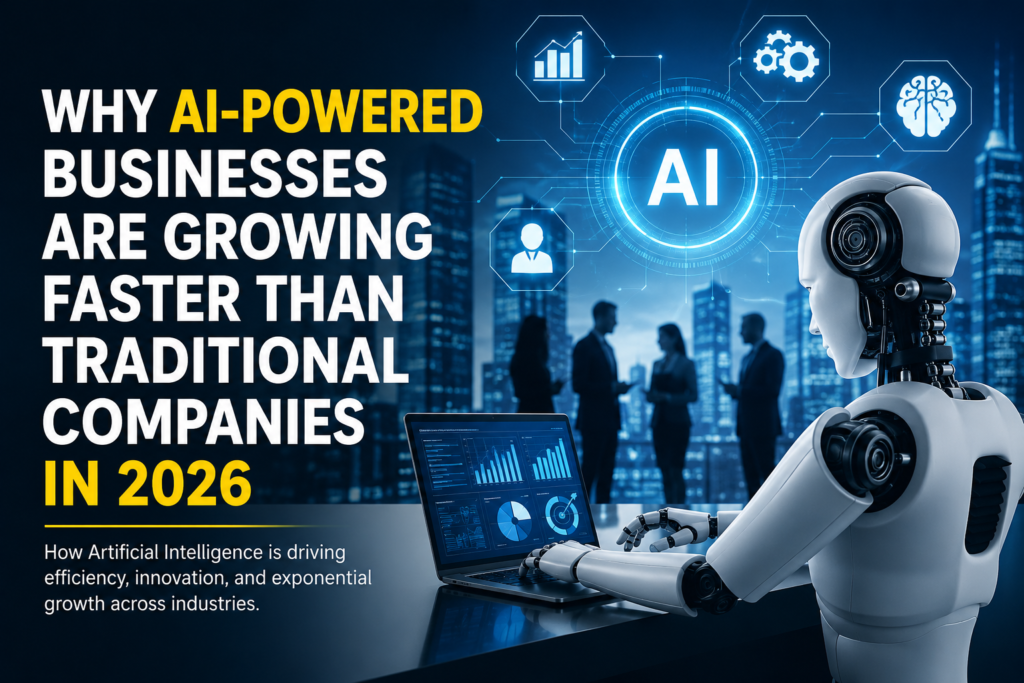
Artificial Intelligence is no longer a futuristic concept reserved for technology giants. In 2026, AI has become one of the most powerful growth drivers for businesses across nearly every industry. From startups and SaaS companies to financial institutions and healthcare providers, organizations are increasingly leveraging AI to improve efficiency, reduce costs, and deliver better customer experiences.
Companies that successfully integrate artificial intelligence into their operations are gaining a significant competitive advantage. While traditional businesses often rely on manual processes and slower decision-making, AI-powered organizations can analyze data faster, automate repetitive tasks, and identify opportunities before competitors do.
As the global economy becomes increasingly digital, AI adoption is rapidly separating industry leaders from businesses struggling to keep pace.
The Rise of AI-Driven Business Models
Over the past decade, businesses have generated unprecedented amounts of data. However, raw data alone provides little value unless organizations can transform it into actionable insights.
Artificial intelligence enables companies to process massive datasets and uncover patterns that would be nearly impossible for humans to identify manually.
Modern AI solutions help businesses:
- Automate workflows
- Predict customer behavior
- Improve operational efficiency
- Personalize customer experiences
- Enhance decision-making
- Increase profitability
These capabilities are helping organizations grow faster while operating more efficiently.
Faster Decision-Making Through Data
One of the biggest advantages of AI is its ability to support data-driven decision-making.
Traditional businesses often depend on historical reports and manual analysis. By the time insights become available, opportunities may already be lost.
AI systems can analyze information in real time and provide recommendations instantly.
Businesses use AI to:
- Forecast demand
- Predict sales trends
- Analyze customer preferences
- Identify operational inefficiencies
- Detect financial risks
Faster decisions allow organizations to respond more effectively to changing market conditions.
Automating Repetitive Tasks
Many companies still spend valuable time on repetitive administrative work.
Examples include:
- Data entry
- Appointment scheduling
- Invoice processing
- Customer support inquiries
- Report generation
AI-powered automation allows these tasks to be completed with minimal human involvement.
As a result, employees can focus on strategic initiatives, innovation, and customer relationships.
Businesses that embrace automation often experience significant productivity improvements while reducing operational costs.
Improving Customer Experiences
Modern customers expect personalized experiences and rapid service.
Artificial intelligence helps businesses meet these expectations through:
AI Chatbots
Chatbots provide instant customer support and can answer common questions 24 hours a day.
Personalized Recommendations
AI analyzes customer behavior to recommend products, services, and content based on individual preferences.
Predictive Service
Businesses can anticipate customer needs and resolve potential issues before they become problems.
Companies that deliver exceptional customer experiences often achieve higher retention rates and stronger brand loyalty.
AI in Marketing and Sales
Marketing and sales departments are among the biggest beneficiaries of artificial intelligence.
AI-powered marketing tools can:
- Analyze audience behavior
- Improve ad targeting
- Generate content ideas
- Optimize campaigns
- Predict conversion likelihood
Sales teams use AI to prioritize leads and identify prospects most likely to make purchasing decisions.
These capabilities help businesses improve marketing efficiency while increasing revenue opportunities.
Supporting Startup Growth
Startups are increasingly adopting AI because it allows small teams to achieve results previously possible only for larger organizations.
AI enables startups to:
- Scale operations faster
- Reduce staffing costs
- Improve customer service
- Accelerate product development
- Compete with established companies
Affordable cloud-based AI tools have made advanced technologies accessible to businesses of all sizes.
This democratization of AI is creating new opportunities for innovation and entrepreneurship.
Financial Benefits of AI Adoption
Organizations investing in AI often experience measurable financial improvements.
Common benefits include:
- Reduced operational expenses
- Increased productivity
- Higher customer retention
- Better forecasting accuracy
- Improved resource allocation
While implementation requires investment, many businesses achieve significant returns through improved efficiency and stronger business performance.
The Future of AI-Powered Growth
Artificial intelligence will continue to evolve and become more deeply integrated into business operations.
Future developments may include:
- Advanced predictive analytics
- Fully automated workflows
- Smarter virtual assistants
- Enhanced customer personalization
- AI-driven strategic planning
Organizations that embrace these innovations early will be better positioned to compete in increasingly dynamic markets.
Conclusion
Artificial intelligence is transforming the way businesses operate, compete, and grow. Companies that successfully leverage AI can improve efficiency, enhance customer experiences, and make faster, more informed decisions.
As digital transformation accelerates across industries, AI-powered businesses are gaining clear advantages over traditional competitors. The organizations that invest in intelligent technologies today are likely to become the market leaders of tomorrow.
For business leaders, entrepreneurs, and investors, understanding and embracing AI is no longer optional—it is becoming a critical factor for long-term success in the modern economy.