

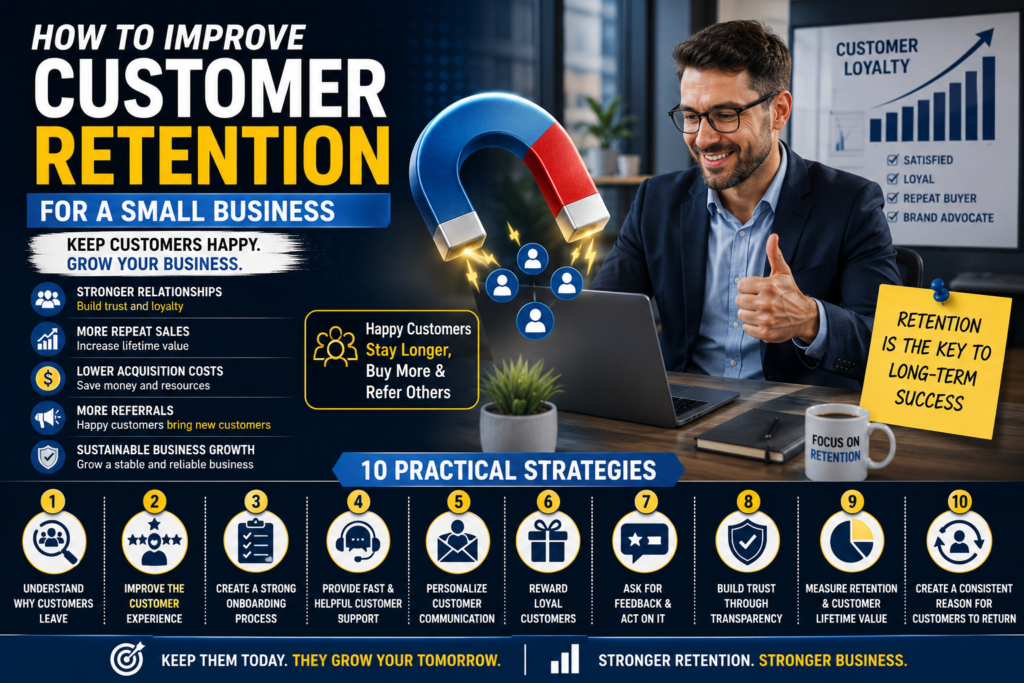
Getting new customers is important, but keeping existing customers can be equally valuable for a growing small business. Customers who have already purchased from a company understand its products or services and may be more likely to buy again when their experience is positive.
Customer retention is the process of encouraging existing customers to continue buying from a business. For small businesses, improving retention can help create more predictable revenue, stronger relationships, referrals and long-term growth.
A successful retention strategy starts with understanding why customers stay, why they leave and what the business can do to make the customer experience more useful and reliable.
1. Understand Why Customers Leave
The first step in improving customer retention is identifying the reasons customers stop buying.
Customers may leave because of:
- Poor customer service
- Product quality problems
- High prices
- Difficult purchasing processes
- Slow responses
- Lack of communication
- Better competitor offers
- Unclear policies
- Poor onboarding
- A product that no longer meets their needs
Do not rely only on assumptions. Use customer surveys, reviews, support conversations, cancellation reasons and sales data to identify recurring problems.
Your target market research can also help you understand whether your business is attracting customers who are genuinely suited to the product or service.
A company may have a retention problem because it is targeting the wrong audience rather than because its product is necessarily poor.
Look for patterns. If customers from one segment stay for much longer than others, that segment may deserve greater attention.
2. Improve the Customer Experience
Customer experience covers every interaction between a customer and a business, from the first website visit to support, delivery, payment and follow-up.
A better customer experience can reduce frustration and make customers more likely to continue doing business with you.
Small businesses can improve customer experience by making processes:
- Clear
- Fast
- Convenient
- Reliable
- Personal
- Easy to understand
Communication is particularly important.
Tell customers what to expect before they purchase. Provide useful updates during delivery or service. Make it easy for them to ask questions and get answers.
Your existing customer experience article covers customer-focused practices such as personalization, fast support, transparency and feedback.
The OECD has also highlighted digital tools that can help SMEs understand customer preferences, personalize offerings and strengthen customer loyalty. OECD research on digital transformation and customer relationships provides useful background on this area.
3. Create a Strong Onboarding Process
For many businesses, the period immediately after a purchase is critical.
Customers need to understand how to use the product, what happens next and where to get help.
A strong customer onboarding process can include:
- Welcome emails
- Setup instructions
- Product tutorials
- Frequently asked questions
- Training materials
- Quick-start guides
- Customer support contacts
- Follow-up messages
For service businesses, onboarding could include a clear explanation of timelines, deliverables, communication methods and next steps.
For software businesses, onboarding might include account setup, tutorials, product demonstrations and guided configuration.
The goal is to help customers reach the expected outcome as quickly as possible.
A customer who struggles immediately after purchasing may become frustrated before they have experienced the full value of the product.
4. Provide Fast and Helpful Customer Support
Customer support can have a direct impact on loyalty.
Customers do not expect every business to be perfect, but they generally expect problems to be handled professionally.
Create clear support channels and establish realistic response times.
For example:
- Email support
- Live chat
- Phone support
- Help center
- Social media support
- FAQ pages
Small businesses can often use their size to provide a more personal support experience than larger competitors.
Train staff to listen carefully, understand the issue and offer practical solutions instead of simply following a rigid script.
When a problem cannot be fixed immediately, communication still matters. Customers are more likely to remain patient when they know what is happening and when they can expect an update.
5. Personalize Customer Communication
Customers are more likely to respond to communication that is relevant to their interests and previous interactions.
Personalization can include:
- Product recommendations
- Relevant email updates
- Personalized offers
- Useful reminders
- Industry-specific content
- Customer-specific support
However, personalization does not mean sending excessive messages or using customer information in ways that feel intrusive.
The purpose should be to provide more useful communication.
A small business can begin with simple segmentation. For example, divide customers according to product purchased, location, purchase frequency or business type.
Then create communication that fits each segment.
This approach can also support a broader customer retention strategy because customers receive information that is more relevant to their needs.
6. Reward Loyal Customers
A loyalty program does not need to be complicated.
Small businesses can reward repeat customers through:
- Discounts
- Loyalty points
- Exclusive offers
- Early access
- Free upgrades
- Referral rewards
- Member-only content
- Special service packages
The most effective rewards should encourage behavior that is valuable to both the customer and the business.
For example, a retailer might offer a reward after several purchases, while a service business could provide a discounted renewal or a bonus service for long-term clients.
Avoid discounts so frequent that customers stop buying at the normal price. Loyalty programs should strengthen relationships rather than train customers to wait for promotions.
7. Ask for Feedback and Act on It
Customer feedback can show you what is working and where improvements are needed.
Useful feedback methods include:
- Short surveys
- Post-purchase questions
- Reviews
- Customer interviews
- Support conversations
- Cancellation surveys
- Social media comments
Do not collect feedback simply to store it.
Look for repeated themes and prioritize issues that affect large numbers of customers.
When possible, tell customers when their feedback has influenced a product or service improvement.
This demonstrates that the company listens.
Feedback can also help identify new opportunities. Customers may suggest features, services, products or improvements that become useful additions to the business.
8. Build Trust Through Reliability and Transparency
Trust is an important part of long-term customer relationships.
Businesses can strengthen trust by being clear about:
- Pricing
- Delivery times
- Refund policies
- Service limitations
- Product availability
- Contracts
- Data handling
- Customer support
Avoid making promises that the business cannot consistently deliver.
A small mistake may be recoverable, but repeated misleading communication can permanently damage customer confidence.
Transparency becomes particularly important when a problem affects customers. Explain what happened, what is being done and what customers should expect next.
Reliable businesses give customers confidence that they know what they are paying for and what they will receive.
9. Measure Customer Retention and Customer Lifetime Value
You cannot improve retention effectively without measuring it.
Important customer retention metrics can include:
- Customer retention rate
- Customer churn rate
- Repeat purchase rate
- Customer lifetime value
- Average purchase value
- Renewal rate
- Repeat order frequency
One useful concept is customer lifetime value, which estimates the total value a customer may generate over the relationship with a business.
A company should compare retention with acquisition costs.
If a business spends heavily to acquire customers but loses them quickly, increasing marketing expenditure may not solve the underlying problem.
Instead, improving the product, service or customer experience may create greater long-term value.
Digital tools can help businesses track customer behavior and identify patterns. OECD research on SMEs notes that digital tools such as CRM systems, analytics and online platforms can help businesses understand customers and improve engagement and loyalty. OECD digital transformation of SMEs
10. Create a Consistent Reason for Customers to Return
Retention becomes easier when customers have a strong reason to continue buying from a business.
That reason might be:
- Better quality
- Convenience
- Specialist expertise
- Reliable support
- Exclusive products
- Competitive pricing
- Personal service
- Continuous improvement
Businesses should regularly ask:
What makes customers choose us again?
If the answer is unclear, the business may need to improve its value proposition.
Retention is also connected to your broader business growth strategy. Existing customers can generate repeat revenue, referrals and valuable feedback that helps the company improve.
Your existing Business Growth Strategies in 2026 article can be used as a broader resource for connecting retention with sustainable business expansion.
Retention should therefore not be treated as a separate customer-service activity. It should be part of product development, marketing, sales and business strategy.
Conclusion
Improving customer retention requires more than offering occasional discounts.
Small businesses need to understand why customers leave, improve the customer experience, provide effective onboarding and support, personalize communication, reward loyalty, collect feedback and measure retention performance.
The goal is to create a business that consistently delivers enough value for customers to have a reason to return.
A strong retention strategy can also make growth more sustainable because the company is not forced to depend entirely on constantly finding new customers.
When customers trust a business, understand its value and receive consistently good service, they are more likely to return, recommend the company and contribute to long-term growth.