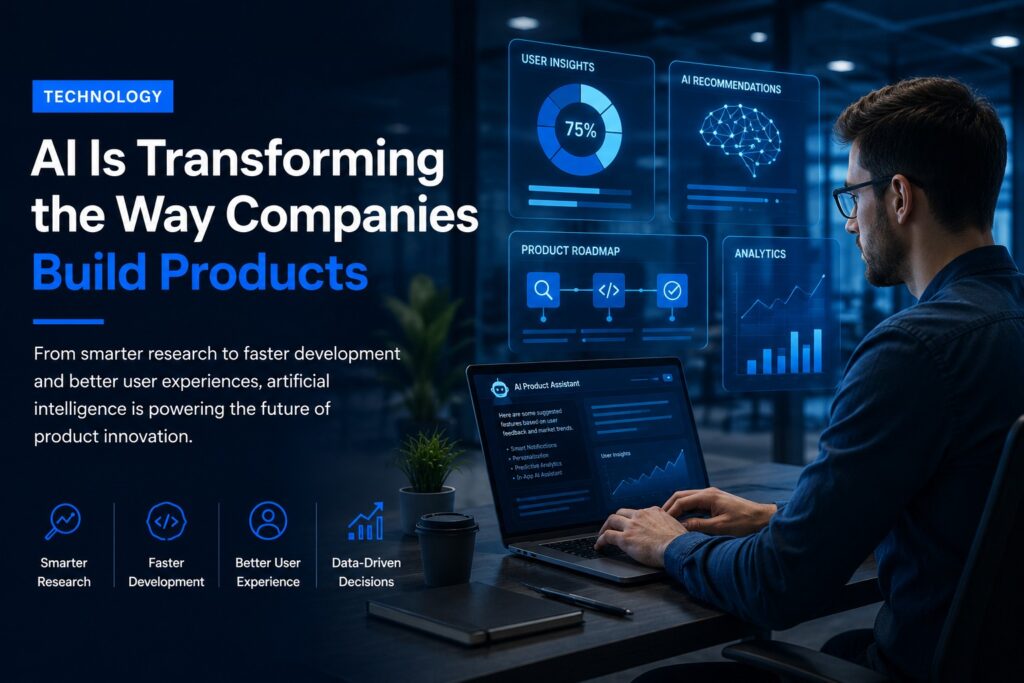

Artificial intelligence is rapidly reshaping how companies design, develop, test, and launch products. What once required months of research, manual analysis, and extensive development cycles can now be accelerated through AI-powered tools and intelligent automation.
From startups building their first software product to global enterprises managing complex product portfolios, organizations are increasingly using artificial intelligence to make smarter decisions, reduce development costs, and deliver better customer experiences.
As competition intensifies across industries, AI has become more than a technological advantage—it is becoming a critical component of modern product development strategies.
The Evolution of Product Development
Traditional product development often followed a lengthy process involving:
- Market research
- Customer interviews
- Product planning
- Design iterations
- Development cycles
- Testing phases
- Product launch
While this approach remains important, AI is enhancing nearly every stage of the process.
Organizations can now analyze massive amounts of customer data, identify market opportunities, predict user behavior, and automate repetitive tasks that previously slowed innovation.
The result is faster product development and more informed decision-making.
Understanding Customer Needs Through AI
One of the biggest challenges in product development is understanding what customers truly want.
Artificial intelligence helps companies gather insights from multiple sources, including:
- Customer reviews
- Social media discussions
- Support tickets
- Surveys
- Search trends
- User behavior analytics
AI systems can process millions of data points and identify patterns that human teams might miss.
For example, a software company can use AI-powered sentiment analysis to determine which features customers appreciate most and which problems cause frustration.
These insights allow product teams to prioritize improvements that have the greatest impact on user satisfaction.
Accelerating Market Research
Market research traditionally requires significant time and resources.
AI-powered analytics tools can now:
- Monitor competitor activities
- Analyze industry trends
- Track consumer behavior
- Identify emerging opportunities
Instead of waiting weeks for research reports, companies can access real-time insights that support faster strategic decisions.
This enables businesses to respond quickly to market changes and maintain a competitive advantage.
AI-Powered Product Design
Artificial intelligence is increasingly supporting product designers throughout the creative process.
Modern design tools can:
- Generate design suggestions
- Create interface variations
- Recommend layout improvements
- Predict user engagement
Rather than replacing designers, AI acts as a collaborative assistant that helps teams explore more ideas in less time.
Designers can focus on creativity and user experience while AI handles repetitive and data-intensive tasks.
This combination often results in higher-quality products and more efficient workflows.
Faster Software Development
Software development is one of the areas experiencing the greatest impact from AI.
Developers now use AI-powered coding assistants to:
- Generate code snippets
- Detect bugs
- Suggest improvements
- Automate testing
- Improve documentation
These tools help engineers work more efficiently and reduce the time required to build new features.
By automating routine programming tasks, development teams can devote more attention to solving complex business challenges.
Improving Product Testing
Testing is essential for ensuring product quality.
Artificial intelligence enhances testing by:
- Automatically identifying errors
- Simulating user interactions
- Detecting performance issues
- Predicting potential failures
AI-powered testing systems can analyze thousands of scenarios much faster than manual testing methods.
This improves reliability while reducing the time required before launch.
Organizations can deliver products to market more quickly without compromising quality.
Personalization at Scale
Today’s customers expect personalized experiences.
AI allows businesses to customize products and services based on individual preferences.
Examples include:
- Personalized recommendations
- Dynamic content
- Customized dashboards
- Intelligent search results
- Adaptive user experiences
Companies such as streaming platforms, e-commerce businesses, and software providers use AI to tailor experiences for millions of users simultaneously.
This level of personalization increases engagement, customer satisfaction, and retention.
Predictive Analytics for Product Strategy
Predictive analytics helps companies anticipate future outcomes based on historical data.
Product teams use predictive models to:
- Forecast demand
- Predict customer churn
- Estimate feature adoption
- Identify growth opportunities
Instead of relying solely on intuition, decision-makers can use data-backed insights to guide product investments.
This reduces risk and improves the likelihood of successful product launches.
AI and Customer Feedback Analysis
Customer feedback is one of the most valuable resources for product improvement.
However, manually reviewing thousands of comments and support requests can be overwhelming.
AI systems can automatically:
- Categorize feedback
- Identify recurring issues
- Measure sentiment
- Highlight feature requests
These insights help organizations continuously improve products based on real user needs.
Companies can respond more quickly to problems and prioritize updates that create the greatest value.
Enhancing Collaboration Across Teams
Successful product development requires collaboration between:
- Product managers
- Designers
- Developers
- Marketing teams
- Customer support teams
AI-powered project management and collaboration tools improve communication by:
- Automating task assignments
- Tracking progress
- Identifying bottlenecks
- Generating performance reports
This helps teams stay aligned and maintain productivity throughout the product lifecycle.
Reducing Development Costs
Efficiency gains provided by artificial intelligence can significantly reduce development costs.
Organizations save resources through:
- Faster research
- Automated workflows
- Improved testing
- Better forecasting
- Reduced rework
These cost savings allow businesses to invest more heavily in innovation and growth initiatives.
For startups with limited budgets, AI can provide access to capabilities that were previously available only to larger organizations.
Challenges and Considerations
While AI offers substantial benefits, companies must also address several challenges.
Data Quality
AI systems depend on accurate and reliable data.
Poor-quality data can produce misleading results and ineffective decisions.
Privacy and Security
Organizations must ensure customer data is handled responsibly and in compliance with regulations.
Human Oversight
AI should support human decision-making rather than replace it entirely.
Experienced professionals remain essential for strategy, creativity, and ethical considerations.
Bias and Fairness
Companies should regularly evaluate AI systems to ensure outcomes remain fair and unbiased.
Responsible implementation is critical for maintaining trust and long-term success.
The Future of AI in Product Development
Artificial intelligence will continue to evolve and become even more integrated into product development processes.
Future advancements may include:
- More advanced predictive modeling
- Fully automated testing environments
- AI-generated prototypes
- Enhanced customer behavior forecasting
- Real-time product optimization
Organizations that embrace these innovations will be better positioned to compete in increasingly dynamic markets.
The companies that combine human creativity with artificial intelligence will likely lead the next generation of product innovation.
Conclusion
Artificial intelligence is fundamentally transforming how companies build products. From customer research and design to development, testing, and optimization, AI enables organizations to work faster, make smarter decisions, and deliver more valuable experiences.
While challenges remain, the benefits of AI-driven product development are becoming increasingly clear. Businesses that strategically integrate artificial intelligence into their workflows can improve efficiency, reduce costs, and accelerate innovation.
As technology continues to advance, AI will play an even greater role in shaping the products and services that define the future of business.